

 QuranGPT
The Unbroken Chain of Textual Preservation: How the Quran Defeated Historical Entropy
An evidence-based historical investigation into the preservation of the Holy Quran. From 7th-century manuscript discoveries to the global oral memorization network, discover how the Quran remained letter-perfect across 1,400 years.
The Holy Quran Team
Author
Every major religious text in human history has suffered from the inevitable laws of historical entropy: lost original manuscripts (autographs), anonymous authorship, centuries of translation drift, theological interpolations, and sectarian variant readings.
- The Old Testament manuscripts in Hebrew (the Masoretic Text) date to the 9th–10th century CE — over a thousand years after the events described.
- The New Testament exists in over 5,800 Greek manuscripts containing an estimated 200,000 to 400,000 textual variants, with no surviving original manuscripts from the 1st century.
Yet the Holy Quran stands as the sole exception in global literary history. From the moment of its revelation in 7th-century Arabia to every smartphone and printed copy in Tokyo, Cairo, London, and Jakarta today, the Quran contains one single, identical, universally agreed-upon text.
1. The Divine Guarantee of Preservation
Unlike previous scriptures whose preservation was entrusted to human custodians who altered them over time, Allah made a direct promise in the Quran:
إِنَّا نَحْنُ نَزَّلْنَا الذِّكْرَ وَإِنَّا لَهُ لَحَافِظُونَ
"Indeed, it is We who sent down the Quran and indeed, We will be its guardian."
(Surah Al-Hijr 15:9)
This verse is both a theological statement and an audacious historical prophecy. Fourteen centuries later, empirical manuscript evidence and global oral transmission prove this prophecy true.
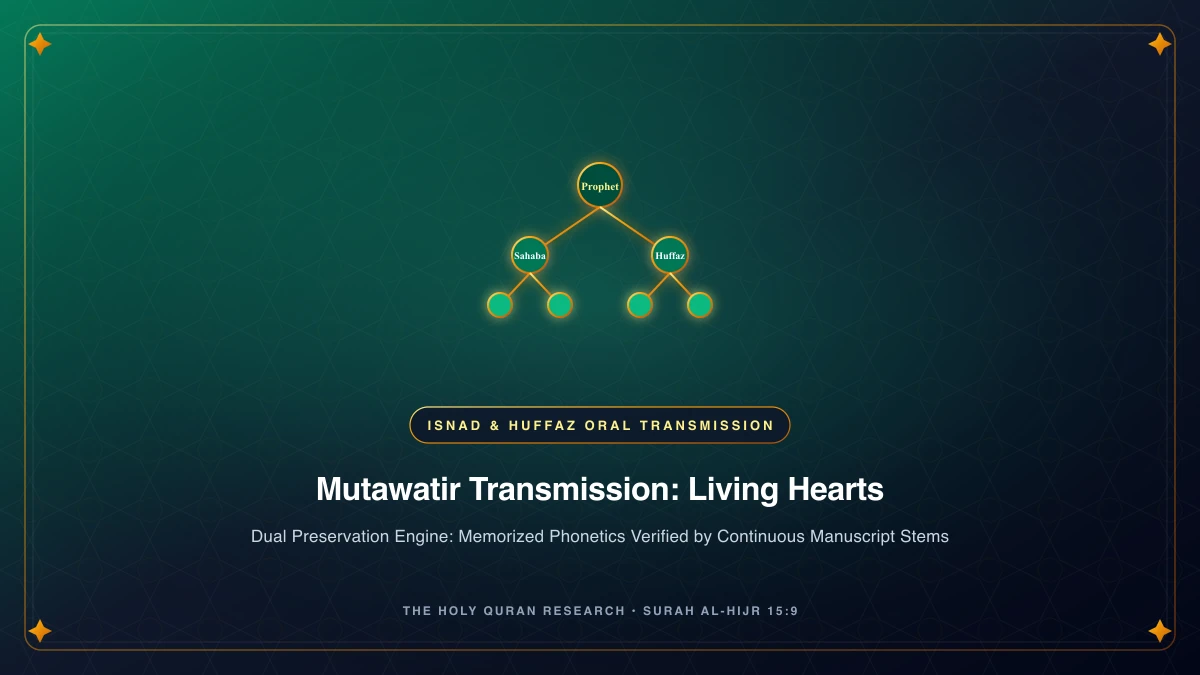
Millions of Huffaz worldwide hold the exact same Arabic text in memory, providing a living fail-safe against textual alteration.
2. The Dual-Track Security System: Oral and Written Transmission
The preservation of the Quran did not rely on paper alone. It utilized a revolutionary dual-track system:
                  THE DUAL PRESERVATION ENGINE

       Track 1: Oral Memory (Huffaz)     Track 2: Physical Manuscripts
       ═════════════════════════════     ═════════════════════════════
       • Mass oral transmission (Mutawatir) • Scribes wrote during revelation
       • Taught directly by the Prophet ﷺ   • Parchment, stone, bone, leather
       • Recited 5x daily in communal Salah • Compiled by Abu Bakr (632 CE)
       • Verified teacher-to-student Isnad  • Standardized by Uthman (650 CE)
                    │                                 │
                    └───────────────┬─────────────────┘
                                    ▼
                 PERFECT LETTER-BY-LETTER SYNCHRONIZATION
If every printed copy of the Quran on Earth were burned today, the entire text could be reconstructed letter-for-letter in a single afternoon by millions of children, scholars, and elders across every continent who have committed it to memory.
3. Archaeological Breakthrough: The Birmingham Quran Manuscript
In 2015, the University of Birmingham conducted radiocarbon dating (Oxford Radiocarbon Accelerator Unit) on parchment leaves of a Quran manuscript (Cadbury Research Library, Mingana Collection).
Key Scientific Findings:
- Radiocarbon Date: Dated with 95.4% accuracy to between 568 CE and 645 CE.
- Historical Context: Prophet Muhammad ﷺ lived from 570 CE to 632 CE. The manuscript was produced either during his lifetime or within a decade of his death.
- Textual Match: The parchment, written in early Hijazi script containing Surahs 18 to 20, is 100% identical to the Quran read today.
David Thomas, Professor of Christianity and Islam at Birmingham, noted:
"These portions must have been in a form very similar to the Quran we have today, and the parts that are surviving are identical to modern text. This confirms that the Quran has undergone no significant change since the time of the Prophet."
4. Ancient Manuscripts Across the World
| Manuscript | Estimated Date | Location | Textual Alignment |
|---|---|---|---|
| Birmingham Folios | 568–645 CE | Birmingham, UK | 100% identical to modern text |
| Topkapi Manuscript | Mid-1st Century AH | Istanbul, Turkey | Complete Quran codex matching standard Uthmanic text |
| Sana'a Palimpsest | 1st Century AH | Sana'a, Yemen | Lower script verifies early scribal teaching; upper text matches Uthmanic canon |
| Samarkand Kufic Codex | 1st–2nd Century AH | Tashkent, Uzbekistan | Complete early Arabic script matching modern text |
5. The Science of Isnad (Chains of Transmission)
Islam pioneered the most rigorous biographical and textual verification system ever conceived: the Isnad. Every recitation style (Qira'ah) has an unbroken chain of identified, vetted human teachers stretching back to the Companions and the Prophet Muhammad ﷺ himself.
Scholars developed Ilm ar-Rijal (Biographical Evaluation), cataloging the memory, integrity, and eyewitness accounts of over 100,000 historical transmitters to ensure no forged variant could ever enter the text.
Conclusion: A Living Miracle of History
In a world where documents decay, translations diverge, and human memory fades, the Holy Quran stands preserved in its original language, tone, and phonetics. It remains the only open window to the exact words uttered by a Prophet over 1,400 years ago.