

 QuranGPT
The Quran's Literary Inimitability (I'jaz): Why No Human Has Ever Met the Linguistic Challenge
An in-depth linguistic and rhetorical analysis of I'jaz al-Quran. Explore why the Quran's unique literary genre, phonology, semantic depth, and ring composition remain unmatched across 1,400 years of Arabic literature.
The Holy Quran Team
Author
Every prophet was given a miracle suited to the pinnacle skill of their era:
- Moses was given miracles that surpassed the sorcery and magic of ancient Egypt.
- Jesus was given miracles that cured incurable illnesses, exceeding the medicine of the Greco-Roman world.
- Prophet Muhammad ﷺ was sent to 7th-century Arabs whose cultural superpower was poetry, eloquence, and linguistic rhetoric.
The pre-Islamic Arabs were so obsessed with poetic mastery that annual poetry festivals (like Suq Ukadh) were held, and the victorious poems (Al-Mu'allaqat) were embroidered in gold and hung inside the Kaaba.
Yet when the Quran was recited, the greatest masters of Arabic rhetoric stood paralyzed in intellectual awe.
1. The Falsification Challenge Issued to Humanity
The Quran did not merely assert divine origin; it issued an open, standing falsification test to the entire human race across four escalating stages:
وَإِن كُنتُمْ فِي رَيْبٍ مِّمَّا نَزَّلْنَا عَلَىٰ عَبْدِنَا فَأْتُوا بِسُورَةٍ مِّن مِّثْلِهِ وَادْعُوا شُهَدَاءَكُم مِّن دُونِ اللَّهِ إِن كُنتُمْ صَادِقِينَ فَإِن لَّمْ تَفْعَلُوا وَلَن تَفْعَلُوا فَاتَّقُوا النَّارَ الَّتِي وَقُودُهَا النَّاسُ وَالْحِجَارَةُ ۖ أُعِدَّتْ لِلْكَافِرِينَ
"And if you are in doubt about what We have sent down upon Our Servant [Muhammad], then produce a surah the like thereof and call upon your witnesses other than Allah, if you should be truthful. But if you do not — and you will never be able to — then fear the Fire, whose fuel is men and stones, prepared for the disbelievers."
(Surah Al-Baqarah 2:23-24)
Notice the audacious certainty: "And you will never be able to" (Wa lan taf'alu). For fourteen centuries, the enemies of Islam who possessed supreme command of Arabic spent fortunes and fought wars to extinguish the message — yet not a single rival surah was ever produced that could withstand literary scrutiny.
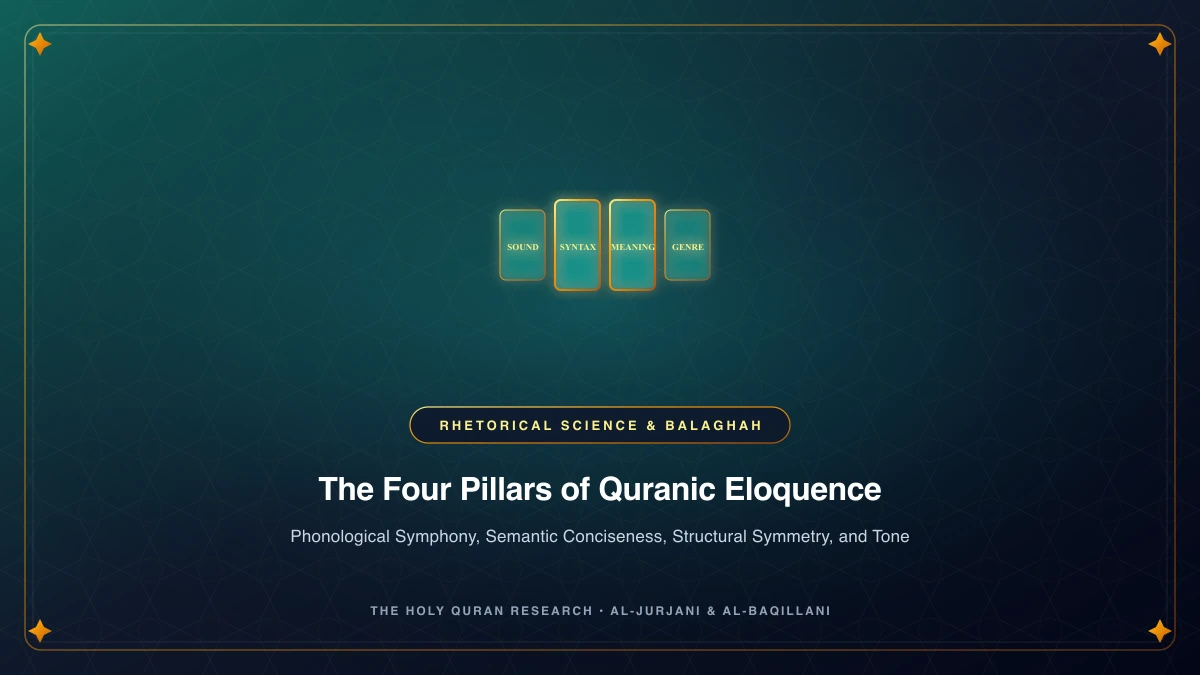
Arabic trilateral root morphology allows Quranic terms to carry multifaceted layers of meaning simultaneously without lexical ambiguity.
2. A Completely Unique Literary Genre
In Arabic literary theory, all human Arabic expression falls into one of two categories:
- Shi'r (Poetry): Governed strictly by the 16 rhythmic meters of Al-Khalil ibn Ahmad (Bahr), requiring end-rhymes (Qafiyah).
- Nathr (Prose): Either non-rhymed everyday speech or rhymed prose (Saj'), which is prone to artificial filler words.
The Quran matches neither genre. It broke all existing stylistic conventions to invent a brand new literary form:
- It maintains acoustic rhythm, internal cadences, and dramatic pitch shifts without conforming to any of the 16 poetic meters.
- It never sacrifices factual precision or legal nuance for the sake of rhyme.
- When recited aloud, it produces a distinct auditory resonance (Tajweed) that induces profound psychological impact on listeners who do not even understand Arabic.
3. The Discovery of Ring Composition (Chiasmus)
In recent decades, Western literary scholars and non-Muslim orientalists have discovered that the longest, most complex chapters of the Quran are structured with mathematical Ring Composition (mirror symmetry).
Scholar Michel Cuypers (author of The Banquet: A Reading of the Fifth Sura of the Qur'an) and Raymond Farrin have demonstrated that Surah Al-Baqarah (286 verses) is structured around a central axis:
            RING COMPOSITION OF SURAH AL-BAQARAH

      A: Faith vs. Unbelief (Verses 1–20)
        B: Allah's Creation & Covenant (Verses 21–39)
          C: Moses & Israelites (Verses 40–141)
            ★ CENTER: Change of Qiblah & The Middle Nation (Verses 142–152) ★
          C': Abraham & The New Community (Verses 153–242)
        B': Laws of Creation, Charity & Justice (Verses 243–283)
      A': Faith vs. Unbelief (Verses 284–286)
The thematic center of the entire chapter (the "Middle Nation" / Ummatan Wasata) occurs precisely at verse 143 — the exact structural midpoint of the 286-verse chapter!
Prophet Muhammad ﷺ could not read or write, did not have a whiteboard or computer manuscript, and recited verses orally over a period of 23 years in response to historical events. To maintain multidimensional ring composition across thousands of verses uttered orally over two decades is humanly impossible.
4. Linguistic Precision: The Distinction Between Words
The Quran never uses synonyms interchangeably. Every single word choice reflects absolute lexical perfection:
| Context | Quranic Word Used | Alternative Arabic Word | Why the Quranic Choice is Superior |
|---|---|---|---|
| Wife of Pharaoh vs. Wife of Zechariah | Imra'ah (Woman/Wife) vs. Zawj (Spouse) | Zawj | Zawj is only used when there is full spiritual, physical, and emotional harmony. Because Pharaoh was an unbeliever while his wife was a believer, the Quran precisely used Imra'ah. |
| Pharaoh's Era vs. Joseph's Era | Fir'awn (Pharaoh) vs. Malik (King) | Malik | Hieroglyphic decipherment in the 19th century confirmed that Egyptian rulers during Joseph's era (Hyksos period) were called "Kings", while during Moses' era (New Kingdom) the title shifted to "Pharaoh". |
| Rain as Blessing vs. Rain as Punishment | Ghayth (Relief/Rain) vs. Matar (Precipitation) | Matar | In the Quran, Matar is strictly used for storms of divine punishment; Ghayth is used for life-giving agricultural rain. |
Conclusion: The Divine Signature
The German philosopher Johann Wolfgang von Goethe remarked after studying the Quran in translation:
"The Koran has always seemed to me a wonderful book... Its style, in accordance with its contents and aim, is stern, grand, terrible — and ever and anon truly sublime."
The linguistic architecture of the Quran remains an open, unassailable miracle standing before all of humanity: the direct Word of the Living God.