

 QuranGPT
The Inviolable Pure Monotheism (Tawhid): Why Islam's Concept of God is Philosophically Flawless
A rational and theological examination of Tawhid — Islam's uncompromising monotheism. Discover why a single, uncreated, transcendent Sovereign is the only coherent metaphysical explanation for the cosmos.
The Holy Quran Team
Author
Throughout human history, thousands of religious systems and philosophical traditions have attempted to answer the fundamental metaphysical question: What is the ultimate nature of the Creator?
Most systems fell into one of two logical pitfalls:
- Anthropomorphism and Plurality: Reducing the Creator to human forms, flawed deities who fight, reproduce, die, or divide into multiple personas.
- Materialism and Nihilism: Denying the Creator entirely, forcing one to believe that an exquisitely fine-tuned, mathematically structured universe emerged spontaneously out of absolute nothingness without cause or intent.
Islam stands apart with an uncompromising, crystal-clear declaration known as Tawhid (Pure Monotheism). It is a theology so logically pristine that even secular philosophers of religion acknowledge its unmatched coherence.
1. Surah Al-Ikhlas: The Four Axioms of Divine Perfection
In just four short verses, the Holy Quran establishes the complete metaphysical boundary of Divine reality:
قُلْ هُوَ اللَّهُ أَحَدٌ اللَّهُ الصَّمَدُ لَمْ يَلِدْ وَلَمْ يُولَدْ وَلَمْ يَكُن لَّهُ كُفُوًا أَحَدٌ
"Say, 'He is Allah, [who is] One. Allah, the Eternal Refuge [As-Samad]. He neither begets nor is born, Nor is there to Him any equivalent.'"
(Surah Al-Ikhlas 112:1-4)
The Four Logical Pillars of Surah Al-Ikhlas:
- Ahad (The Absolute One): God is an indivisible, simple unity. He is not composed of parts, persons, or physical dimensions.
- As-Samad (The Self-Sufficient Sustainer): Everything in existence depends on Him, while He depends on nothing.
- Lam Yalid wa Lam Yulad (Neither Begetter nor Begotten): God is outside the biological, temporal cycle of generation, ancestry, and decay.
- Lam Yakun Lahu Kufuwan Ahad (Peerless & Transcendent): No created entity can resemble Him, and He resembles nothing in creation.
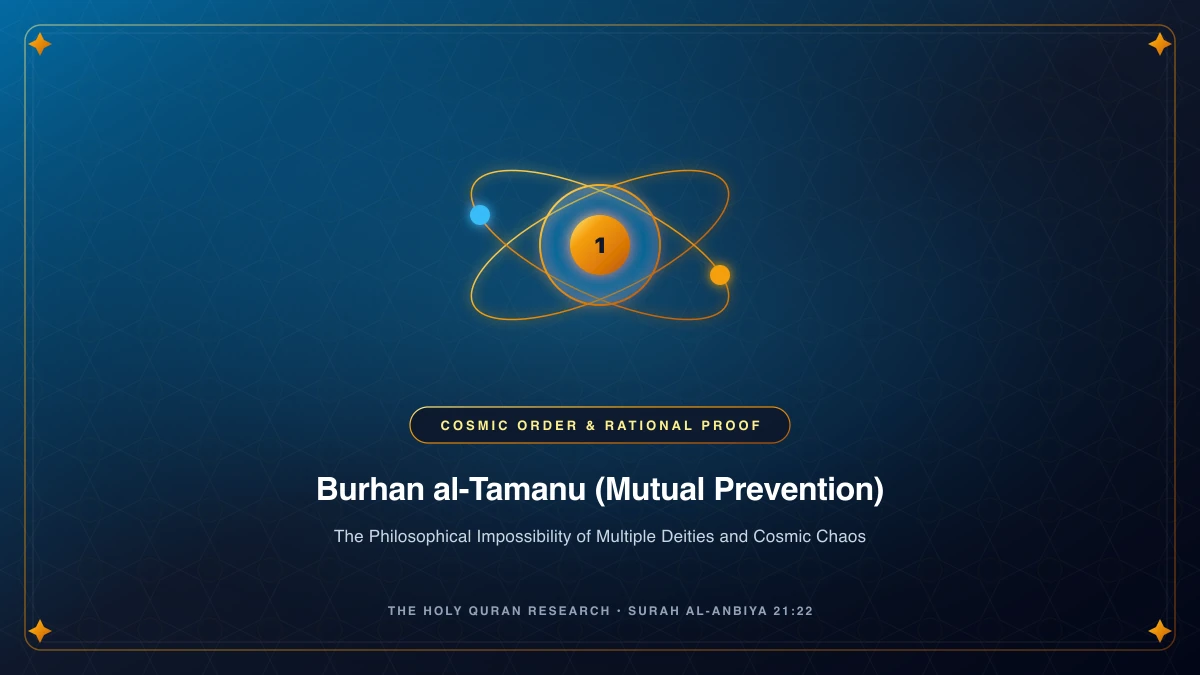
The fundamental uniformity of physical constants across the observable universe reflects a singular, unified Creator rather than competing wills.
2. The Argument from Contingency (Dalil al-Imkan)
Classical Muslim theologians, notably Imam al-Ghazali and Ibn Rushd, formulated what modern philosophy calls the Argument from Contingency:
- Premise 1: Every object in the physical universe is contingent (it could exist or not exist, and its properties are limited).
- Premise 2: An infinite regress of contingent causes is logically impossible (just as an infinite series of soldiers waiting for orders from the previous soldier would never fire a shot).
- Premise 3: Therefore, the chain of contingent existence must terminate at a Necessary Being (Wajib al-Wujud) — a Being whose non-existence is impossible, who is uncaused, timeless, and self-sufficient.
Allah articulates this rational deduction directly in the Quran:
أَمْ خُلِقُوا مِنْ غَيْرِ شَيْءٍ أَمْ هُمُ الْخَالِقُونَ أَمْ خَلَقُوا السَّمَاوَاتِ وَالْأَرْضَ بَل لَّا يُوقِنُونَ
"Or were they created by nothing, or were they the creators [of themselves]? Or did they create the heavens and the earth? Rather, they are not certain."
(Surah At-Tur 52:35-36)
3. Why Multiple Gods are Mathematically and Logically Impossible
If there were multiple sovereign deities, the universe would descend into chaos. If God A wanted gravity to attract matter, but God B wanted it to repel, either:
- One overrides the other — meaning the defeated one was never truly omnipotent God.
- They compromise — meaning both are constrained by a higher agreement and are not completely sovereign.
The Quran stated this principle fourteen centuries ago:
لَوْ كَانَ فِيهِمَا آلِهَةٌ إِلَّا اللَّهُ لَفَسَدَتَا
"Had there been within them [the heavens and earth] gods besides Allah, they both would have been ruined."
(Surah Al-Anbiya 21:22)
Modern physics confirms that the laws of nature are universally symmetric. The charge of an electron and the speed of light in the Andromeda galaxy are identical to those on Earth — a testament to a Single Universal Lawgiver.
4. Theological Comparison: Why Tawhid Stands Superior
| Theological System | Concept of the Divine | Logical Contradiction / Vulnerability |
|---|---|---|
| Polytheism | Multiple regional/domain deities | Competing wills, physical limitations, lack of ultimate sovereignty |
| Pantheism | Universe itself is God | Confuses contingent matter and suffering with the Divine |
| Anthropomorphism | God takes human flesh/avatar | Inherits physical human limitations (hunger, death, ignorance) |
| Islamic Tawhid | One, Uncreated, Transcendent, All-Sustaining | Zero logical contradiction; satisfies all requirements of necessary existence |
5. The Psychological Liberation of Tawhid
Tawhid is not merely a philosophical formula — it is the ultimate psychological liberation for humanity:
- Freedom from Superstition: A Muslim fears no ghosts, lucky charms, zodiac signs, or malicious idols.
- Equality of Man: Because God alone is Sovereign, no human king, tyrant, or oligarch possesses divine authority. All mortals stand shoulder-to-shoulder on equal footing.
- Singular Purpose: Instead of attempting to please multiple conflicting gods or societal pressures, the believer focuses their entire existence on pleasing the One Loving Creator.
"Say, 'Indeed, my prayer, my rites of sacrifice, my living and my dying are for Allah, Lord of the worlds. No partner has He. And this I have been commanded, and I am the first of the Muslims.'"
(Surah Al-An'am 6:162-163)
Conclusion: The Truth of Pure Reason
Islam does not ask the human intellect to commit intellectual suicide by accepting logical paradoxes. It presents a concept of God that satisfies the deepest demands of philosophy, mathematics, and human intuition: Allah is One, Eternal, and Perfect.