

 QuranGPT
The Unassailable Character of Prophet Muhammad ﷺ: The Trilemma of Liar, Deluded, or True Messenger
A forensic psychological and historical examination of the life of Prophet Muhammad ﷺ. Known for 40 years as Al-Amin (The Trustworthy), his unwavering sincerity, rejection of worldly wealth, and profound humility leave only one rational conclusion.
The Holy Quran Team
Author
When evaluating any claim of divine revelation, the primary question must always center on the character and psychology of the claimant.
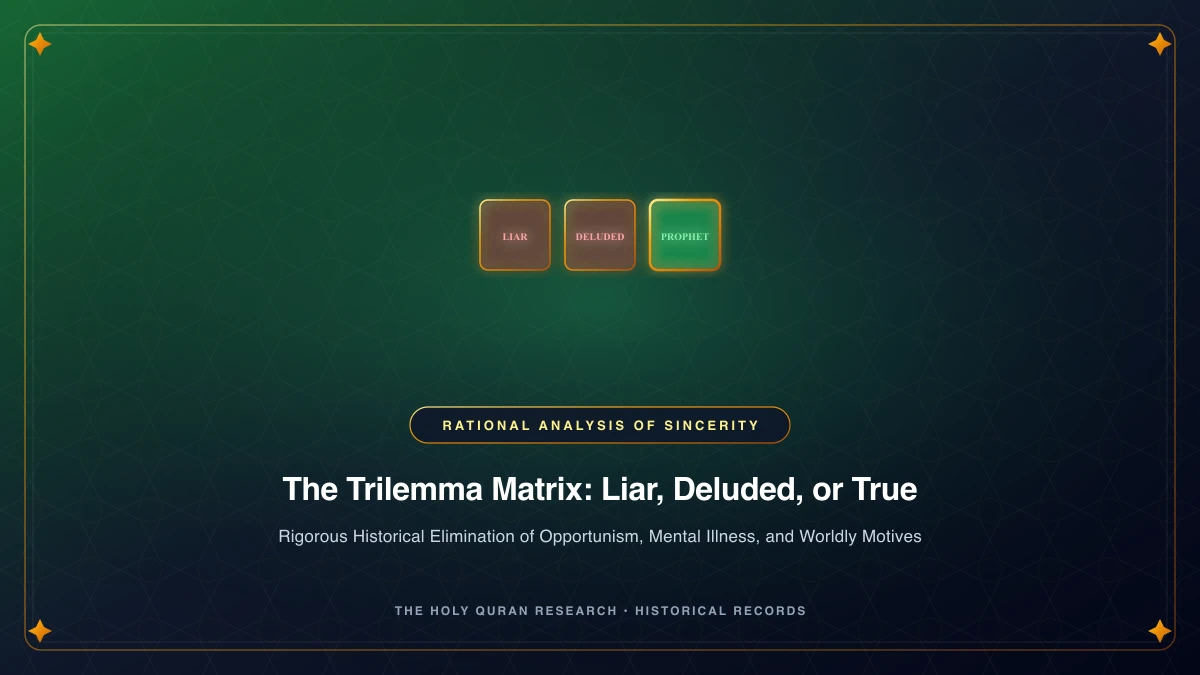
Philosophically, when someone claims to receive messages from God, there are only three logical possibilities:
- The Liar: He knowingly invented the claims for personal, political, or financial gain.
- The Deluded: He was mentally unstable or hallucinating, sincerely believing his delusions.
- The True Messenger: He was speaking the objective truth as a prophet of God.
A rigorous, critical examination of the historical record demonstrates that the first two options are utterly impossible, leaving only the third conclusion.
1. Forty Years as "Al-Amin" (The Trustworthy)
Before receiving revelation at age 40, Muhammad ﷺ lived a completely transparent life in the small, close-knit desert community of Mecca. In an era where rivalries and deceit were commonplace, he was universally recognized by friends and foes alike with two honorific titles:
- As-Sadiq: The Truthful One (who never told a lie).
- Al-Amin: The Trustworthy (to whom people entrusted their most valuable possessions).
When he first publicly announced his prophethood from the hill of Safa, he asked the assembled Meccans:
"If I were to tell you that there is an army behind this mountain ready to attack you, would you believe me?"
They replied in unison: "Yes, for we have never found you to tell a single lie."
(Sahih al-Bukhari 4770)
It is psychologically impossible for a man who spent 40 years refusing to tell a petty lie to suddenly invent the greatest, most audacious lie in human history — claiming to speak with the Creator of the Universe.
The Prophet's life established an enduring ethical civilization that transformed Arabia from tribal violence into a global lighthouse of justice.
2. Rejection of Limitless Wealth, Power, and Kingship
If a man invents a religion for worldly gain, his price can be bought. When the Meccan nobility realized that Muhammad's message was gaining momentum, they sent Utbah ibn Rabi'ah with an official offer:
"O Muhammad, if you want wealth, we will gather enough wealth to make you the richest man in Arabia. If you want power, we will make you our king and take no decision without your approval. If you want women, choose the ten noblest women of Quraysh. Just stop preaching this message."
What was the Prophet's response? He did not negotiate. He looked at his uncle Abu Talib and said:
"By Allah, if they were to place the sun in my right hand and the moon in my left on condition that I abandon this course, I would never abandon it until Allah makes it victorious or I perish in the attempt."
(Ibn Hisham, As-Seerah an-Nabawiyyah)
A charlatan accepts the crown and the treasure. Only a true prophet rejects kingship to endure starvation, assassination attempts, and exile for a divine mandate.
3. The Test of Grief: The Death of His Son Ibrahim
In 632 CE, the Prophet's infant son Ibrahim passed away. The Prophet wept tears of profound human grief. On that exact afternoon, a total solar eclipse occurred across Arabia.
The people of Medina immediately whispered: "The sun has eclipsed out of grief for the death of the Prophet's son!"
A manipulative imposter would have seized this extraordinary cosmic coincidence to solidify his status as a divine supernatural figure. Instead, Prophet Muhammad ﷺ immediately called the entire congregation to the mosque and announced:
إِنَّ الشَّمْسَ وَالْقَمَرَ آيَتَانِ مِنْ آيَاتِ اللَّهِ لَا يَنْخَسِفَانِ لِمَوْتِ أَحَدٍ وَلَا لِحَيَاتِهِ
"The sun and the moon are two signs among the signs of Allah. They do not eclipse because of the death of anyone, nor because of his life. So when you see them, supplicate to Allah and pray."
(Sahih al-Bukhari 1043, Sahih Muslim 901)
This single incident alone disproves the charge of charlatanism. An imposter claims credit for miracles he did not perform; a true prophet redirects credit to Allah alone.
4. The Self-Rebuking Verses in the Quran
In the Quran, there are passages where the Prophet ﷺ is explicitly corrected and gently reprimanded for minor human judgments:
- Surah Abasa (80:1-2): Rebuked for frowning and turning away from a poor blind man (Abdullah ibn Umm Maktum) while trying to preach to wealthy Meccan leaders.
- Surah At-Tahrim (66:1): Questioned for forbidding himself honey to please his wives.
If Muhammad were the author of the Quran, he would never have canonized eternal verses recording his own reprimands to be recited by billions of believers in prayer until the end of time.
5. The Lifestyle of an Ascetic King
When Prophet Muhammad ﷺ passed away as the undisputed ruler of the entire Arabian Peninsula:
- He owned no gold, silver, or land.
- His personal armor was pawned to a Jewish merchant in Medina for 30 measures of barley to feed his household.
- He slept on a coarse palm-fiber mat that left deep red marks on his side.
When his companion Umar ibn al-Khattab saw him sleeping on the bare mat and wept, comparing his humble state to the Roman Caesar and Persian Chosroes who lived in luxury, the Prophet ﷺ smiled and said:
"Are you not pleased, O Umar, that they have this fleeting world, and we have the eternal Hereafter?"
(Sahih al-Bukhari 4987)
Conclusion: An Honest Verdict
Michael H. Hart, American astrophysicist and historian, ranked Prophet Muhammad as #1 in his book The 100: A Ranking of the Most Influential Persons in History, writing:
"My choice of Muhammad to lead the list of the world's most influential persons may surprise some readers and may be questioned by others, but he was the only man in history who was supremely successful on both the religious and secular levels."
An honest examination of the historical record leaves no room for doubt: Prophet Muhammad ﷺ was neither a liar nor deluded. He was the True Messenger of Allah.