

 QuranGPT
The Moral and Legal Perfection of the Shariah: The Maqasid and Universal Human Rights
A comprehensive legal and ethical analysis of Islamic jurisprudence. Discover the Maqasid al-Shariah — the five higher universal objectives of Islamic law — and why Islamic legal philosophy established human rights and systemic justice 1,400 years ago.
The Holy Quran Team
Author
In contemporary media discourse, the term Shariah is often misunderstood or reduced to criminal penal codes. Yet in Islamic jurisprudence, Shariah literally translates to "the clear path leading to the source of water (life)."
Classical Islamic jurists like Imam al-Ghazali (d. 1111 CE) and Imam al-Shatibi (d. 1388 CE) systematized the philosophy of Islamic law into a profound legal framework known as Maqasid al-Shariah (The Higher Objectives of Islamic Law).
Every single ruling, obligation, and prohibition in Islam exists solely to protect and cultivate five universal human necessities.
1. The Five Essential Human Necessities (Al-Daruriyyat al-Khams)
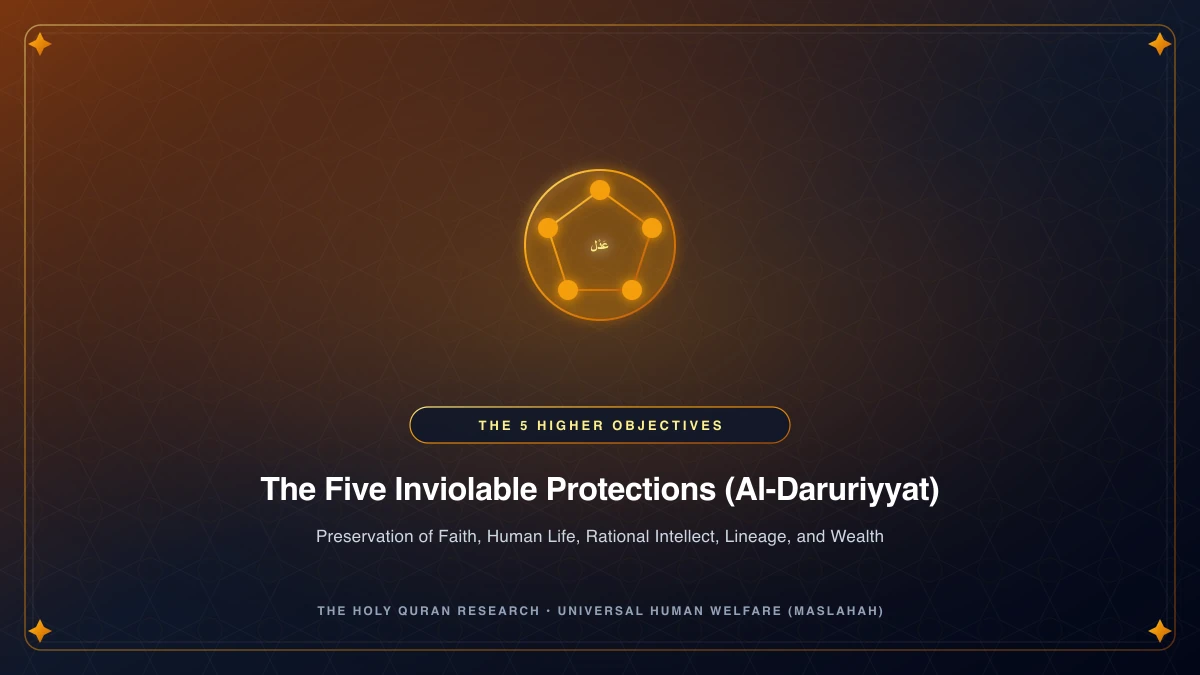
Islamic jurisprudence posits that no society can achieve justice, peace, and flourishing without the absolute protection of five core pillars:
               THE FIVE ESSENTIAL OBJECTIVES OF SHARIAH

    ┌──────────────────────┬──────────────────────┬──────────────────────┐
    │ 1. Hifdh ad-Din      │ 2. Hifdh an-Nafs     │ 3. Hifdh al-Aql      │
    │ Preservation of      │ Preservation of      │ Preservation of      │
    │ Faith & Conscience   │ Human Life           │ Intellect & Reason   │
    └──────────────────────┴──────────────────────┴──────────────────────┘
                           │ 4. Hifdh an-Nasl     │ 5. Hifdh al-Mal      │
                           │ Preservation of      │ Preservation of      │
                           │ Family & Lineage     │ Property & Wealth    │
                           └──────────────────────┴──────────────────────┘
- Preservation of Faith & Conscience (Hifdh ad-Din): Freedom of religious conscience and direct personal connection with the Creator without clerical gatekeepers.
- Preservation of Life (Hifdh an-Nafs): The absolute sanctity of human life. The Quran declares: "Whoever kills a soul... it is as if he had slain all of mankind" (Surah Al-Ma'idah 5:32).
- Preservation of Intellect (Hifdh al-Aql): Safeguarding human cognitive function by prohibiting intoxicants, drugs, and psychological manipulation.
- Preservation of Family & Lineage (Hifdh an-Nasl): Protecting the integrity of the family unit, women's rights, and the ethical upbringing of children.
- Preservation of Wealth (Hifdh al-Mal): Guaranteeing private property rights, prohibiting theft, usury (Riba), monopoly hoarding, and economic fraud.
Islamic jurisprudence extends legal protection beyond humans to animal welfare, ecological preservation, and zero-waste water stewardship.
2. The Universal Golden Rule of Justice
The Quran establishes justice as an absolute, unconditional mandate that must never be compromised by personal bias, race, or geopolitical enmity:
يَا أَيُّهَا الَّذِينَ آمَنُوا كُونُوا قَوَّامِينَ لِلَّهِ شُهَدَاءَ بِالْقِسْطِ ۖ وَلَا يَجْرِمَنَّكُمْ شَنَآنُ قَوْمٍ عَلَىٰ أَلَّا تَعْدِلُوا ۚ اعْدِلُوا هُوَ أَقْرَبُ لِلتَّقْوَىٰ
"O you who have believed, be persistently standing firm for Allah, witnesses in justice, and do not let the hatred of a people prevent you from being just. Be just; that is nearer to righteousness."
(Surah Al-Ma'idah 5:8)
In modern international relations, justice is frequently weaponized through double standards. The Shariah demands that a Muslim judge must rule in favor of a non-Muslim against a Muslim if the non-Muslim is in the right — a standard upheld throughout centuries of Islamic court records in Cordoba, Cairo, and Istanbul.
3. Human Rights Pioneered by Islam 1,400 Years Ago
| Modern Human Right | Traditional Western Realization | Islamic Legislation (610–632 CE) |
|---|---|---|
| Women's Independent Property Rights | Late 19th Century (UK Married Women's Property Act 1882) | Granted in 610 CE; women keep full ownership of wealth, dowry, and inheritance |
| Abolition of Racial Supremacy | Mid-20th Century (US Civil Rights Act 1964) | Codified in the Farewell Sermon (632 CE): "No Arab is superior to a non-Arab" |
| Prisoner of War Rights | Geneva Conventions (1949) | Prophet commanded: "Feed them the same food you eat and clothe them with what you wear" |
| Animal Welfare Protections | 19th–20th Century animal cruelty acts | Prophet cursed anyone who burdens an animal beyond its strength or tortures a creature |
| Environmental Stewardship | Earth Day (1970) | Banned cutting trees during conflict; water conservation mandated during ablution |
4. The Farewell Sermon: The First Universal Human Rights Charter
In 632 CE, before a gathering of over 100,000 pilgrims on the plains of Arafat, Prophet Muhammad ﷺ delivered his final sermon, establishing the fundamental pillars of human civilization:
"O people! Your lives, your property, and your honor are sacred and inviolable until you meet your Lord... An Arab has no superiority over a non-Arab, nor does a non-Arab have any superiority over an Arab; a white person has no superiority over a black person, nor does a black person have any superiority over a white person — except by piety and good action."
(Musnad Ahmad 22978)
Conclusion: A Living System for Human Dignity
The Shariah is not a rigid relic of antiquity; it is a profound, dynamic legal philosophy engineered to protect the vulnerable, restrain tyranny, and establish equity. It provides humanity with the timeless moral blueprint needed to build a just and merciful society.