

 QuranGPT
Economic Justice and the Elimination of Exploitation: Why Islamic Finance Solves Global Crises
A profound economic inquiry into the prohibition of Riba (usury/interest) and the mandate of Zakat. Discover why Islamic economic philosophy prevents inflationary asset bubbles, eliminates debt traps, and builds resilient real-economy prosperity.
The Holy Quran Team
Author
The contemporary global economy is plagued by recurring structural crises: astronomical sovereign debt ($300+ trillion worldwide), runaway inflation, devastating housing bubbles, and the concentration of over 50% of global wealth in the hands of the top 1% of billionaires.
Every few years, the debt-based financial system collapses — triggering mass unemployment, bank bailouts paid by taxpayers, and austerity on the poor.
Why does modern economics continually fail? Because it is built on a predatory foundation: debt created out of thin air multiplied by compounding interest.
Fourteen hundred years ago, Islam enacted the world's most sophisticated, resilient economic framework designed to eliminate exploitation at the root.
1. The Quranic War on Usury (Riba)
The Quran speaks about the prohibition of Riba (interest/usury) with a severity unmatched by almost any other sin:
يَا أَيُّهَا الَّذِينَ آمَنُوا اتَّقُوا اللَّهَ وَذَرُوا مَا بَقِيَ مِنَ الرِّبَا إِن كُنتُم مُّؤْمِنِينَ فَإِن لَّمْ تَفْعَلُوا فَأْذَنُوا بِحَرْبٍ مِّنَ اللَّهِ وَرَسُولِهِ ۖ وَإِن تُبْتُمْ فَلَكُمْ رُءُوسُ أَمْوَالِكُمْ لَا تَظْلِمُونَ وَلَا تُظْلَمُونَ
"O you who have believed, fear Allah and give up what remains [due to you] of interest, if you should be believers. And if you do not, then be informed of a war [against you] from Allah and His Messenger. But if you repent, you may have your principal — [thus] you do no wrong, nor are you wronged."
(Surah Al-Baqarah 2:278-279)
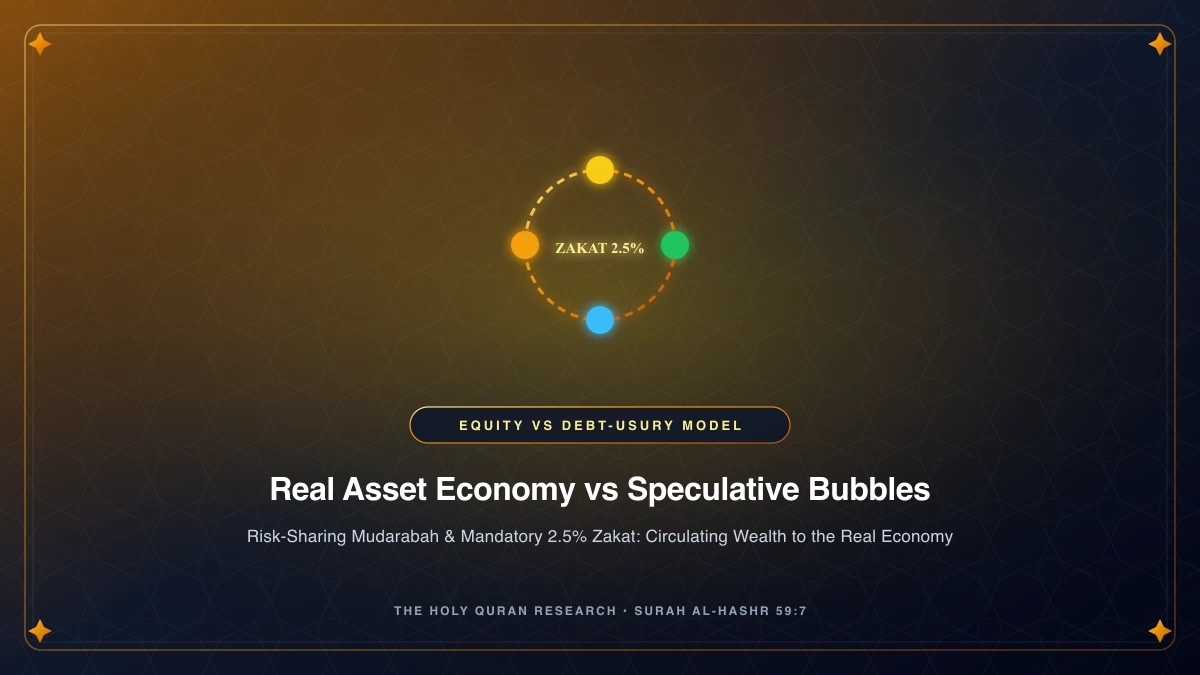
The mandatory annual wealth tax of Zakat directly recirculates dormant capital from the wealthy into community sustenance and poverty alleviation.
2. The Core Sickness of Interest vs. Real Economy
Why is interest so catastrophic for human civilization?
      CONVENTIONAL DEBT SYSTEM            ISLAMIC REAL-ASSET SYSTEM
      ════════════════════════            ═════════════════════════
   • Money makes money via debt        • Money must be tied to real goods/assets
   • 100% risk transferred to borrower • Profit & Loss Sharing (Mudarabah/Musharakah)
   • Lender profits even if venture fails • Investor shares success and failure
   • Creates artificial speculative bubbles • Prevents unbacked credit expansion
   • Compounding interest traps poor   • Mandatory 2.5% wealth circulation (Zakat)
In a conventional banking system:
- A bank lends money at 8% interest to an entrepreneur.
- If the business burns down, the entrepreneur loses everything and goes bankrupt, but the bank legally seizes his house.
- The lender takes zero operational risk while demanding guaranteed profit. This divorces the financial sector from the real physical economy.
In the Islamic economic model:
- Money cannot be leased for guaranteed interest.
- If an investor wants returns, they must enter a Profit-and-Loss Sharing (PLS) partnership (Mudarabah / Musharakah).
- Both parties share the risk and the reward. If the venture fails through no negligence, both share the loss. This forces capital to flow only into productive, socially beneficial, thoroughly vetted businesses.
3. Zakat: The Dynamic Anti-Hoarding Mechanism
Conventional economics relies on income taxes (taxing hard work and labor). Islam taxes idle, stagnant, hoarded wealth:
- Zakat (2.5% annual wealth tax): Assessed annually on surplus accumulated capital, gold, silver, savings, and investments exceeding the minimum threshold (Nisab).
- Economic Impact: If a wealthy person hoards $10,000,000 in a vault without investing it in the real economy, Zakat will continually reduce it by 2.5% each year. This creates an irresistible economic incentive to invest capital into real businesses, factories, jobs, and services.
The Quran explicitly explains this civilizational objective:
كَيْ لَا يَكُونَ دُولَةً بَيْنَ الْأَغْنِيَاءِ مِنكُمْ
"So that it [wealth] will not be a perpetual circulation only among the rich among you."
(Surah Al-Hashr 59:7)
4. Why the Vatican Endorsed Islamic Finance
Following the devastating global financial crash of 2008 caused by toxic subprime mortgage speculation and derivative debt trading, the Vatican's official newspaper, L'Osservatore Romano, published an extraordinary editorial:
"The ethical principles on which Islamic finance is founded may bring banks closer to their clients and to the true spirit which should mark every financial service... Western banks could look to the rules of Islamic finance to restore trust amongst clients during the current global crisis."
Islamic banks survived the 2008 crash with record stability because the Shariah prohibits Gharar (deceptive ambiguity and gambling) and Maysir (speculative derivatives).
5. Summary: Islamic Economic Justice
| Economic Principle | Islamic Mandate | Societal Outcome |
|---|---|---|
| Elimination of Usury (Riba) | Zero-interest financing | Elimination of predatory debt enslavement and housing foreclosure crises |
| Mandatory Wealth Tax (Zakat) | 2.5% annual tax on idle capital | Elimination of generational wealth hoarding; continuous poverty alleviation |
| Risk-Sharing Equity (Musharakah) | Investors share real business risk | Alignment of financial profits with real-world economic productivity |
| Prohibition of Hoarding (Ihtikar) | Ban on monopolizing essential goods | Fair, competitive market pricing without artificial shortages |
Conclusion: A Moral Economy for Mankind
Islam demonstrates that true spirituality is not confined to personal prayer inside a mosque — it governs the marketplace, the bank, and the treasury. By subordinating financial capital to moral justice and human dignity, Islam presents the only economic architecture capable of sustaining long-term global peace and prosperity.