

 QuranGPT
Time Dilation & Relativity in the Quran: How 7th-Century Revelation Foreshadowed Einstein's Physics
An evidence-based examination of how the Quranic descriptions of 1,000-year and 50,000-year cosmic days align with modern relativistic time dilation and gravitational physics.
The Holy Quran Team
Author
For centuries, classical human civilization viewed time as an immutable, uniform river flowing steadily and identically for all observers throughout the cosmos. In 1687, Sir Isaac Newton formalized this assumption in his Principia Mathematica, asserting that "Absolute, true, and mathematical time, of itself, and from its own nature, flows equably without relation to anything external."
To the ancient and classical world, a second on Earth was identical to a second in the farthest heavens.
In 1905 and 1915, Albert Einstein overturned this fundamental pillar of physics with his Special and General Theories of Relativity. Einstein demonstrated that time is neither absolute nor universal; rather, time is dynamic and elastic. It stretches, contracts, and dilates depending on an observer's relative velocity through space and the strength of the surrounding gravitational field.
Yet over thirteen centuries before Einstein published his relativistic field equations, and long before the invention of atomic clocks or satellites, the Holy Quran explicitly articulated the relativity of time. In multiple verses, the Quran described cosmic realms where a single day corresponds to one thousand earthly years, or fifty thousand earthly years, directly linking the perception of time to cosmic movement and divine reference frames.
1. The Quranic Architecture of Elastic Time
In 7th-century Arabia, when astronomy was dominated by pre-Copernican geocentric mythology, the Quran introduced an astonishing concept: time is measured differently depending on who is observing it and what realm is being traversed.
The most famous Quranic articulation of time relativity appears in Surah Al-Ma'arij:
تَعْرُجُ ٱلْمَلَـٰٓئِكَةُ وَٱلرُّوحُ إِلَيْهِ فِى يَوْمٍۢ كَانَ مِقْدَارُهُۥ خَمْسِينَ أَلْفَ سَنَةٍۢ
Surah Al-Ma'arij (70:4): "The angels and the Spirit will ascend to Him during a Day the measure of which is fifty thousand years."
In Surah As-Sajdah, the Quran describes another cosmic timescale associated with the descent and ascent of divine command through the heavens:
يُدَبِّرُ ٱلْأَمْرَ مِنَ ٱلسَّمَآءِ إِلَى ٱلْأَرْضِ ثُمَّ يَعْرُجُ إِلَيْهِ فِى يَوْمٍۢ كَانَ مِقْدَارُهُۥٓ أَلْفَ سَنَةٍۢ مِّمَّا تَعُدُّونَ
Surah As-Sajdah (32:5): "He directs the affair from the heaven to the earth; then it will ascend to Him in a Day, the measure of which is a thousand years of what you count."
Notice the critical phrase at the conclusion of Surah As-Sajdah: Mimma ta'uddun — "of what you count." The Quran deliberately qualifies the measurement: a single day in that celestial frame of reference corresponds to one thousand years according to human earthly reckoning.
And in Surah Al-Hajj, the Quran reiterates the non-absolute nature of temporal progression:
وَيَسْتَعْجِلُونَكَ بِٱلْعَذَابِ وَلَن يُخْلِفَ ٱللَّهُ وَعْدَهُۥ ۚ وَإِنَّ يَوْمًا عِندَ رَبِّكَ كَأَلْفِ سَنَةٍۢ مِّمَّا تَعُدُّونَ
Surah Al-Hajj (22:47): "And they urge you to hasten the punishment. But Allah will never fail in His promise. And indeed, a day with your Lord is like a thousand years of those which you count."
To a 7th-century nomadic auditor, stating that one day could equal 1,000 or 50,000 years could easily have been dismissed as hyperbole. In the light of modern relativistic physics, however, these statements describe the precise physical behavior of time in high-velocity and extreme-gravitational regimes.
2. Einstein's Special Relativity: Kinematic Time Dilation
In Special Relativity, Einstein established that the speed of light in a vacuum ($c \approx 299,792$ km/s, approximately $3 \times 10^8$ m/s) is an absolute cosmic constant for all observers, regardless of their motion. Because the speed of light cannot vary, space and time must adjust.
When an object travels at a velocity $v$ approaching the speed of light, an observer at rest will measure the moving object's clock as ticking significantly slower than their own. This phenomenon is governed by the Lorentz transformation:
Δt' = Δt / √(1 - v² / c²)
Where:
- $\Delta t$ is the proper time experienced by the moving traveler.
- $\Delta t'$ is the dilated time measured by an observer in a stationary frame.
- $v$ is the velocity of the moving traveler.
- $c$ is the speed of light.
| Traveler Velocity ($v$) | Dilated Earth Time per 1 Traveler Day | Physical / Relativistic Context |
|---|---|---|
| 0.90 c | 2.29 Earth Days | Relativistic particle accelerators |
| 0.99 c | 7.09 Earth Days | High-energy cosmic ray muon decay |
| 0.99999999999 c | ~1,000 Earth Years | Foreshadowed by Surah As-Sajdah (32:5) |
| 0.9999999999999999 c | ~50,000 Earth Years | Foreshadowed by Surah Al-Ma'arij (70:4) |
In Islamic theology, angels are non-corporeal entities created from Nur (light). As narrated by Aisha (may Allah be pleased with her):
The Messenger of Allah ﷺ said: "The angels were created from light, the jinn were created from a smokeless flame of fire, and Adam was created from that which has been described to you."
(Sahih Muslim #2996)
When entities composed of or traveling at velocities approaching the speed of light ascend through cosmic dimensions (Ta'ruju al-Mala'ikatu), their internal time frame undergoes near-infinite dilation relative to an earthly observer. A single day of traversal in their relativistic frame corresponds to tens of thousands of years for observers bound to Earth's slow reference frame.

3. General Relativity: Gravitational Time Dilation
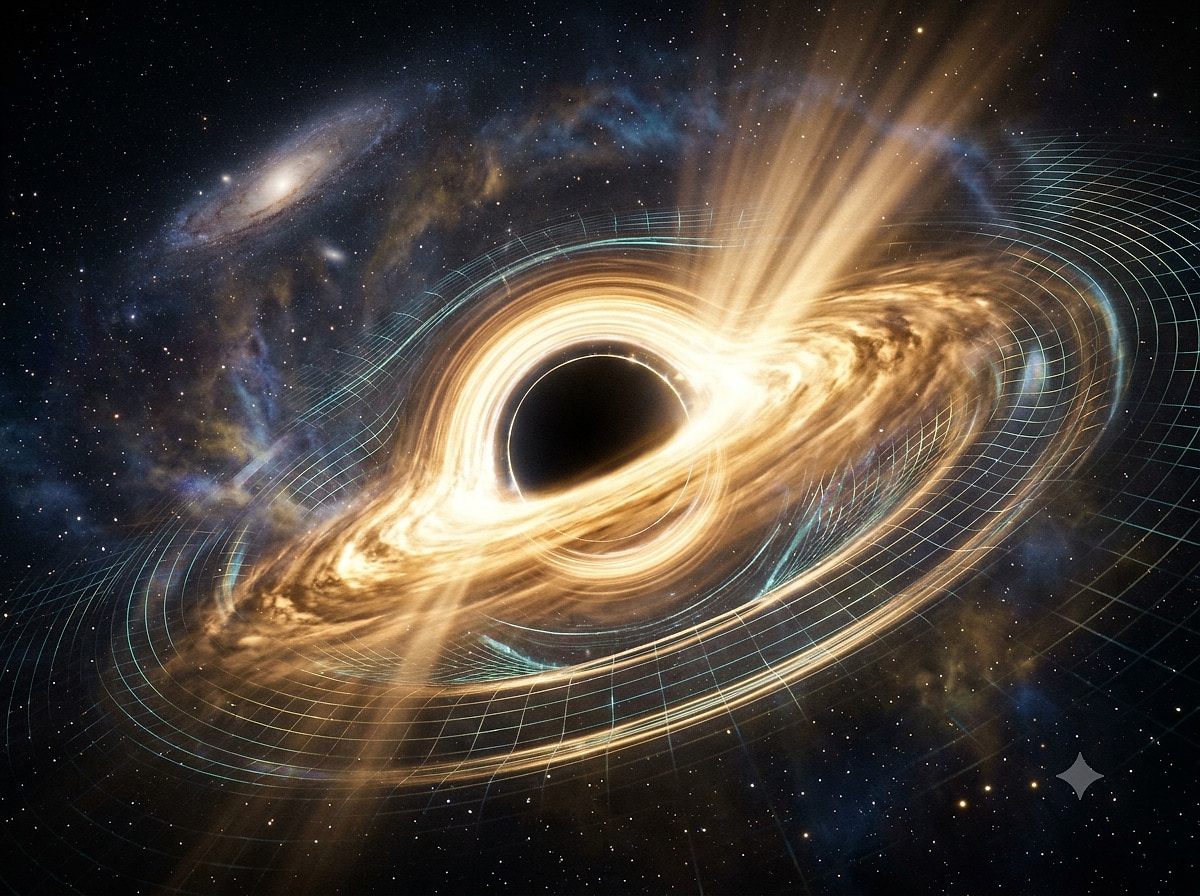
Einstein’s 1915 General Theory of Relativity revealed an even deeper truth: gravity is not a physical pulling force, but the curvature of four-dimensional space-time caused by mass and energy.
The stronger the gravitational potential $\Phi$, the more space-time curves, and the slower time passes relative to an observer in a weaker gravitational field. Clocks located near massive celestial bodies — such as neutron stars or black holes — tick measurably slower than clocks located in empty interstellar space.
This gravitational time dilation is verified every second by modern Global Positioning System (GPS) satellites:
- Due to their orbital speed (~14,000 km/h), satellite atomic clocks run 7 microseconds per day slower than ground clocks (Special Relativity).
- However, because they orbit 20,200 km above Earth where gravity is weaker, their clocks run 45 microseconds per day faster than ground clocks (General Relativity).
- GPS engineers must apply a net relativistic correction of $+38$ microseconds every single day; failing to do so would cause navigational location errors of over 11 kilometers within 24 hours.
| Gravitational Environment | Space-Time Curvature | Relative Clock Behavior |
|---|---|---|
| Strong Gravitational Field (Deep Space-Time Well) | Severe curvature | Time slows down significantly |
| Weak Gravitational Field (Outer Interstellar Space) | Minimal curvature | Time passes relatively faster |
| Extreme Event Horizon (Singularity) | Infinite curvature | Time dilation approaches infinity |
When the Quran speaks of divine cosmic affairs descending from the highest celestial horizons to Earth (Yudabbiru al-amra minas-sama'i ila al-ard), it describes transitions between vastly different gravitational and cosmological potentials, where temporal progression naturally stretches across millennia.
4. The Sleepers of the Cave: Subjective vs. Objective Time
The relativity of temporal perception is not restricted to astrophysics in the Quran; it is also explored at the level of human consciousness. In Surah Al-Kahf, the Quran recounts the story of the young believers who sought refuge in a cave and were put into a miraculous suspended state:
وَكَذَٰلِكَ بَعَثْنَـٰهُمْ لِيَتَسَآءَلُوا۟ بَيْنَهُمْ ۚ قَالَ قَآئِلٌۭ مِّنْهُمْ كَمْ لَبِثْتُمْ ۖ قَالُوا۟ لَبِثْنَا يَوْمًا أَوْ بَعْضَ يَوْمٍۢ ۚ قَالُوا۟ رَبُّكُمْ أَعْلَمُ بِمَا لَبِثْتُمْ
Surah Al-Kahf (18:19): "And similarly, We awakened them that they might question one another. Said a speaker from among them, 'How long have you remained [here]?' They said, 'We have remained a day or part of a day.' They said, 'Your Lord is best knowing of how long you remained.'"
The Quran subsequently reveals that they remained preserved in the cave for 300 solar years, which equals 309 lunar years (18:25). Yet, to the sleeping youths, the experience felt like nothing more than an afternoon nap: "a day or part of a day."
This distinction between objective coordinate time and subjective proper time underscores a profound philosophical and scientific reality: time is a creature of Allah, contingent and variable, rather than an absolute self-existent deity.
As the Prophet Muhammad ﷺ narrated in a profound Hadith Qudsi:
Narrated by Abu Hurairah (may Allah be pleased with him): The Prophet ﷺ said:
"Allah said: 'The son of Adam offends Me; he curses Time (Ad-Dahr), whereas I am Time [the Creator and Controller of Time]; in My Hand are all things, and I cause the alternation of the night and the day.'"
(Sahih al-Bukhari #4826, Sahih Muslim #2246)

5. Comparative Epistemology: Revelation vs. Mythological Antiquity
To appreciate the rational significance of these Quranic verses, one must compare them with contemporary 7th-century mythologies:
| Civilization & Text | Concept of Time and Space | Alignment with Modern Physics |
|---|---|---|
| Classical Greek Philosophy (Aristotle) | Absolute, static celestial spheres; eternal, uncreated uniform time | ❌ Falsified by relativistic physics and the Big Bang |
| Medieval European Scholasticism | Absolute Newtonian framework; uniform temporal ticking across creation | ❌ Falsified by Special and General Relativity |
| Ancient Near Eastern Mythologies | Chaotic cyclical time tied to warring deities and earthly reincarnation | ❌ Falsified by thermodynamic entropy and cosmology |
| The Holy Quran (7th Century) | Dynamic, elastic, relative time (Yawmun ka-alfi sanah, Khamsina alfa sanah) | ✅ Corroborated by modern relativistic time dilation |
How could an unlettered man in the 7th century formulate a cosmological framework that consistently rejected the universal common-sense assumption of uniform time, choosing instead to describe time as elastic, relative, and observer-dependent?
Conclusion: Signs for Those Who Reason
The convergence between modern relativistic physics and the Quranic verses on time dilation is not a forced apologetic exercise; it is an unavoidable realization of textual precision.
The Quran does not indulge in mathematical derivations of tensors or Lorentz transformations. Instead, it provides categorical, qualitative statements about the architecture of reality that remain immune to scientific obsolescence.
Fourteen hundred years after its revelation, as physicists measure microsecond shifts on orbiting satellites and observe starlight bending around black holes, the Quran’s declaration stands as an invitation to human curiosity:
إِنَّ فِى خَلْقِ ٱلسَّمَـٰوَٰتِ وَٱلْأَرْضِ وَٱخْتِلَـٰفِ ٱلَّيْلِ وَٱلنَّهَارِ لَـَٔايَـٰتٍۢ لِّأُو۟لِى ٱلْأَلْبَـٰبِ
Surah Ali 'Imran (3:190): "Indeed, in the creation of the heavens and the earth and the alternation of the night and the day are signs for those of understanding."