

 QuranGPT
Surah Maryam: Supplication for the Impossible & Reproductive Biology
Discover the profound spiritual lessons of Surah Maryam — Zakariya's whispered dua, overcoming infertility, bone aging science, and the obstetric power of fresh dates.
The Holy Quran Team
Author
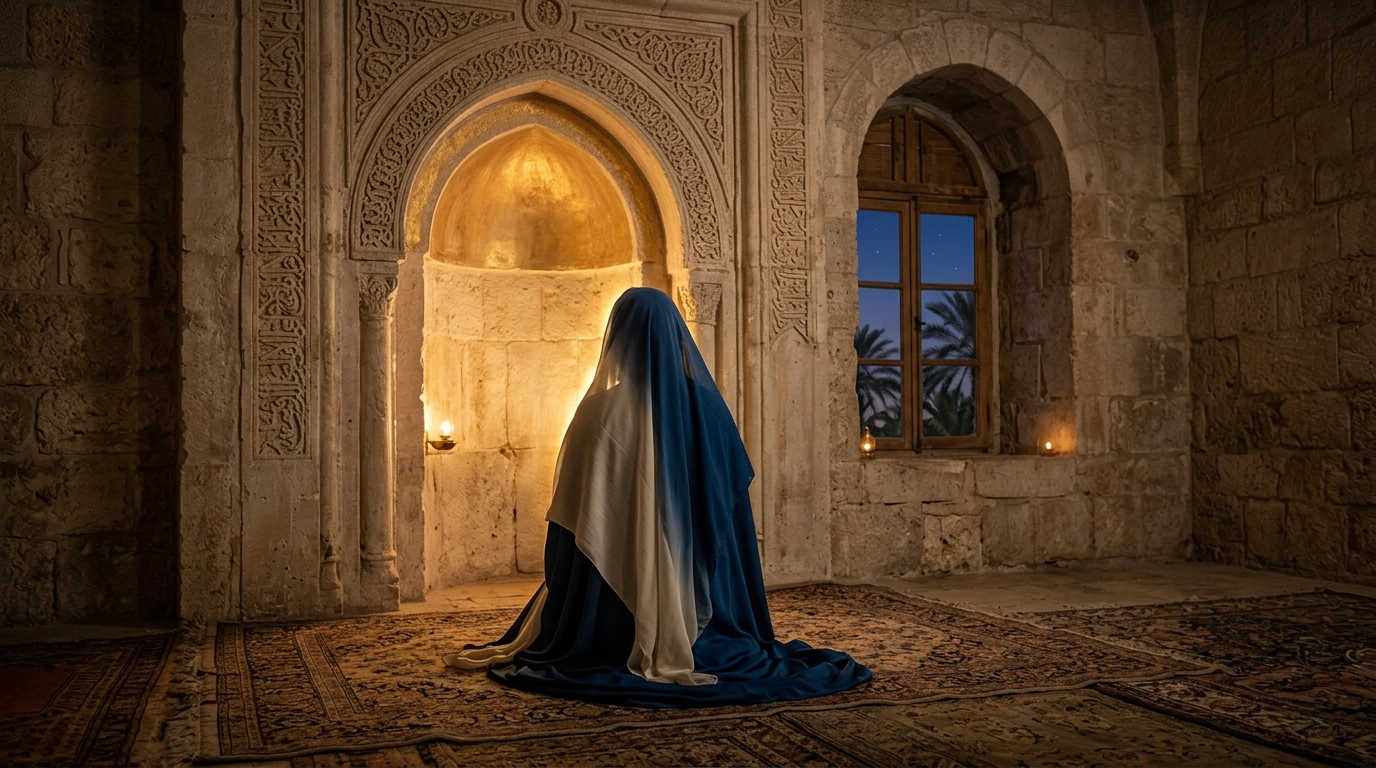
Human life is frequently confronted with trials that appear insurmountable under the standard laws of physics, biology, and clinical medicine. Whether battling prolonged infertility, chronic degenerative illness, or agonizing grief, the human soul easily succumbs to despair when empirical odds turn to zero.
Yet, within the nineteenth chapter of the Holy Quran, Surah Maryam, Allah Almighty unveils an extraordinary divine manifesto on the metaphysics of supplication (Dua), the fragility of biological determinism, and the omnipotence of divine creation.
The Surah begins not with thunderous cosmic declarations, but with an intimate, whispered cry from an aged prophet whose physical biology had long crossed the threshold of reproductive viability:
ذِكْرُ رَحْمَتِ رَبِّكَ عَبْدَهُ زَكَرِيَّا
"[This is] a mention of the mercy of your Lord to His servant Zechariah."
— Surah Maryam (19:2)
إِذْ نَادَىٰ رَبَّهُ نِدَاءً خَفِيًّا
"When he called to his Lord a whispered [hidden] call."
— Surah Maryam (19:3)
Surah Maryam interweaves two profound biological impossibilities: the granting of an heir (Prophet Yahya / John) to an elderly, infertile couple, followed by the miraculous parthenogenic conception of Prophet Isa (Jesus, peace be upon him) by the virgin Maryam (Mary, peace be upon her).
When analyzed through modern endocrinology, reproductive biology, rheumatology, and obstetrics, the verses of Surah Maryam present astonishing clinical accuracy alongside timeless spiritual healing.
1. The Anatomy of a Whispered Prayer: Nida'an Khafiyya
Why did Prophet Zakariya (AS) make his supplication in a whisper (Nida'an Khafiyya)? Classical tafsir and modern psychology reveal profound wisdom:
- Sincerity Free from Ostentation (Ikhlas): A whispered plea strips away performative religiosity. In Islamic spiritual theology, a hidden dua is forty times more beloved to Allah than a publicized one (Al-Hasan al-Basri).
- Emotional Vulnerability in Infertility: Infertility carries profound social stigma and private emotional pain. Whispering allows the soul to pour out its deepest vulnerabilities without public exposure.
- Proximity to the All-Hearing (As-Sami'): As Zakariya knew, Allah is closer to the servant than their jugular vein (Surah Qaf 50:16). Raising one's voice is unnecessary when addressing the Lord of the Throne.

2. Biological Senescence: Bone Demineralization & Gray Hair Correlation
In verse 4 of Surah Maryam, Prophet Zakariya describes his somatic deterioration with stunning clinical precision:
قَالَ رَبِّ إِنِّي وَهَنَ الْعَظْمُ مِنِّي وَاشْتَعَلَ الرَّأْسُ شَيْبًا وَلَمْ أَكُن بِدُعَائِكَ رَبِّ شَقِيًّا
"He said, 'My Lord, indeed my bones have grown feeble, and my head has flared with gray hair, and never have I been in my supplication to You, my Lord, unblessed.'"
— Surah Maryam (19:4)
The Rheumatological & Dermatological Science
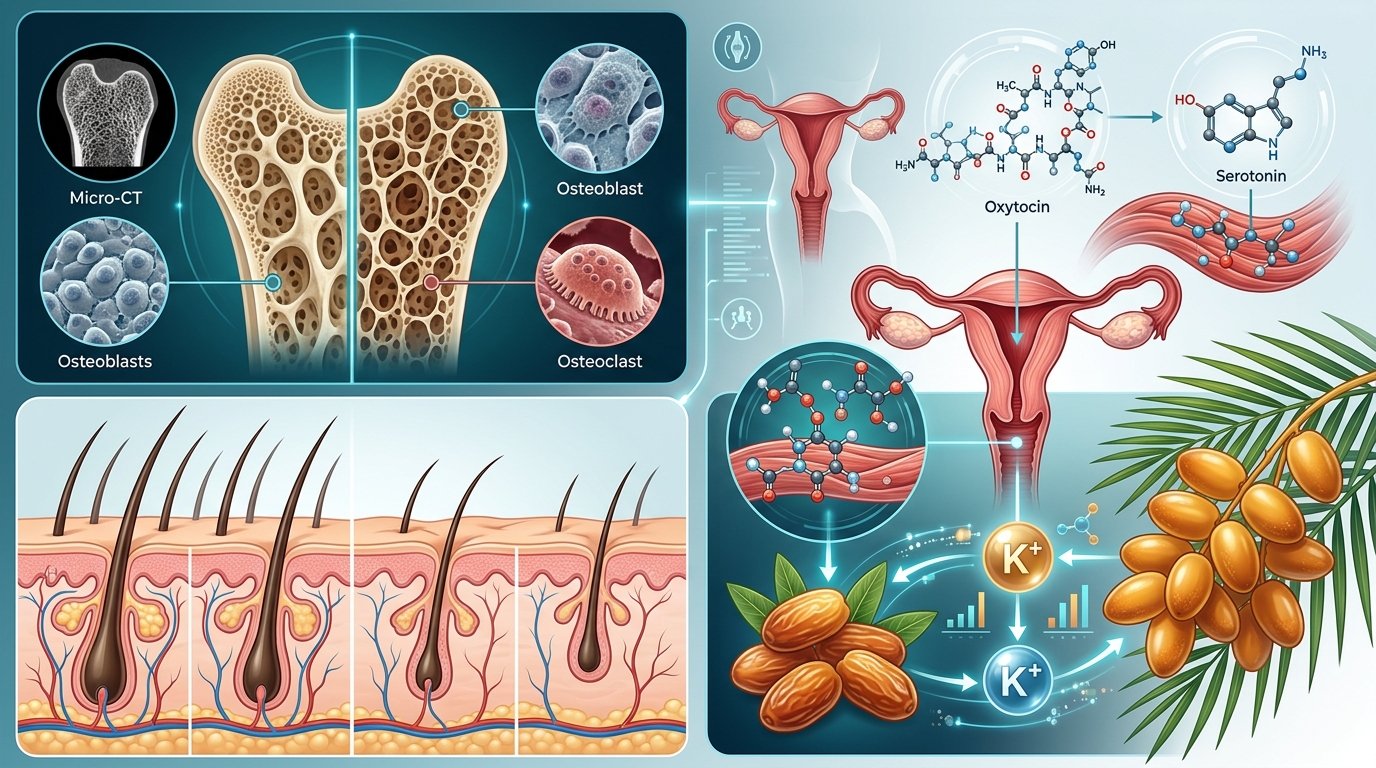
The juxtaposition of bone weakness (Wahana al-'Adhm) and the flaring of gray hair (Ishta'ala ar-Ra'su Shayba) is not merely poetic rhetoric; it represents an exact physiological syndrome of advanced human aging:
| Clinical Feature | Quranic Expression | Modern Pathophysiological Mechanism |
|---|---|---|
| Severe Osteopenia / Osteoporosis | Wahana al-'Adhm (Feeble bones) | Age-related osteoclast hyperactivity over osteoblasts; loss of trabecular micro-architecture and calcium demineralization |
| Melanocyte Stem Cell Exhaustion | Ishta'ala ar-Ra'su Shayba (Flared gray hair) | Depletion of hair follicle melanocyte stem cells (McSCs) caused by cumulative oxidative stress ($H_2O_2$) and reactive oxygen species (ROS) |
| Shared Wnt/$\beta$-Catenin Signaling Pathway | Direct coupling of both symptoms | Research in Journal of Bone and Mineral Research confirms that the Wnt/$\beta$-catenin pathway simultaneously governs both osteoblast bone formation and follicular melanocyte pigmentation |
In landmark gerontological research, scientists have confirmed that individuals with premature graying and hair thinning exhibit significantly lower bone mineral density (BMD) at the femoral neck and lumbar spine (Mortazavi et al., 2013; British Journal of Dermatology). Zakariya (AS) articulated the exact biological biomarkers of advanced systemic senescence.
3. Divine Biological Reprogramming: "Huwa 'Alayya Hayyin"
Despite reaching extreme age and having a wife who was biologically barren from youth ('Aqir), Zakariya’s faith in Allah’s creative capability remained absolute:
قَالَ رَبِّ أَنَّىٰ يَكُونُ لِي غُلَامٌ وَكَانَتِ امْرَأَتِي عَاقِرًا وَقَدْ بَلَغْتُ مِنَ الْكِبَرِ عِتِيًّا
"He said, 'My Lord, how will I have a boy when my wife has been barren and I have reached extreme old age?'"
— Surah Maryam (19:8)
قَالَ كَذَٰلِكَ قَالَ رَبُّكَ هُوَ عَلَيَّ هَيِّنٌ وَقَدْ خَلَقْتُكَ مِن قَبْلُ وَلَمْ تَكُ شَيْئًا
"[The angel] said, 'Thus [it will be]; your Lord says, "It is easy for Me, for I created you before, while you were nothing."'"
— Surah Maryam (19:9)
The Word "Hayyin" (هَيِّنٌ) — "It is Easy for Me"
In human medicine, reversing ovarian senescence, restoring depleted Anti-Müllerian Hormone (AMH), and rejuvenating aged spermatogenesis requires complex genetic and cellular interventions.
To Allah, the Creator of cellular biology, reviving dormant reproductive tissue is Hayyin (effortless). As clarified in Surah Al-Anbiya:
"So We responded to him, and We gave to him John, and We cured for him his wife."
— Surah Al-Anbiya (21:90)
The Arabic term Aslahna (أَصْلَحْنَا - We cured / rehabilitated) indicates an active, divine biological restoration of the reproductive endocrine system, enabling conception where pathology previously dictated sterility.
4. Maryam (AS) in the Sanctuary: Pure Devotion & Parthenogenesis
The narrative transitions from the miraculous conception within marriage to the ultimate reproductive miracle — conception without male fertilization:
وَاذْكُرْ فِي الْكِتَابِ مَرْيَمَ إِذِ انْتَبَذَتْ مِنْ أَهْلِهَا مَكَانًا شَرْقِيًّا • فَاتَّخَذَتْ مِنْ دُونِهِمْ حِجَابًا فَأَرْسَلْنَا إِلَيْهَا رُوحَنَا فَتَمَثَّلَ لَهَا بَشَرًا سَوِيًّا
"And mention in the Book [the story of] Mary, when she withdrew from her family to an eastern place and secluded herself from them. Then We sent to her Our Angel [Gabriel], and he appeared before her as a well-proportioned man."
— Surah Maryam (19:16–17)
قَالَتْ أَنَّىٰ يَكُونُ لِي غُلَامٌ وَلَمْ يَمْسَسْنِي بَشَرٌ وَلَمْ أَكُ بَغِيًّا • قَالَ كَذَٰلِكَ قَالَ رَبُّكِ هُوَ عَلَيَّ هَيِّنٌ ۖ وَلِنَجْعَلَهُ آيَةً لِلنَّاسِ وَرَحْمَةً مِّنَّا ۚ وَكَانَ أَمْرًا مَّقْضِيًّا
"She said, 'How can I have a boy while no man has touched me and I have not been unchaste?' He said, 'Thus [it will be]; your Lord says, "It is easy for Me, and We will make him a sign to the people and a mercy from Us. And it is a matter already decreed."'"
— Surah Maryam (19:20–21)
Maryam’s station is unique in human history. Dedicated by her mother before birth to the worship of Allah in the Mihrab (sanctuary), she exemplified total chastity, spiritual isolation (Khalwah), and complete trust (Tawakkul).
5. The Obstetric Science of Labor: Fresh Dates (Rutab) & Water Therapy
When the agonizing onset of labor contractions arrived, Maryam (AS) sought solace beneath a solitary date palm tree:
فَأَجَاءَهَا الْمَخَاضُ إِلَىٰ جِذْعِ النَّخْلَةِ قَالَتْ يَا لَيْتَنِي مِتُّ قَبْلَ هَٰذَا وَكُنتُ نَسْيًا مَّنسِيًّا
"And the pains of childbirth drove her to the trunk of a palm tree. She said, 'Oh, I wish I had died before this and was in oblivion, forgotten.'"
— Surah Maryam (19:23)
In response to her intense physical and emotional anguish, divine inspiration provided a precise nutritional and physiological intervention:
فَنَادَاهَا مِن تَحْتِهَا أَلَّا تَحْزَنِي قَدْ جَعَلَ رَبُّكِ تَحْتَكِ سَرِيًّا • وَهُزِّي إِلَيْكِ بِجِذْعِ النَّخْلَةِ تُسَاقِطْ عَلَيْكِ رُطَبًا جَنِيًّا • فَكُلِي وَاشْرَبِي وَقَرِّي عَيْنًا
"Then he called her from below her, 'Do not grieve; your Lord has provided beneath you a stream. And shake toward you the trunk of the palm tree; it will drop upon you ripe, fresh dates. So eat and drink and be contented.'"
— Surah Maryam (19:24–26)
Modern Obstetric & Gynecological Validation of Fresh Dates (Rutab)
Modern obstetrics has extensively investigated the biochemical profile of fresh dates (Phoenix dactylifera) during late pregnancy and labor:
- Natural Oxytocin-Mimicking Activity: Ripe dates contain compounds that bind to uterine myometrial oxytocin receptors, stimulating rhythmic uterine contractions and accelerating cervical dilation (Al-Kuran et al., Journal of Obstetrics and Gynaecology, 2011).
- Shortening the Duration of Labor: In a randomized prospective trial (Razali et al., 2017), women consuming dates in the active phase of labor demonstrated significantly shorter first-stage labor (380 min vs. 520 min) and a dramatically lower requirement for synthetic oxytocin (Pitocin).
- Prevention of Postpartum Hemorrhage (PPH): The high concentration of tannins and calcium in fresh dates induces natural hemostasis by promoting sustained uterine contraction after placental delivery, drastically reducing blood loss (Khadem et al., Iranian Journal of Nursing and Midwifery Research, 2007).
- Instant Non-Glycemic Monosaccharides: The simple sugars in fresh dates (glucose and fructose) are absorbed directly through the gastric mucosa, providing immediate energy to exhausted uterine smooth muscle without triggering sharp reactive hypoglycemia.
- Hydrotherapy & Cryotherapy (Sariyya): The cool flowing rivulet (Sariyya) beneath Maryam provided clean hydration to restore circulating maternal blood volume and cold-water therapy to reduce perineal inflammation and body heat.
6. Spiritual Takeaways: Blueprint for Dua in Times of Despair
Surah Maryam provides every believer facing "impossible" situations with an actionable spiritual formula:
- Never Limit Allah by Your Circumstances: Clinical diagnoses, financial deadlocks, and family hardships operate within created worldly laws. Allah is the Creator of the laws. Never say "it is impossible."
- Combine Total Hope with Vulnerable Humility: Begin your dua by acknowledging your absolute weakness, as Zakariya did ("my bones are feeble"), while holding unwavering certainty in Allah’s mercy ("never have I been unblessed in supplication to You").
- Seek Solitude and Seclusion (Khalwah): Like Maryam (AS) withdrawing behind a barrier (Hijab), create quiet, sacred spaces in your daily routine where worldly distractions are shut out and your heart communicates purely with Allah.
- Take Action While Relying on Allah: Even in the throes of labor, Maryam was instructed to "shake the trunk of the palm tree." A weak woman in labor cannot physically move a heavy palm tree, but Allah demands our sincere effort (Asbab) while He alone delivers the miraculous fruit.
Scientific & Islamic References
- Al-Kuran, O., et al. (2011). The effect of late pregnancy consumption of date fruit on labour and delivery. Journal of Obstetrics and Gynaecology, 31(1), 29–31.
- Razali, N., et al. (2017). Date fruit consumption at term: Effect on length of gestation, labour and delivery. Journal of Obstetrics and Gynaecology, 37(5), 595–600.
- Khadem, N., et al. (2007). Comparing the efficacy of dates and oxytocin in the management of postpartum hemorrhage. Iranian Journal of Nursing and Midwifery Research, 12(2), 57–61.
- Mortazavi, H., et al. (2013). Association between premature hair greying and bone mineral density in premenopausal women. British Journal of Dermatology, 169(4), 841–846.
- Ibn Kathir, I. (2000). Tafsir al-Qur'an al-Azim (Surah Maryam 19:1–36). Dar Ibn Hazm, Beirut.
- Al-Qurtubi, M. (2006). Al-Jami' li-Ahkam al-Qur'an. Al-Resalah Publishers, Beirut (Vol. 13, pp. 12–45).