

 QuranGPT
Supreme Court Seeks Centre's Stand on Data Protection Act Dilution of RTI: Transparency Activists Warn of Information Blackout
A comprehensive constitutional and legal report on the Supreme Court issuing formal notice to the Union Government regarding legal challenges against Section 44(3) of the Digital Personal Data Protection (DPDP) Act, which amends Section 8(1)(j) of the Right to Information (RTI) Act.
The Holy Quran Team
Author
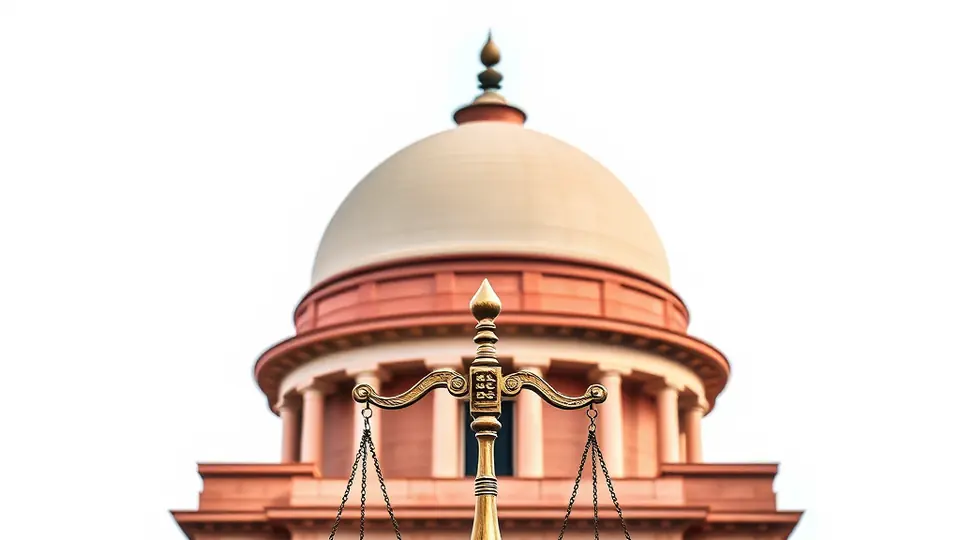
Supreme Court Seeks Centre's Stand on Data Protection Act Dilution of RTI: Transparency Activists Warn of Information Blackout
In a critical constitutional face-off touching upon the delicate equilibrium between individual digital privacy and democratic governmental transparency, the Supreme Court of India has issued a formal notice to the Union Government on a batch of Public Interest Litigations (PILs) challenging controversial amendments made to the Right to Information (RTI) Act, 2005 through the enactment of the Digital Personal Data Protection (DPDP) Act.
The petitions, filed by prominent transparency activists, former Central Information Commissioners, and civil liberty organizations, contend that Section 44(3) of the DPDP Act fundamentally guts the investigative efficacy of the RTI Act by creating a blanket, absolute ban on the disclosure of all "personal information" of public servants, eliminating the vital "public interest override" clause that previously empowered citizens to expose government corruption, illegal asset accumulation, and fraudulent welfare distribution.
A division bench of the apex court observed that the interplay between fundamental rights under Article 19(1)(a) (Freedom of Speech and Right to Know) and Article 21 (Right to Privacy) requires profound constitutional scrutiny to prevent the emergence of an institutional "information blackout" in governance.
1. The Legal Conflict: How the DPDP Act Altered Section 8(1)(j) of RTI
To understand the magnitude of the constitutional challenge, one must examine how the statutory language of the RTI Act was amended:
graph TD
    A["Original RTI Act (Section 8(1)(j))"] --> B["Personal info exempt ONLY IF it has no relationship to public activity"]
    B --> C["CRITICAL PROVISO: If info cannot be denied to Parliament, it cannot be denied to a citizen"]

    D["DPDP Act 2023 Amendment (Section 44(3))"] --> E["Blanket Exemption for ANY personal information whatsoever"]
    E --> F["Complete Deletion of the Public Interest Override Proviso"]
    F --> G["Total Shielding of Corrupt Public Officials & Welfare Siphoning"]
The Fatal Deletion of the Public Interest Proviso:
- Original 2005 Formulation: Section 8(1)(j) stated that personal information could not be disclosed unless the Public Information Officer (PIO) or appellate authority was satisfied that the larger public interest justified the disclosure. Crucially, the law contained a non-negotiable democratic safeguard: "Information which cannot be denied to the Parliament or a State Legislature shall not be denied to any person."
- The 2023 DPDP Mutation: The amendment replaced this nuanced balance with an unqualified, blanket sentence: "Information which relates to personal information." Furthermore, it completely deleted the parliamentary proviso, effectively placing public servants above public accountability.
2. Real-World Ramifications: The Threat of an Information Blackout
Transparency advocates presented documented real-world case studies demonstrating how the amended law is already being abused by corrupt bureaucrats to stonewall legitimate citizen inquiries:
| Category of Governance Inquiry | Previous Disclosure Under Original RTI | New Rejection Ground Under DPDP |
|---|---|---|
| Disproportionate Assets of Bureaucrats | Property returns and asset declarations of IAS/IPS officers were publicly accessible. | Rejected summarily as "personal financial data". |
| Ration Card & Welfare Siphoning | Beneficiary list verification to catch ghost ration cards and bogus pension claims. | Blocked citing privacy of bogus beneficiary names and addresses. |
| Electoral Candidate Criminal Disclosures | Verification of academic degrees, tax filings, and criminal charges of politicians. | Shielded under the guise of individual digital data protection. |
| Police Atrocities and Custodial Violence | Duty rosters and station logbooks to prove presence of errant police officers. | Denied to victims citing personal attendance records of police staff. |
3. Arguments Raised Before the Supreme Court Bench
Senior advocates representing the petitioners argued that the RTI Act was forged through decades of grassroots struggle by ordinary citizens to hold colonial-style bureaucracies accountable to the sovereign people of India.
"Privacy was conceived by this Hon'ble Court in the historic Puttaswamy verdict as a shield to protect the ordinary citizen from the surveillance of an overreaching State. It was never intended to be converted into a dark cloak for corrupt public officials to hide their wrongdoing from public scrutiny."
— Extract from Petitioners' Legal Submission
The Supreme Court directed the Union Ministry of Law and Justice and the Ministry of Electronics and Information Technology (MeitY) to file their comprehensive counter-affidavits within six weeks.
4. Conclusion: Defending the Democratic Right to Know
The Right to Information is the oxygen of Indian democracy. Without the ability of citizens, investigative journalists, and anti-corruption crusaders to scrutinize public spending and official conduct, democratic accountability becomes an empty slogan.
The forthcoming Supreme Court hearings will stand as a monumental test of constitutional jurisprudence—determining whether the Indian republic remains an open, transparent democracy or retreats into bureaucratic opacity.