

 QuranGPT
The Solar System in the Quran: Modern Astrophysics, Orbital Mechanics & Cosmic Equilibrium
An exhaustive scientific and theological analysis comparing modern planetary physics, the solar apex trajectory, and gravitational equilibrium with Quranic astronomy.
The Holy Quran Team
Author
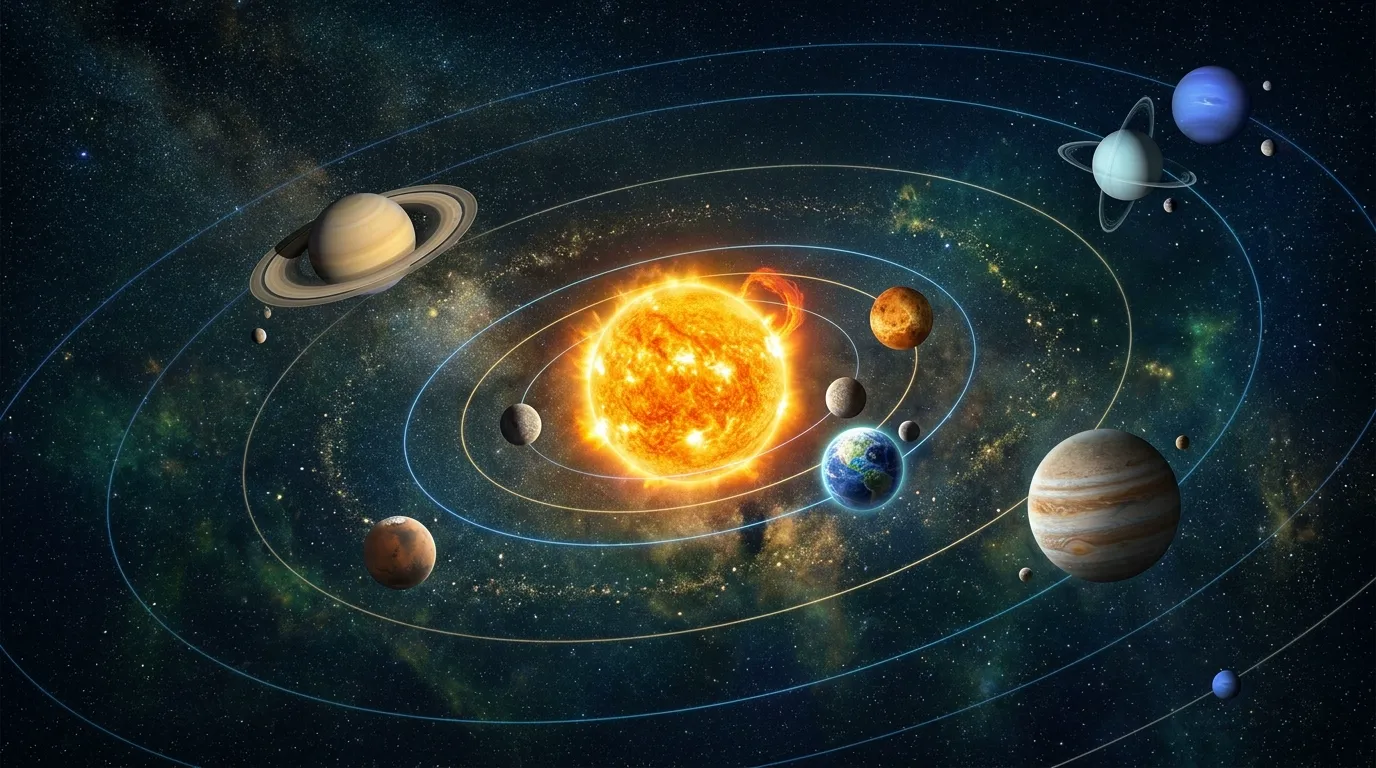
In the astrophysical consensus of 2026, our Solar System is understood not as a static clockwork mechanism, but as a hyper-dynamic, gravitationally bound vortex traveling through the interstellar medium of the Milky Way galaxy at approximately 220 kilometers per second.
From the nuclear fusion furnaces in the solar core to the intricate magnetospheric shields deflecting high-energy cosmic rays, planetary science reveals a cosmos governed by uncompromising mathematical equilibrium, precise angular momentum conservation, and finely tuned physical constants.
Remarkably, over fourteen centuries ago—in an era dominated by geocentric myths, flat-earth folklore, and Aristotelian crystalline spheres—the Holy Quran articulated profound cosmological principles regarding celestial motion. The Quran declared that the Sun and Moon swim in designated orbital paths (Yasbahun), that the Sun travels along an appointed trajectory toward a designated term (Mustaqarr), that the celestial canopy functions as a protected ceiling (Saqfan Mahfuza), and that the entire cosmic architecture is maintained in delicate physical balance (Al-Mizan).
This comprehensive inquiry investigates the profound convergence between 21st-century solar astrophysics, orbital mechanics, planetary geology, and classical Quranic cosmology.
1. Executive Summary: Solar Astrophysics & Quranic Cosmology Matrix
Modern astrophysics and Quranic cosmology converge upon five fundamental pillars of celestial mechanics. Each pillar illustrates that orbital dynamics are deterministic, quantifiable, and preserved through universal equilibrium.
| Parameter | Astrophysical Reality | Quranic Terminology & Verse |
|---|---|---|
| Solar Trajectory | Sun orbits galactic center at ~220 km/s toward Solar Apex | Tajri li-Mustaqarrin Laha — Surah Ya-Sin (36:38) |
| Fluid Orbital Motion | Celestial bodies move freely in gravitational curvature | Kullun fi Falakin Yasbahun — Surah Al-Anbiya (21:33) |
| Luminosity Distinction | Sun is a nuclear light generator; Moon reflects sunlight | Sirajan wa Qamaran Munira — Surah Al-Furqan (25:61) |
| Planetary Shielding | Magnetosphere & atmosphere absorb lethal solar radiation | Saqfan Mahfuza — Surah Al-Anbiya (21:32) |
| Gravitational Order | Exact balance of centrifugal momentum and gravitational pull | Wada'a al-Mizan — Surah Ar-Rahman (55:7) |
2. Heliocentric Dynamics & The Gravitational Anchor of the Sun
Our Solar System comprises a central G-type main-sequence star (the Sun) holding 99.86% of the total system mass, surrounded by eight major planets, hundreds of dwarf planets, and millions of asteroids and comets.
The stability of planetary orbits is maintained by the exact equilibrium between Newton's law of universal gravitation and the centrifugal inertia of orbital velocity:
                  ORBITAL EQUILIBRIUM FORMULATION

      Inward Gravitational Force  =  Outward Centrifugal Requirement

              G · (M_sun · m_planet) / r²  =  (m_planet · v²) / r

              Orbital Velocity: v = √(G · M_sun / r)
If planetary orbital velocities were slightly lower, planets would spiral catastrophically inward into the solar plasma. If orbital velocities were slightly higher, planets would escape into the freezing void of interstellar space.
                      PLANETARY ORBITAL PARAMETERS

   +---------+-------------------+--------------------+----------------------+
   | Planet  | Semi-Major Axis   | Orbital Velocity   | Orbital Period       |
   +---------+-------------------+--------------------+----------------------+
   | Mercury | 0.387 AU          | 47.36 km/s         | 87.97 Earth Days     |
   | Venus   | 0.723 AU          | 35.02 km/s         | 224.70 Earth Days    |
   | Earth   | 1.000 AU          | 29.78 km/s         | 365.25 Earth Days    |
   | Mars    | 1.524 AU          | 24.07 km/s         | 686.98 Earth Days    |
   | Jupiter | 5.204 AU          | 13.07 km/s         | 11.86 Earth Years    |
   | Saturn  | 9.582 AU          | 9.69 km/s          | 29.46 Earth Years    |
   | Uranus  | 19.201 AU         | 6.81 km/s          | 84.01 Earth Years    |
   | Neptune | 30.047 AU         | 5.43 km/s          | 164.79 Earth Years   |
   +---------+-------------------+--------------------+----------------------+
3. The Solar Apex & The Sun's Appointed Trajectory (Mustaqarr)
For centuries, post-Copernican European astronomy incorrectly assumed that while planets orbit the Sun, the Sun itself was stationary at the center of the universe. It was not until the observational breakthroughs of Sir William Herschel in 1783 and modern 20th-century radio astronomy that science recognized the Sun's monumental galactic motion.
The Sun is in continuous, high-speed orbit around the supermassive black hole (Sagittarius A*) at the center of the Milky Way, traveling at 828,000 km/h (~220 km/s). It completes one galactic orbit (a Cosmic Year) approximately every 225 to 250 million years.

The Solar Apex Vector
The Sun does not move randomly; it travels toward a specific celestial coordinate known as the Solar Apex, located in the constellation Hercules near the bright star Vega:
- Apex Direction: Right Ascension 18h 28m, Declination +30°
- Galactic Plane Inclination: The Solar System orbits the Milky Way at an inclination of approximately 60 degrees relative to the galactic disk, creating a majestic three-dimensional helical vortex.
The Quranic Revelation in Surah Ya-Sin
Over a millennium before astronomers discovered the Solar Apex, the Quran explicitly described the Sun's directional journey:
وَٱلشَّمْسُ تَجْرِى لِمُسْتَقَرٍّۢ لَّهَا ۚ ذَٰلِكَ تَقْدِيرُ ٱلْعَزِيزِ ٱلْعَلِيمِ
"And the sun runs [tajri] toward its resting place / appointed term [mustaqarr]. That is the determination of the Exalted in Might, the Knowing."
— Surah Ya-Sin (36:38)
Linguistic & Exegetical Insight:
The verb تَجْرِي (Tajri) literally means "to run, flow, or course with speed," precisely describing high-velocity linear and orbital motion rather than static suspension. The noun مُسْتَقَرّ (Mustaqarr) carries dual dimensions:
- Spatial Destination (Mustaqarr Makani): The physical coordinates of the Solar Apex toward which the solar system is heading.
- Temporal Terminus (Mustaqarr Zamani): The finite operational lifespan of the Sun, which astrophysicists calculate will exhaust its hydrogen core fuel in approximately 5 billion years.
4. The Fluid Hydrodynamics of Orbits: Kullun fi Falakin Yasbahun
During late antiquity and the European Middle Ages, prevailing cosmologies (Ptolemaic and Aristotelian) taught that planets were physically embedded in rigid, transparent crystalline spheres that revolved around the Earth.
The Quran shattered this misconception with remarkable hydrodynamic imagery:
وَهُوَ ٱلَّذِى خَلَقَ ٱلَّيْلَ وَٱلنَّهَارَ وَٱلشَّمْسَ وَٱلْقَمَرَ ۖ كُلٌّۭ فِى فَلَكٍۢ يَسْبَحُونَ
"And it is He who created the night and the day and the sun and the moon; all [heavenly bodies] in an orbit are swimming."
— Surah Al-Anbiya (21:33)
The Physics of Yasbahun (Swimming in Gravitational Fields)
The word يَسْبَحُونَ (Yasbahun) is derived from Sabaha, signifying smooth, buoyant swimming or floating through fluid without mechanical friction.
According to Einstein's General Theory of Relativity, space-time is not a rigid grid but a continuous, curved four-dimensional fabric. Celestial bodies do not roll on solid rails; they navigate curved geodesics within gravitational potential wells, moving with hydrodynamic fluid grace through the vacuum of space.
                    CELESTIAL HYDRODYNAMICS COMPARISON

   +-----------------------+-------------------------+-------------------------+
   | Cosmological Model    | Medium of Transmission  | Orbital Mechanism       |
   +-----------------------+-------------------------+-------------------------+
   | Aristotelian/Ptolemy  | Solid Crystalline Balls | Mechanical Rotation     |
   | Cartesian Vortices    | Dense Physical Aether   | Mechanical Swirl        |
   | Quranic Description   | Free Spatial Orbit      | Floating/Swimming Motion|
   | Modern General Rel.   | Curved Space-Time Field | Geodesic Free-Fall      |
   +-----------------------+-------------------------+-------------------------+
5. Luminosity Physics: Distinguishing Siraj (Generator) from Nur (Reflector)
To the unaided human eye, both the Sun and the Moon appear as radiant celestial illuminators. Ancient mythologies frequently characterized them as twin deities or self-luminous cosmic fireballs.
The Quran, however, consistently maintains a strict, scientifically accurate distinction between the intrinsic light of the Sun and the reflected light of the Moon across multiple chapters:
The Sun as an Incandescent Lamp (Siraj / Diya)
وَجَعَلْنَا سِرَاجًۭا وَهَّاجًۭا
"And We made [therein] a burning lamp [Sirajan Wahhaja]."
— Surah An-Naba (78:13)
In solar physics, the Sun generates its own light through thermonuclear proton-proton chain fusion in its core, fusing 600 million tons of hydrogen into helium every second, releasing radiant electromagnetic energy. The Quran uses the terms:
- سِرَاج (Siraj): An active, burning lamp that produces light through internal combustion.
- ضِيَاء (Diya): Intrinsic, self-generated, dazzling illumination (Surah Yunus 10:5).
The Moon as a Reflected Light (Nur / Munir)
تَبَارَكَ ٱلَّذِى جَعَلَ فِى ٱلسَّمَآءِ بُرُوجًۭا وَجَعَلَ فِيهَا سِرَٰجًۭا وَقَمَرًۭا مُّنِيرًۭا
"Blessed is He who has placed in the sky great stars and placed therein a burning lamp [Siraj] and a luminous moon [Qamaran Munira]."
— Surah Al-Furqan (25:61)
In contrast to the Sun, the Moon possesses no internal nuclear fusion. Its surface reflects merely 12% of incident solar photons (an albedo of 0.12). The Quran never refers to the Moon as a Siraj or Diya; it exclusively utilizes the word نُور (Nur) or مُنِير (Munir), denoting borrowed, reflected, and gentle illumination.
6. Planetary Shielding: Earth's Protected Canopy (Saqfan Mahfuza)
The space environment of our Solar System is intensely hostile. The Sun continuously expels the Solar Wind—a supersonic stream of magnetized plasma and energetic protons traveling at 400 to 800 km/s—accompanied by catastrophic Coronal Mass Ejections (CMEs) and ionizing galactic cosmic radiation.

The Dual Shielding Mechanisms of Earth:
- The Magnetosphere (Geomagnetic Dynamo): Generated by convective molten iron in Earth's outer core, the geomagnetic field extends tens of thousands of kilometers into space, deflecting deadly solar plasma into the Van Allen radiation belts and funneling particles safely to the poles (manifesting as auroras).
- The Atmosphere & Stratospheric Ozone Layer: Earth's atmosphere absorbs solar X-rays, gamma rays, and ultraviolet radiation (UV-C and UV-B), while vaporizing millions of meteoric space debris particles daily upon atmospheric entry.
The Quranic Description
وَجَعَلْنَا ٱلسَّمَآءَ سَقْفًۭا مَّحْفُوظًۭا ۖ وَهُمْ عَنْ ءَايَـٰتِهَا مُعْرِضُونَ
"And We made the sky a protected ceiling [Saqfan Mahfuza], but they, from its signs, are turning away."
— Surah Al-Anbiya (21:32)
Without this multi-layered "protected canopy," solar ionizing radiation would strip away planetary water, sterilize biological ecosystems, and render terrestrial life impossible—precisely as occurred on Mars after its internal planetary dynamo decayed.
7. Comparative Analysis: Ancient Astrological Dogma vs. Modern Astrophysics
The structural divergence between medieval folklore and Quranic cosmological precision is stark:
| Astronomical Domain | Ancient 7th-Century Common Belief | Quranic Statements | 2026 Astrophysical Verification |
|---|---|---|---|
| Solar Motion | Sun is stationary or pulled on a mythical chariot | Sun runs along appointed path (Tajri) | Sun orbits galactic core at ~220 km/s toward Solar Apex |
| Lunar Light | Moon is equal light-emitter or cold fire | Moon is reflected light (Nur); Sun is lamp (Siraj) | Moon albedo is ~0.12; reflects solar photons exclusively |
| Planetary Orbits | Rigid physical crystalline spheres | Bodies swim/float in orbits (Yasbahun) | Free-fall geodesic trajectories in curved space-time |
| Atmospheric Role | Passive empty air dome | Protected functional ceiling (Saqfan Mahfuza) | Magnetosphere & ozone shield against cosmic radiation |
| Cosmic Order | Mythological conflict between planetary gods | Precise calculated balance (Mizan & Husban) | Deterministic celestial mechanics & gravitational laws |
8. Epistemological Insights for Modern Astronomical Inquiry
Reflecting upon the astrophysical structure of the Solar System yields five key epistemological takeaways for contemporary researchers, educators, and seekers of knowledge:
- Appreciate the Interconnectedness of Natural Law: The stability of planetary orbits is not an isolated phenomenon; it relies on the universal balance of gravitational constants, thermonuclear rates, and electromagnetic dynamics.
- Recognize the Difference Between Observation and Mechanism: Ancient civilizations observed celestial cycles accurately for calendar-keeping, but lacked the theoretical frameworks (gravity, nuclear fusion, space-time curvature) revealed through deeper scientific inquiry.
- Bridge Science and Spiritual Contemplation (Tadabbur): In Islamic thought, scientific discovery does not diminish spiritual wonder; rather, the deeper we understand magnetospheric physics and solar trajectories, the more we appreciate the extraordinary wisdom of the Creator.
- Reject Astrological Superstition: Authentic Prophetic traditions explicitly dismantled astrological omens, confirming that eclipses and planetary alignments are governed by natural mathematical law rather than human fortunes.
- Protect the Terrestrial Ecosystem: Recognizing that Earth is an exquisitely balanced biological oasis shielded by a delicate atmosphere underscores our collective ethical duty of environmental stewardship (Khilafah).
9. Global Case Studies: Modern Space Missions Validating Solar Mechanics
Recent 21st-century international space missions continue to deepen our empirical understanding of the solar dynamics described in classical texts:
Case Study I: NASA Parker Solar Probe (2018–2026)
Traveling at speeds exceeding 690,000 km/h, the Parker Solar Probe has repeatedly "touched the Sun," diving deep within the solar corona. Its magnetometer and plasma instruments have confirmed the intense Alfvén wave dynamics and magnetic switchbacks that accelerate the solar wind.
Case Study II: ESA Proba-3 Double-Satellite Mission (2024–2026)
Executing autonomous millimeter-precision formation flying in high Earth orbit, the European Space Agency's Proba-3 casts an artificial occulting shadow to observe the inner solar corona continuously, unlocking the thermodynamic mechanisms of coronal mass ejections.
Case Study III: Gaia Space Telescope Galactic Mapping
The European Gaia astrometry mission has cataloged the high-precision 3D positions and proper motions of over 1.8 billion stars, precisely mapping the Sun's helical velocity vector as it orbits the galactic center toward the Solar Apex.
10. Addressing Common Misconceptions Regarding Celestial Texts
When reading ancient religious and classical scientific literature, several common interpretive errors must be avoided:
Misconception 1: "The Quran describes a geocentric universe where the Sun revolves around a stationary Earth."
Correction: The Quran explicitly states that both the Sun and the Moon possess their own independent orbital motions (Kullun fi falakin yasbahun). It nowhere asserts that the Sun orbits Earth, nor that Earth is the stationary cosmic center.
Misconception 2: "The word Mustaqarr means the Sun will stop moving tomorrow."
Correction: Classical Arabic lexicography defines Mustaqarr as an appointed term, stable resting vector, or ultimate destination. In solar astrophysics, this aligns perfectly with both the spatial Solar Apex and the Sun's eventual transition off the main sequence after exhausting its nuclear fuel.
Misconception 3: "Early Muslims viewed astronomy purely through mythological astrology."
Correction: Authentic Islamic scholarship rigorously separated astronomy (Ilm al-Falak) from astrology (Ilm al-Nujum). Scholars like Al-Biruni, Ibn al-Haytham, and Al-Battani condemned astrology as irrational speculation, establishing empirical observational astronomy as an exact mathematical science.
11. Frequently Asked Questions (FAQ)
Q1: What does the Quran mean when it says the Sun runs toward its "Mustaqarr"?
In Surah Ya-Sin (36:38), Mustaqarr refers to both a spatial destination (the Solar Apex toward which our Solar System travels at 220 km/s) and a temporal terminus (the finite scientific lifespan of the Sun before its hydrogen fuel is exhausted).
Q2: Why does the Quran describe the Sun as a "Siraj" and the Moon as "Nur"?
A Siraj is an active, burning lamp producing its own light through internal combustion (analogous to nuclear fusion). Nur denotes reflected, borrowed illumination. This precise distinction matches astrophysics: the Sun generates photons, while the Moon reflects solar radiation.
Q3: How does the Quranic phrase "Kullun fi falakin yasbahun" relate to modern orbital mechanics?
The verb yasbahun means "floating or swimming with buoyant grace." In general relativity, celestial bodies do not move on rigid physical tracks; they move freely through curved space-time geodesics in the frictionless vacuum of space.
Q4: Did the Prophet Muhammad (peace be upon him) reject astrological superstition during eclipses?
Yes, unequivocally. When his infant son Ibrahim passed away on the same day as a solar eclipse and people claimed the Sun was mourning, the Prophet declared: "The Sun and the Moon are two signs among the signs of God. They do not eclipse on account of the death or birth of anyone." (Sahih al-Bukhari).
Q5: What is Earth's "protected ceiling" mentioned in Surah Al-Anbiya (21:32)?
The "protected ceiling" (Saqfan Mahfuza) refers to Earth's dual protective envelope: the geomagnetic field (magnetosphere) that deflects solar wind and cosmic rays, and the atmosphere with its ozone layer that absorbs lethal ultraviolet and X-ray radiation.
Q6: What is the significance of the Solar Apex in modern astronomy?
The Solar Apex is the astronomical point on the celestial sphere toward which the Sun and our entire Solar System are moving relative to the local interstellar standard of rest, located in the constellation Hercules at approximately 220 km/s.
12. Conclusion & Strategic Summary Checklist
The study of our Solar System reveals a cosmic masterpiece of precision, balance, and kinetic harmony. Far from being a chaotic assortment of drifting bodies, planetary orbits are governed by elegant gravitational laws, finely tuned magnetic defenses, and purposeful celestial trajectories.
By examining modern astrophysics alongside the profound statements of the Quran, we discover an enduring harmony between the observable universe and divine wisdom—inviting humanity to continuously explore, calculate, and reflect with intellectual humility.
Summary Checklist
- ✅ Dynamic Solar Orbit: The Sun is not stationary; it travels at 220 km/s toward the Solar Apex (Tajri li-Mustaqarrin Laha).
- ✅ Fluid Orbital Geodesics: Heavenly bodies move freely through space-time curves (Kullun fi Falakin Yasbahun).
- ✅ Luminosity Distinction: The Sun is an active nuclear generator (Siraj); the Moon is a passive reflector (Nur).
- ✅ Protective Planetary Shielding: Earth is enveloped by a vital magnetospheric and atmospheric canopy (Saqfan Mahfuza).
- ✅ Cosmic Equilibrium: Gravitational attraction and orbital momentum are calibrated with mathematical precision (Al-Mizan).
- ✅ Empirical Scientific Tradition: Islamic astronomy established rigorous observational science, uncoupling celestial study from mythological astrology.