

 QuranGPT
The Seven Layered Heavens and Multiverse Models: Modern Physics Meets Quranic Cosmology
Explore the Quranic concept of the Seven Layered Heavens (Sab'a Samawat) alongside modern astrophysics, string theory, and cosmological multiverse models.
The Holy Quran Team
Author
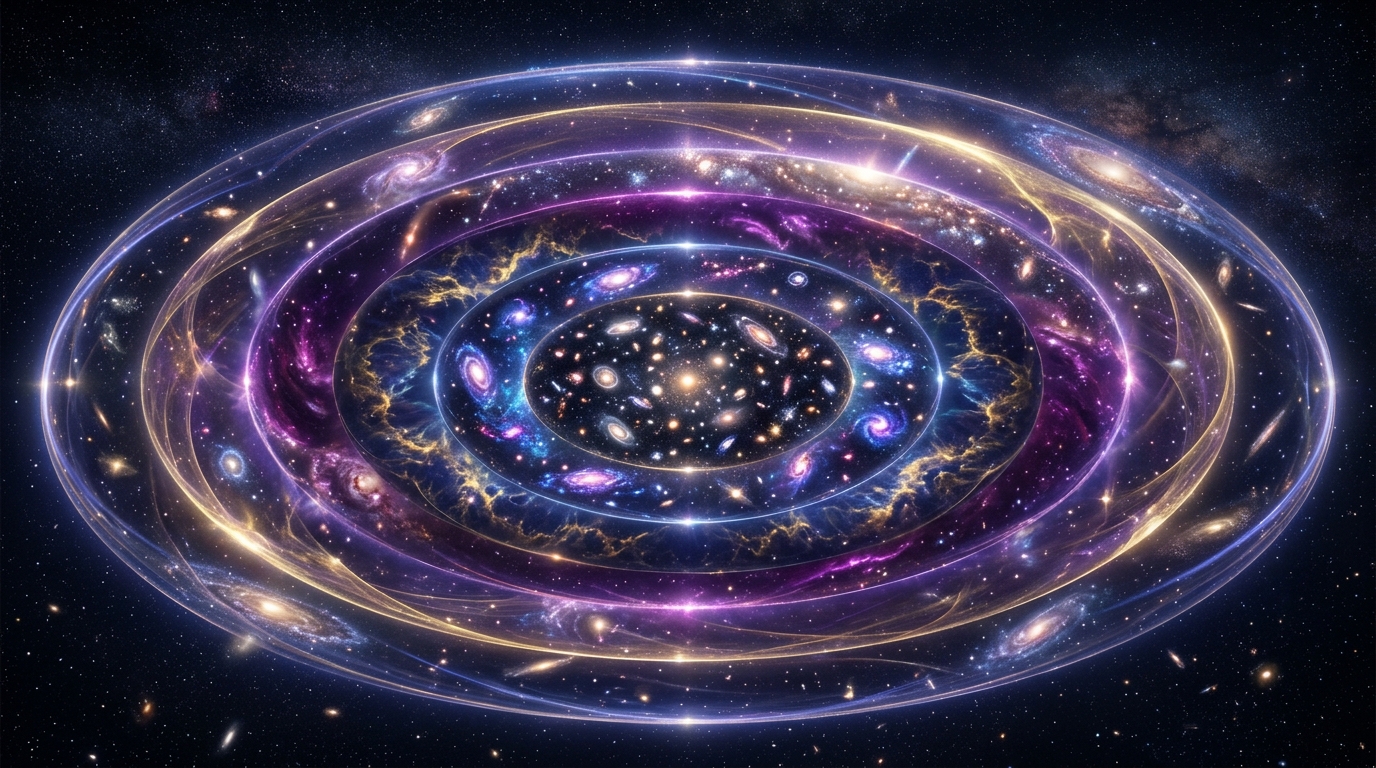
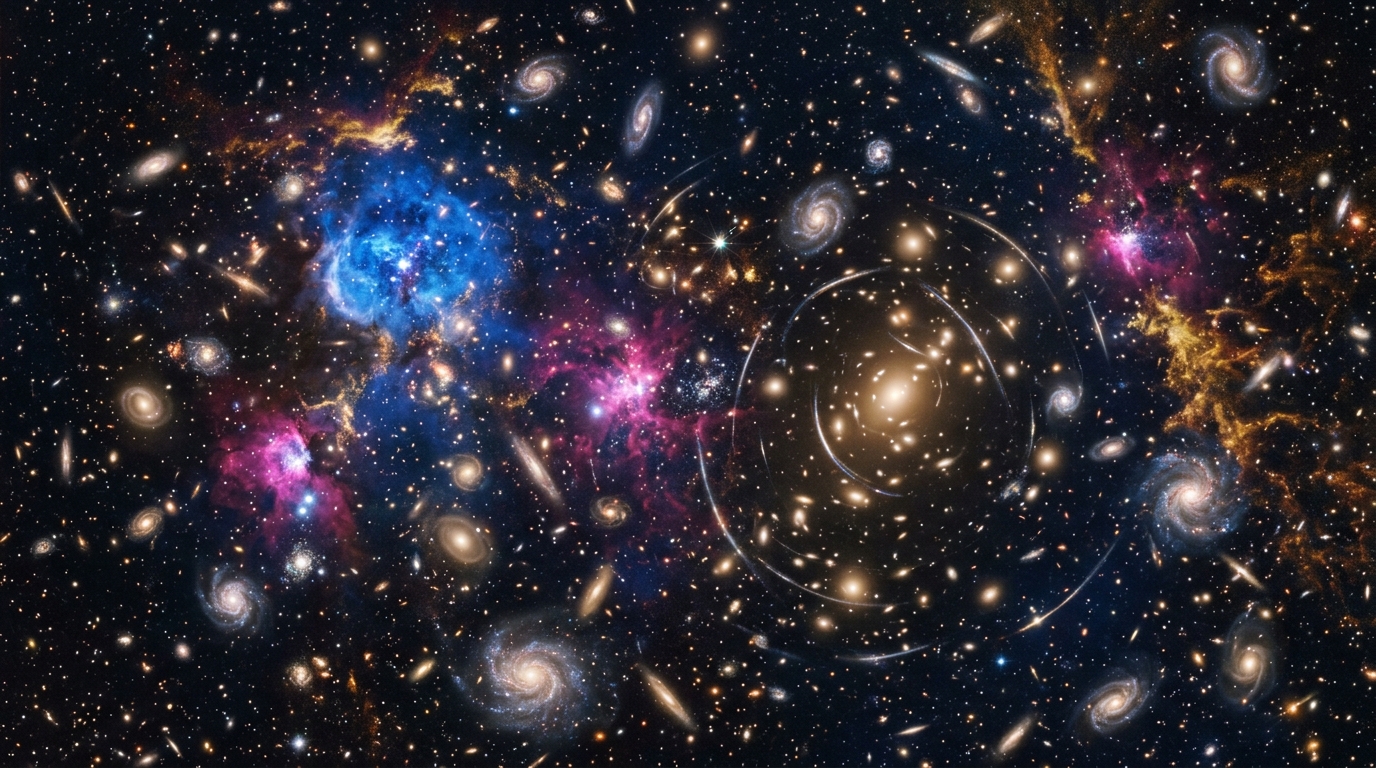
For centuries, human understanding of the cosmos was constrained by what the naked eye could perceive: the gentle glow of the moon, the steady arc of the sun, and the scattered pinpricks of five thousand visible stars. Today, space-based observatories such as the James Webb Space Telescope (JWST) and the Hubble Space Telescope peer deep into the cosmic past, revealing that our planet is an infinitesimal speck amidst an estimated two trillion galaxies spanning an observable diameter of 93 billion light-years.
Yet, as modern theoretical physicists grapple with cosmological horizons, cosmic inflation, higher-dimensional M-theory, and multiverse frameworks, an extraordinary realization emerges: the entirety of what modern astrophysics observes constitutes only the lowest boundary of celestial reality.
Over fourteen hundred years ago, the Holy Quran articulated a profound cosmological structure: the existence of Seven Layered Heavens (Sab‘a Samawat Tibaqan), establishing that everything humans can physically see and detect with telescopes exists entirely within the first and lowest heaven.
الَّذِي خَلَقَ سَبْعَ سَمَاوَاتٍ طِبَاقًا ۖ مَّا تَرَىٰ فِي خَلْقِ الرَّحْمَٰنِ مِن تَفَاوُتٍ ۖ فَارْجِعِ الْبَصَرَ هَلْ تَرَىٰ مِن فُطُورٍ
"[And] who created seven heavens in layers. You do not see in the creation of the Most Merciful any inconsistency. So return [your] vision [to the sky]; do you see any breaks?"
— Surah Al-Mulk (67:3)
1. The Quranic Architecture of the Seven Heavens
The Arabic term Sama' (plural: Samawat) in the Quran carries two distinct contextual meanings depending on its usage:
- The Physical Atmosphere: The immediate sky containing clouds, rain, and protective ozone layers (e.g., Surah Al-Baqarah 2:22).
- The Metaphysical/Cosmological Realms: The seven concentric, layered strata (Tibaqan) of the universe that encompass all creation (e.g., Surah Al-Mulk 67:3, Surah Nuh 71:15).
فَقَضَاهُنَّ سَبْعَ سَمَاوَاتٍ فِي يَوْمَيْنِ وَأَوْحَىٰ فِي كُلِّ سَمَاءٍ أَمْرَهَا ۚ وَزَيَّنَّا السَّمَاءَ الدُّنْيَا بِمَصَابِيحَ وَحِفْظًا ۚ ذَٰلِكَ تَقْدِيرُ الْعَزِيزِ الْعَلِيمِ
"And He completed them as seven heavens within two days and inspired in each heaven its command. And We adorned the nearest heaven with lamps and as protection. That is the determination of the Exalted in Might, the Knowing."
— Surah Fussilat (41:12)
The Lowest Heaven (As-Samaa ad-Dunya): The Realm of All Stars
The Quran explicitly specifies the location of all astronomical bodies:
- In Surah Fussilat (41:12) and Surah Al-Mulk (67:5), Allah states: "We adorned the nearest heaven (As-Samaa ad-Dunya) with lamps (Masabih)."
- The word Masabih (lamps) refers to stars, quasars, and celestial radiant bodies.
This establishes an astronomical reality: every galaxy, black hole, pulsar, nebula, and cosmic web filament observed by modern astrophysics resides exclusively within the First Heaven. The remaining six heavens lie beyond our electromagnetic and gravitational observational thresholds, existing in higher structural or dimensional planes.
2. The Vastness of Scale: The Desert Ring Hadith
To grasp the staggering scale of the seven heavens, classical Islamic scholarship preserved authentic narrations from the Prophet Muhammad ﷺ and his companions that dwarf human imagination.
Narrated by Abdullah ibn Mas'ud and Abu Dharr al-Ghifari (may Allah be pleased with them):
The Messenger of Allah ﷺ said:
"The seven heavens in comparison to the Kursi (the Footstool) are nothing but like seven dirhams (small coins) thrown into a vast desert shield; and the Kursi in comparison to the 'Arsh (the Supreme Throne) is like an iron ring thrown into a vast open desert."
— Recorded by Ibn Abi Shaybah in Kitab al-'Arsh #58; Bayhaqi in Al-Asma' was-Sifat #862; Graded Sahih by Sheikh al-Albani in Silsilat al-Ahadith as-Sahihah #109
This profound analogy reveals exponential cosmological scaling:
- First Heaven: Contains our entire observable universe ($\sim 93$ billion light-years across with $>2$ trillion galaxies).
- Second through Seventh Heavens: Successively encompass the preceding realms with unimaginable dimensional magnitude.
- The Kursi & 'Arsh: Transcend the entire seven-layered cosmic continuum entirely.
3. Modern Multiverse Models in Theoretical Physics
In contemporary theoretical physics and physical cosmology, the hypothesis that our observable universe is not the entirety of existence has evolved from fringe philosophy into active mathematical modeling. Cosmologists categorize multiverse hypotheses into established levels (notably formulated by MIT cosmologist Max Tegmark, 2003):
Level I: Beyond the Cosmological Horizon (Hubble Volumes)
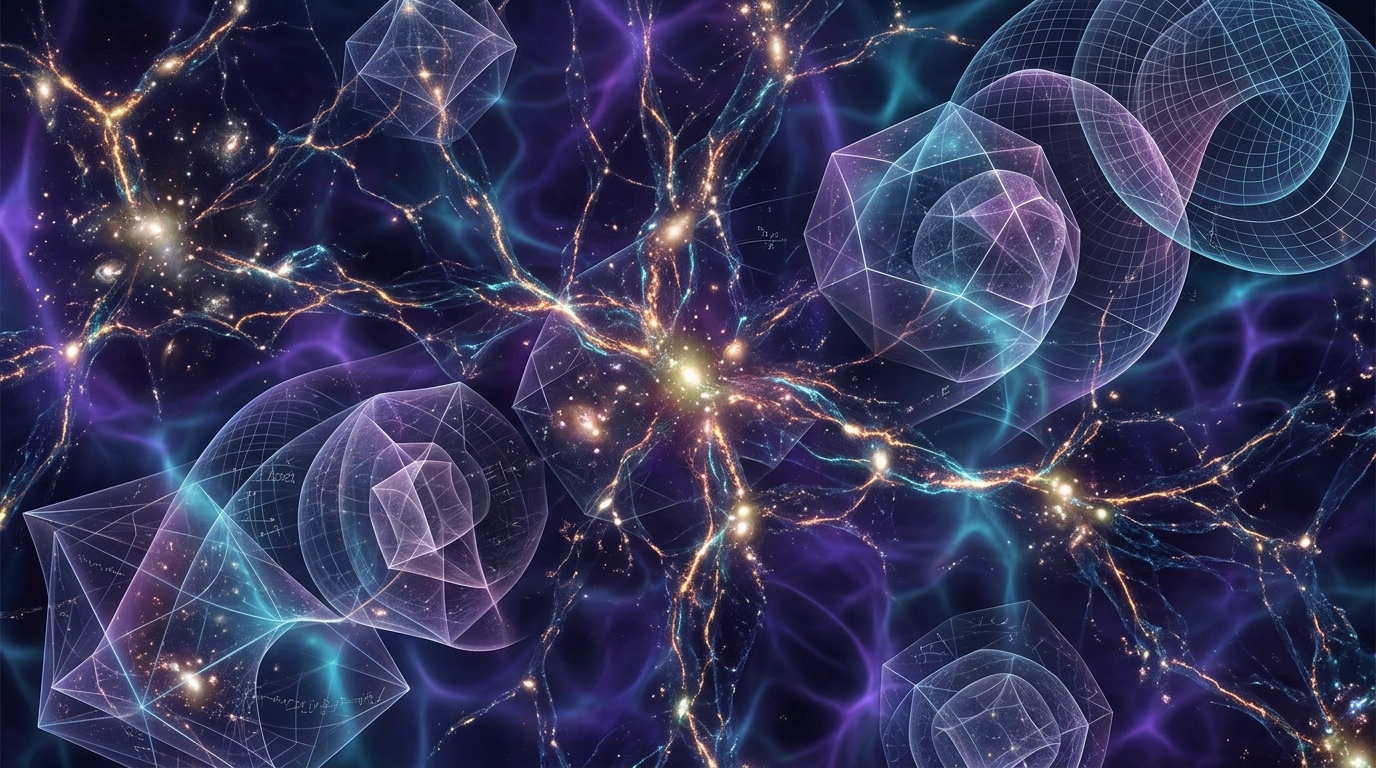
Because the speed of light is finite and the universe is approximately $13.8$ billion years old, we can only observe photons that have traveled to us since the Big Bang. This creates a sphere called the Hubble Volume. If spatial geometry is flat and infinite (as supported by Planck satellite Cosmic Microwave Background measurements), there exist infinite other Hubble volumes outside our causal contact.
Level II: Chaotic Inflation & Bubble Universes
Proposed by cosmologists Alan Guth (MIT) and Andrei Linde (Stanford University), the theory of Eternal Cosmic Inflation suggests that the rapid exponential expansion of space never stops everywhere simultaneously. While inflation halted in our pocket of spacetime (forming our universe), quantum fluctuations cause other regions to continue inflating, creating isolated "bubble universes" separated by expanding voids.
Level IV / String Theory: Brane Cosmology & Higher Dimensions
In M-Theory (an 11-dimensional extension of Superstring Theory developed by Edward Witten and colleagues), our familiar four-dimensional spacetime (three spatial dimensions + one time dimension) may be a 3-dimensional membrane (or "3-brane") floating inside a higher-dimensional spacetime called the Bulk.
In models proposed by physicists Lisa Randall (Harvard) and Raman Sundrum (the Randall-Sundrum Model, 1999), multiple parallel brane universes could exist stacked across higher spatial dimensions, separated by microscopic or macroscopic extra-dimensional gaps where only gravity can propagate across the bulk.
4. Comparing Quranic Cosmology with Modern Theoretical Physics
While the Quran is a book of divine guidance and signs (Ayat) rather than a technical astrophysics manual, the conceptual convergence between its cosmological descriptions and cutting-edge physics is striking:
| Dimension / Aspect | Quranic Cosmology (Sab'a Samawat) | Modern Theoretical Physics |
|---|---|---|
| Structure of Realms | Seven distinct, concentric layered strata (Tibaqan - 67:3). | Multi-brane cosmological sheets stacked across higher dimensions in M-Theory. |
| Scope of Stars & Light | All stars and galaxies are confined exclusively to the lowest heaven (41:12). | All observable matter and electromagnetic radiation are bounded within our Hubble volume. |
| Initial Singularity | Heavens and earth were a joined entity before separation (Ratqan fa-Fataqnahuma - 21:30). | The Big Bang singularity: all space, time, and matter emerged from an ultra-dense initial state. |
| Cosmic Expansion | Continuous expansion of the celestial canopy (Inna la-Musi'un - 51:47). | Accelerating cosmic expansion driven by Dark Energy ($H_0 \approx 70\text$). |
| Inter-Realm Boundaries | Impenetrable cosmic gates (Abwab as-Sama') with angelic sentinels (78:19, 7:40). | Event horizons, dimensional compactification boundaries, and Planck-scale energy barriers. |
5. The Cosmic Journey: Empirical Limits vs. Al-Ghayb (The Unseen)
A vital principle of Islamic epistemology is recognizing the boundary between empirical observation (Shahadah) and the Unseen (Al-Ghayb).
اللَّهُ الَّذِي خَلَقَ سَبْعَ سَمَاوَاتٍ وَمِنَ الْأَرْضِ مِثْلَهُنَّ يَتَنَزَّلُ الْأَمْرُ بَيْنَهُنَّ لِتَعْلَمُوا أَنَّ اللَّهَ عَلَىٰ كُلِّ شَيْءٍ قَدِيرٌ وَأَنَّ اللَّهَ قَدْ أَحَاطَ بِكُلِّ شَيْءٍ عِلْمًا
"It is Allah who has created seven heavens and of the earth, the like of them. [His] command descends among them so you may know that Allah is over all things competent and that Allah has encompassed all things in knowledge."
— Surah At-Talaq (65:12)
During the miraculous Night Journey and Ascension (Al-Isra' wal-Mi'raj), the Prophet Muhammad ﷺ traversed the Seven Heavens under divine escort (Sahih al-Bukhari #3887, Sahih Muslim #162). The narration describes distinct celestial portals (Abwab) that required authorization for entry, inhabited by past prophets and angelic hosts, culminating at the Sidrat al-Muntaha (the Lote Tree of the Utmost Boundary) beyond which no creation may pass.
This indicates that the upper six heavens are not merely distant spatial coordinates in physical three-dimensional space, but higher metaphysical and dimensional domains that cannot be breached by chemical rockets or detected by electromagnetic sensors.
6. The Psychological & Spiritual Impact of Cosmic Perspective
Contemplating the architecture of the Seven Heavens transforms the human psyche from self-centered arrogance into profound humility (Khushu'):
- Eradication of Human Hubris: When an individual realizes that our entire planet is less than a dust particle within the first heaven, and the first heaven is like a tiny ring in a vast desert before the Kursi, human arrogance dissolves.
- Confidence in Divine Providence: The Creator who flawlessly orchestrates the gravitational orbits of trillions of galaxies across seven dimensional tiers is intimately capable of resolving your personal struggles, anxieties, and life burdens.
- The Call to Tafakkur (Deep Reflection): The Quran repeatedly invites humanity to look upward:
تُسَبِّحُ لَهُ السَّمَاوَاتُ السَّبْعُ وَالْأَرْضُ وَمَن فِيهِنَّ ۚ وَإِن مِّن شَيْءٍ إِلَّا يُسَبِّحُ بِحَمْدِهِ وَلَٰكِن لَّا تَفْقَهُونَ تَسْبِيحَهُمْ ۗ إِنَّهُ كَانَ حَلِيمًا غَفُورًا
"The seven heavens and the earth and whatever is in them exalt Him. And there is not a thing except that it exalts [Allah] by His praise, but you do not understand their exalting. Indeed, He is ever Forbearing and Forgiving."
— Surah Al-Isra (17:44)
Conclusion
The convergence between modern physics and Quranic cosmology does not require forcing religious texts into temporary scientific hypotheses. Rather, it reveals a breathtaking harmony: while modern science is just beginning to formulate mathematical models for multiverse realms, extra dimensions, and cosmic horizons, the Holy Quran declared over fourteen centuries ago that our glittering starry sky is merely the ground floor of an infinitely grander, seven-layered masterpiece designed by the All-Knowing, All-Wise Creator.