

 QuranGPT
The Quran's Description of Embryology: A Miraculous Match with Modern Developmental Biology
A detailed scientific analysis of how the Quranic verses in Surah Al-Mu'minun (23:12-14) describe human embryological development with accuracy that matches modern biology — revealed 1,400 years before microscopes existed.
The Holy Quran Team
Author
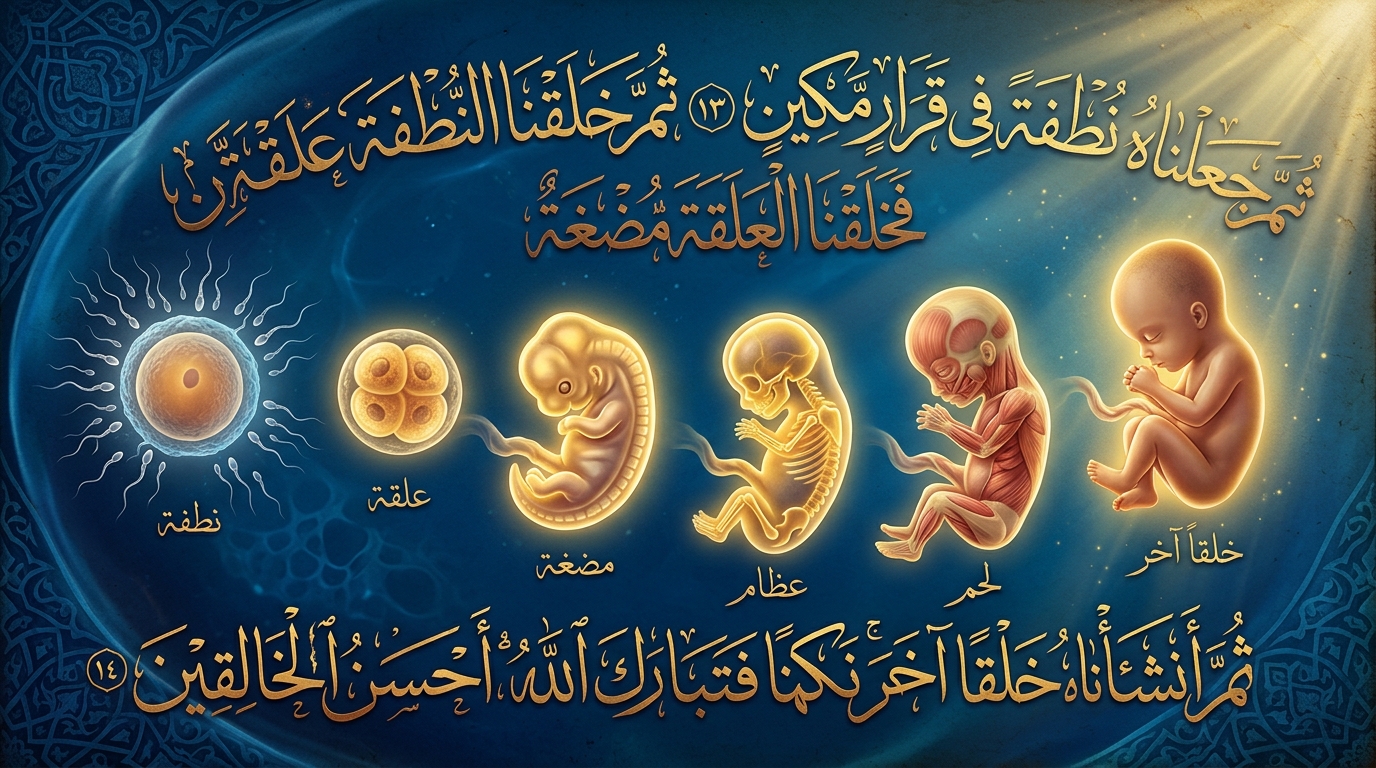
In the 7th century CE, no microscope existed. No ultrasound. No laboratory. The internal development of the human embryo inside the womb was completely invisible to any observer. Yet the Holy Quran, revealed through the Prophet Muhammad ﷺ over 1,400 years ago, describes the stages of human embryological development with a precision that modern embryologists consider extraordinary.
This is not retrofitted interpretation. These are the Quran's own Arabic words — and they match modern developmental biology with a specificity that cannot be explained by the science available in the 7th century.
1. The Quranic Verses on Embryology
Allah says in Surah Al-Mu'minun:
وَلَقَدْ خَلَقْنَا الْإِنسَانَ مِن سُلَالَةٍ مِّن طِينٍ ثُمَّ جَعَلْنَاهُ نُطْفَةً فِي قَرَارٍ مَّكِينٍ ثُمَّ خَلَقْنَا النُّطْفَةَ عَلَقَةً فَخَلَقْنَا الْعَلَقَةَ مُضْغَةً فَخَلَقْنَا الْمُضْغَةَ عِظَامًا فَكَسَوْنَا الْعِظَامَ لَحْمًا ثُمَّ أَنشَأْنَاهُ خَلْقًا آخَرَ ۚ فَتَبَارَكَ اللَّهُ أَحْسَنُ الْخَالِقِينَ
"And certainly did We create man from an extract of clay. Then We placed him as a sperm-drop (Nutfah) in a firm resting place. Then We made the sperm-drop into a clinging substance (Alaqah). Then We made the clinging substance into a lump of flesh (Mudghah). Then We made from the lump of flesh bones and clothed the bones with flesh; then We produced him as another creation. So blessed is Allah, the best of creators."
(Surah Al-Mu'minun 23:12-14)
The sequential stages of Nutfah, Alaqah (clinging clot), and Mudghah (chewed lump) align precisely with modern Carnegie embryonic staging.
2. Stage-by-Stage Scientific Analysis
Stage 1: Nutfah (نُطْفَة) — The Sperm-Drop (Weeks 1-2)
The word Nutfah literally means "a small amount of liquid" or "a trickle drop." The Quran specifies it is placed in Qarar Makin — "a firm, secure resting place" — an extraordinarily accurate description of the uterus and its mucous lining that anchors the fertilized egg.
Modern Biology Match: ✅ Perfect — Fertilized egg implants in uterine mucosa as a microscopic quantity of mixed sperm and ovum fluid.
Stage 2: Alaqah (عَلَقَة) — The Clinging Substance (Weeks 3-4)
The Arabic word Alaqah has three simultaneous meanings:
- "Something that clings" — the implanted embryo does cling to the uterine wall
- "A leech-like organism" — at 3-4 weeks, the embryo visually resembles a leech and receives nutrition by clinging to the uterine wall like a leech to skin
- "A blood clot" — the embryo at this stage is a mass of vascularizing cells that externally resembles a blood clot
        ALAQAH: THREE MEANINGS, THREE SCIENTIFIC CONFIRMATIONS

   1. "Clinging substance" ──► Embryo adheres to uterine wall via trophoblasts
   2. "Leech-like"         ──► Identical morphology shown in electron microscopy
   3. "Blood clot"         ──► External appearance: dark red, coagulated-looking mass
Professor Keith Moore, one of the world's most cited embryologists and author of The Developing Human (the standard textbook used in 60 countries), stated upon reviewing these Quranic descriptions:
"I was astonished by the accuracy of the Quranic descriptions of the embryo's appearance at different stages. The Quran described the embryo as resembling a leech at a certain stage — and when I compared this to a photograph of a leech, I was amazed by the similarity."
— Prof. Keith L. Moore, The Developing Human: Clinically Oriented Embryology, 8th Edition
Modern Biology Match: ✅ Perfect — Electron microscope images of 3-4 week embryos match the Arabic word Alaqah in all three meanings simultaneously.
Stage 3: Mudghah (مُضْغَة) — The Chewed Lump of Flesh (Weeks 5-6)
Mudghah means "something that has been chewed" — a lump that looks like it has teeth marks in it. This is one of the most striking Quranic descriptions.
Modern embryology confirms that at 5-6 weeks, the embryo:
- Has a distinctly segmented, somite structure that gives it the appearance of bite marks
- Shows 28-30 pairs of somites — segments resembling the indentations left by teeth marks
- Measures approximately 4-6mm — roughly the size of a piece of chewed flesh
Modern Biology Match: ✅ Perfect — The somite pattern of the 5-6 week embryo when photographed is indistinguishable in appearance from a chewed piece of soft tissue.
Stage 4: Bone Formation Before Muscle Cladding (Weeks 7-8)
The Quran states: "We made from the Mudghah bones, and clothed the bones with flesh."
This sequence — bone cartilage first, then muscle tissue around it — was considered by some early commentators as simply figurative. Modern embryology confirms it is literally, sequentially accurate:
| Embryological Event | Week | Quran Sequence |
|---|---|---|
| Cartilage (proto-bone) formation begins | Week 6-7 | ✅ Bone before flesh |
| Primary muscle cells attach to cartilage | Week 7-8 | ✅ Flesh "clothes" bone |
| Ossification (hardening of bone) | Week 8+ | ✅ Confirmed sequence |
Stage 5: Khalqan Akhar (خَلْقًا آخَر) — Another Creation
The Quran ends with: "Then We produced him as another creation" — marking the moment the embryo becomes a new, qualitatively different being. Embryologists identify this as the point of ensoulment — when the neural development and physical organization cross the threshold from "embryo" to "fetus" (~10-12 weeks).
3. What 7th Century Science Could Not Have Known
The 7th century Arabian Peninsula had no microscopes, no scalpels for systematic dissection, no preserved embryological specimens. The dominant Greek medical tradition (Galen, Aristotle) taught that the embryo formed from blood and semen mixing directly into a fully formed miniature human — a theory entirely wrong on every level.
The Quran's description contradicts the Greek tradition on every point and matches the modern microscope-verified reality on every point. There is no rational historical explanation for this except divine revelation.
4. Islamic Scholars Who Pioneered Embryological Research
Building on Quranic foundations, Muslim scholars advanced embryology as a medical science:
- Ibn Sina (Avicenna) — Described fetal development in Canon of Medicine, matching Quranic stages
- Ibn al-Quff (13th century) — First Muslim scholar to study capillaries and fetal circulation
- Al-Nafis — Discovered pulmonary blood circulation, prerequisite for understanding fetal oxygenation
Conclusion: A Sign from the Creator of Life
The embryological precision of the Quran is not coincidental. It cannot be the product of observation, because the processes described were invisible to human observation until the invention of the microscope in the 17th century. It cannot be borrowed from Greek science, because the Greek descriptions are fundamentally wrong while the Quran is fundamentally right.
The only coherent explanation is the one the Quran itself provides:
"He knows what is within the wombs."
(Surah Luqman 31:34)
The One who created the embryo described His creation — and every advance in embryological science has confirmed the description He revealed 1,400 years ago. All glory belongs to Allah, the Best of Creators (Ahsanu al-Khaliqeen).