

 QuranGPT
Prophetic Sleep Hygiene & Tahajjud: Chronobiology, Melatonin & Night Vigil
Discover how Prophetic sleep routines align with modern chronobiology — early sleep post-Isha, right-lateral posture, the Qailulah nap, and Tahajjud hormonal renewal.
The Holy Quran Team
Author

In an era dominated by late-night artificial blue light, chronic sleep deprivation, and disruption of natural circadian cycles, over 60% of modern adults suffer from sleep disturbances, metabolic disorders, and chronic fatigue. While modern sleep medicine continually updates guidelines on "sleep hygiene," the Holy Quran and the authentic Sunnah of the Prophet Muhammad ﷺ established a comprehensive chronobiological blueprint for restorative sleep and nocturnal rejuvenation over fourteen centuries ago.
In the Islamic worldview, sleep is not wasted time; it is a profound divine sign (Ayah), a biological necessity for physical cellular repair, and a vital spiritual threshold that prepares the believer for both worldly productivity and deep communion with Allah.
وَهُوَ الَّذِي جَعَلَ لَكُمُ اللَّيْلَ لِبَاسًا وَالنَّوْمَ سُبَاتًا وَجَعَلَ النَّهَارَ نُشُورًا
"And it is He who has made the night for you as clothing and sleep [a means for] rest and has made the day a resurrection."
— Surah Al-Furqan (25:47)
The Quranic word Subatan (from the root s-b-t) signifies a complete cessation of bodily activity, deep rest, and rejuvenation. When analyzed through modern neurobiology, endocrinology, and chronobiology, the Prophetic protocol of sleep presents an astonishingly accurate alignment with the natural circadian rhythms of human physiology.
1. The Circadian Rhythm & Early Sleep Post-Isha
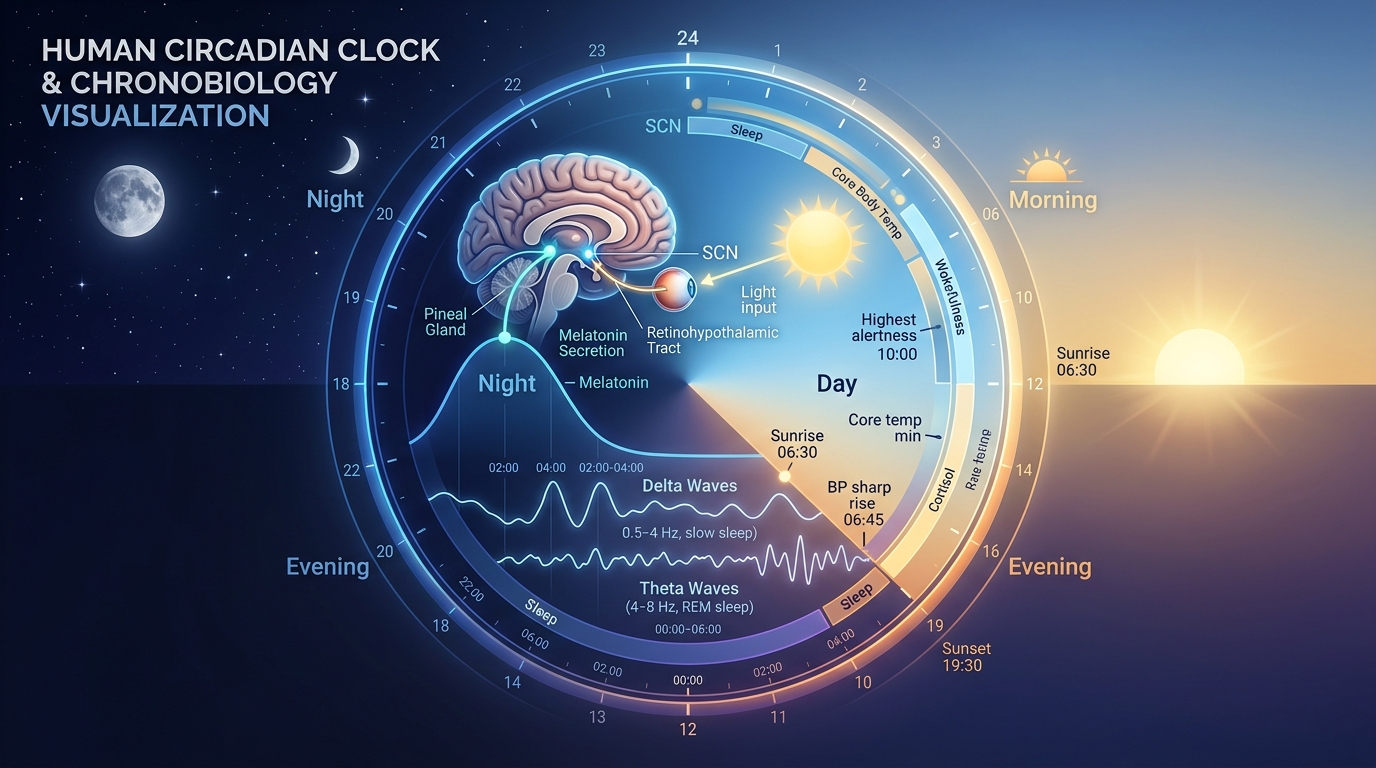
Modern chronobiology reveals that the human body is governed by an internal master clock situated in the Suprachiasmatic Nucleus (SCN) of the anterior hypothalamus. The SCN synchronizes hormonal secretions with the 24-hour solar day-night cycle.
A. The Prohibition of Late-Night Idle Talk
The Prophet Muhammad ﷺ maintained a strict nocturnal routine:
Narrated Abu Barzah (may Allah be pleased with him):
"The Messenger of Allah ﷺ used to dislike sleeping before the Isha prayer and talking (engaging in idle conversation) after it."
— Sahih al-Bukhari #568, Sahih Muslim #647
By sleeping shortly after the Isha (night) prayer, the Prophet ﷺ ensured that the initial hours of sleep coincided precisely with the biological peak of nocturnal melatonin secretion (typically between 10:00 PM and 2:00 AM).
B. Slow-Wave Deep Sleep & Glymphatic Brain Cleansing
During the first third of the night, the brain enters Slow-Wave Sleep (NREM Stage 3), characterized by synchronized delta waves ($0.5–4\text$).
- In a landmark discovery published in Science (Nedergaard et al., 2013), neuroscientists demonstrated that during slow-wave deep sleep, the brain’s Glymphatic System expands by $60%$.
- Cerebrospinal fluid rushes through interstitial brain tissue, washing away toxic metabolic waste, including neurodegenerative amyloid-beta and tau proteins.
- Staying awake past midnight drastically curtails slow-wave deep sleep, directly impairing memory consolidation, immune competence, and cognitive longevity.
2. Darkness & Environmental Sleep Hygiene in the Sunnah
Long before the invention of electric light bulbs and smartphones, the Prophet ﷺ established strict protocols for preparing the sleep environment:
Narrated Jabir bin Abdullah (may Allah be pleased with him):
The Messenger of Allah ﷺ said: "Extinguish the lamps when you go to bed at night, close the doors, tie the mouths of water-skins, and cover the food and drink..."
— Sahih al-Bukhari #3280, Sahih Muslim #2012
Photoreceptor Inhibition & Melatonin Optimization
The pineal gland synthesizes melatonin from serotonin only in the absence of light. Intrinsically photosensitive retinal ganglion cells (ipRGCs) contain melanopsin, a photopigment hypersensitive to short-wavelength blue light ($\approx 460–480\text$).
- Even faint ambient light or screen illumination before bed suppresses nocturnal melatonin release by over $50%$, causing fragmented sleep and delayed sleep onset latency.
- The Sunnah of complete darkness optimizes pineal gland function, supports deep restorative sleep, and protects nighttime cellular repair.
3. The Biomechanics of Sleep Posture: Right-Lateral Decubitus
One of the most emphasized physical instructions of the Prophet ﷺ is the posture adopted when lying down:
Narrated Al-Bara' ibn 'Azib (may Allah be pleased with him):
The Prophet ﷺ said: "When you go to bed, perform ablution (wudu) as you do for prayer, then lie down on your right side..."
— Sahih al-Bukhari #247, Sahih Muslim #2710
تَتَجَافَىٰ جُنُوبُهُمْ عَنِ الْمَضَاجِعِ يَدْعُونَ رَبَّهُمْ خَوْفًا وَطَمَعًا وَمِمَّا رَزَقْنَاهُمْ يُنفِقُونَ
"Their sides forsake their beds; they call upon their Lord in fear and hope, and they spend from what We have provided them."
— Surah As-Sajdah (32:16)
Anatomical & Cardiovascular Benefits of Sleeping on the Right Side
Modern medical physiology highlights several critical biomechanical advantages of the right lateral decubitus position:
- Cardiovascular Relief: The heart is positioned in the left hemithorax. Sleeping on the right side prevents the heavier right lung and mediastinal weight from exerting mechanical compression upon the heart, optimizing cardiac output, stroke volume, and venous return via the inferior vena cava.
- Gastric Emptying & Digestion: The anatomical curvature of the stomach allows food and digestive enzymes to settle naturally along the greater curvature without exerting upward pressure on the lower esophageal sphincter (LES), drastically reducing the risk of gastroesophageal reflux disease (GERD) and nocturnal acid reflux.
- Optimized Respiratory Airway Patency: Right-side lateral sleeping keeps the upper airway open, significantly reducing obstructive sleep apnea episodes, snoring, and intermittent nocturnal hypoxia compared to supine (back) sleeping.
The Explicit Prohibition of Prone (Stomach) Sleeping
The Prophet ﷺ explicitly warned against sleeping on one's stomach:
When the Prophet ﷺ saw a man lying on his stomach in the mosque, he nudged him and said: "This is a posture that Allah dislikes." (Sunan at-Tirmidhi #2768, Sunan Abi Dawud #5040; Graded Sahih).
Pulmonology and spinal biomechanics confirm that sleeping on the stomach forces extreme cervical spine rotation, compresses the diaphragm, causes hypoventilation, and strains the lumbar curve.
4. The Qailulah: The Prophetic Midday Power Nap
In addition to nighttime rest, Islamic tradition features the Qailulah—a brief midday rest taken before or after the Dhuhr prayer:
Narrated Anas bin Malik (may Allah be pleased with him):
The Prophet ﷺ said: "Take a midday nap (Qailulah), for the devils do not take a midday nap."
— Al-Mu'jam al-Awsat of Imam at-Tabarani #3158; Graded Hasan by Sheikh al-Albani in Sahih al-Jami' #4431
NASA & Harvard Chronobiology Research on Napping
Modern chronobiologists have identified a natural physiological dip in human alertness between 1:00 PM and 3:00 PM (the "post-prandial circadian dip"), driven by core body temperature shifts:
- A famous NASA study on fatigued pilots demonstrated that a 26-minute nap boosted cognitive performance by 34% and overall alertness by 54%.
- Research from Harvard University shows that brief naps (under 30 minutes) restore working memory, lower blood pressure, and reduce cardiovascular mortality by over $30%$ without inducing "sleep inertia" (the grogginess caused by awakening from slow-wave deep sleep).
5. The Neurobiology & Spiritual Splendor of Tahajjud
The crown jewel of Prophetic chronobiology is waking during the last third of the night for the voluntary night prayer (Tahajjud / Qiyam al-Layl).
وَمِنَ اللَّيْلِ فَتَهَجَّدْ بِهِ نَافِلَةً لَّكَ عَسَىٰ أَن يَبْعَثَكَ رَبُّكَ مَقَامًا مَّحْمُودًا
"And from [part of] the night, pray with it as additional [worship] for you; it is expected that your Lord will resurrect you to a praised station."
— Surah Al-Isra (17:79)
The Divine Descent in the Last Third of the Night
Narrated Abu Hurairah (may Allah be pleased with him):
The Messenger of Allah ﷺ said:
"Our Lord, the Blessed and Exalted, descends every night to the lowest heaven when one-third of the night remains and says: 'Who calls upon Me that I may answer him? Who asks of Me that I may give him? Who seeks My forgiveness that I may forgive him?'"
— Sahih al-Bukhari #1145, Sahih Muslim #758
Physiological & Hormonal Rejuvenation During Night Vigil
- Cortisol Awakening Response (CAR) Modulation: In the pre-dawn hours, the adrenal cortex begins its natural morning surge of cortisol to prepare the body for wakefulness. Performing Wudu (ablution with cool water) and engaging in tranquil Tahajjud recitation mitigates acute cortisol spikes, replacing stress-induced hypertension with parasympathetic vagal calm.
- Brainwave Coherence (Alpha & Theta Synchronization): In the profound quiet of pre-dawn hours, the brain operates in tranquil Alpha ($8–12\text$) and Theta ($4–8\text$) wave frequencies, heightening neuroplasticity, memory retention of Quranic verses, and emotional introspection.
- Biphasic Sleep Optimization: Waking after 4.5 to 6 hours of sleep allows the body to complete multiple 90-minute ultradian sleep cycles, awakening naturally during light NREM stages rather than groggy deep sleep.
6. The Complete Prophetic Sleep Protocol Matrix
| Prophetic Habit | Sunnah Reference | Modern Chronobiological Mechanism | Practical Health Outcome |
|---|---|---|---|
| Early Bedtime Post-Isha | Sahih al-Bukhari #568 | Maximizes Slow-Wave Deep Sleep (NREM 3). | Glymphatic brain detoxification; amyloid clearance. |
| Darkening the Room | Sahih al-Bukhari #3280 | Eliminates blue-light melanopsin stimulation. | Stimulates pineal melatonin release; deeper sleep. |
| Pre-Sleep Ablution (Wudu) | Sahih al-Bukhari #247 | Vasodilation & peripheral cooling. | Lowers core body temperature, accelerating sleep onset. |
| Right-Lateral Posture | Sahih al-Bukhari #247 | Reduces cardiac compression & optimizes gastric emptying. | Prevents GERD; maximizes pulmonary ventilation. |
| Avoiding Stomach Sleep | Sunan at-Tirmidhi #2768 | Prevents spinal torsion & hypoventilation. | Protects cervical spine; maintains open airways. |
| Midday Qailulah Nap | Al-Mu'jam al-Awsat #3158 | Aligns with circadian post-prandial alertness dip. | 34% boost in alertness; reduced cardiovascular strain. |
| Pre-Dawn Tahajjud | Sahih al-Bukhari #1145 | Balances pre-morning cortisol surge via vagal tone. | Deep psychological peace; enhanced focus & vitality. |
Conclusion
The sleep habits of the Prophet Muhammad ﷺ were not random cultural customs; they represent an extraordinary, divinely guided system of preventive medicine and spiritual elevation. By aligning our sleep patterns with the natural biological clock—sleeping early in complete darkness, resting on the right side, taking a brief midday Qailulah, and rising for the serene peace of Tahajjud—we unlock profound physical vitality, mental clarity, and spiritual closeness to the Creator.