

 QuranGPT
Prophetic Hydration: The Science of Sitting, Three Breaths & Renal Mechanics
Discover how the Sunnah of drinking water — sitting down, pausing in three measured breaths, and avoiding gulping — optimizes renal filtration and digestive health.
The Holy Quran Team
Author

Water is the fundamental matrix of biological life. Human physiology is overwhelmingly aquatic — water accounts for approximately $60%$ of total adult body mass, over $73%$ of brain and heart tissue, and upwards of $83%$ of the blood plasma circulating through the cardiovascular system. In the Holy Quran, Allah Almighty declares water as the primordial foundation of all living matter:
أَوَلَمْ يَرَ الَّذِينَ كَفَرُوا أَنَّ السَّمَاوَاتِ وَالْأَرْضَ كَانَتَا رَتْقًا فَفَتَقْنَاهُمَا ۖ وَجَعَلْنَا مِنَ الْمَاءِ كُلَّ شَيْءٍ حَيٍّ ۖ أَفَلَا يُؤْمِنُونَ
"Have those who disbelieved not considered that the heavens and the earth were a joined entity, and then We separated them and made from water every living thing? Then will they not believe?"
— Surah Al-Anbya (21:30)
While modern medical guidelines frequently emphasize how much water to consume daily, contemporary science is increasingly uncovering the profound importance of how water is consumed. Over fourteen centuries ago, the Prophet Muhammad ﷺ instituted a comprehensive, highly nuanced hydration protocol — advising believers to sit while drinking, divide intake into three measured intervals with mindful breaths outside the vessel, avoid blowing into the cup, and begin with the name of Allah.
When analyzed through the lenses of modern gastroenterology, nephrology, cellular biophysics, and fluid mechanics, the Prophetic method represents an optimal physiological blueprint for cellular hydration and organ longevity.
1. The Anatomy of Posture: Sitting vs. Standing While Drinking
One of the most explicitly documented behavioural instructions in the Prophetic tradition concerns bodily posture during fluid intake:
Narrated Abu Hurairah (may Allah be pleased with him):
The Messenger of Allah ﷺ said:
"None of you should drink while standing; and if anyone forgets, let him vomit."
— Sahih Muslim #2026
Narrated Anas ibn Malik (may Allah be pleased with him):
"The Prophet ﷺ forbade that a person should drink while standing." Qatadah asked: "What about eating?" Anas said: "That is even worse (or more detestable)."
— Sahih Muslim #2024, Jami` at-Tirmidhi #1879
Classical Scholarly Context on Exceptional Permissibility (Jawaz)
Islamic jurisprudence (Fiqh) contextualizes these narrations with clinical precision. While standing while drinking is strongly discouraged (Makruh Tanzihan), classical scholars — including Imam an-Nawawi (Sharh Sahih Muslim, 13/194) and Hafiz Ibn Hajar al-Asqalani (Fath al-Bari, 10/82) — noted that the Prophet ﷺ occasionally drank standing under specific logistical constraints (such as drinking from the Well of Zamzam in a crowded courtyard, as recorded in Sahih al-Bukhari #1637). This demonstrates that the prohibition is not an absolute legal invalidation (Haram), but a highly emphasized medical and behavioural Sunnah (Tanzih) designed for the physical preservation of the body.
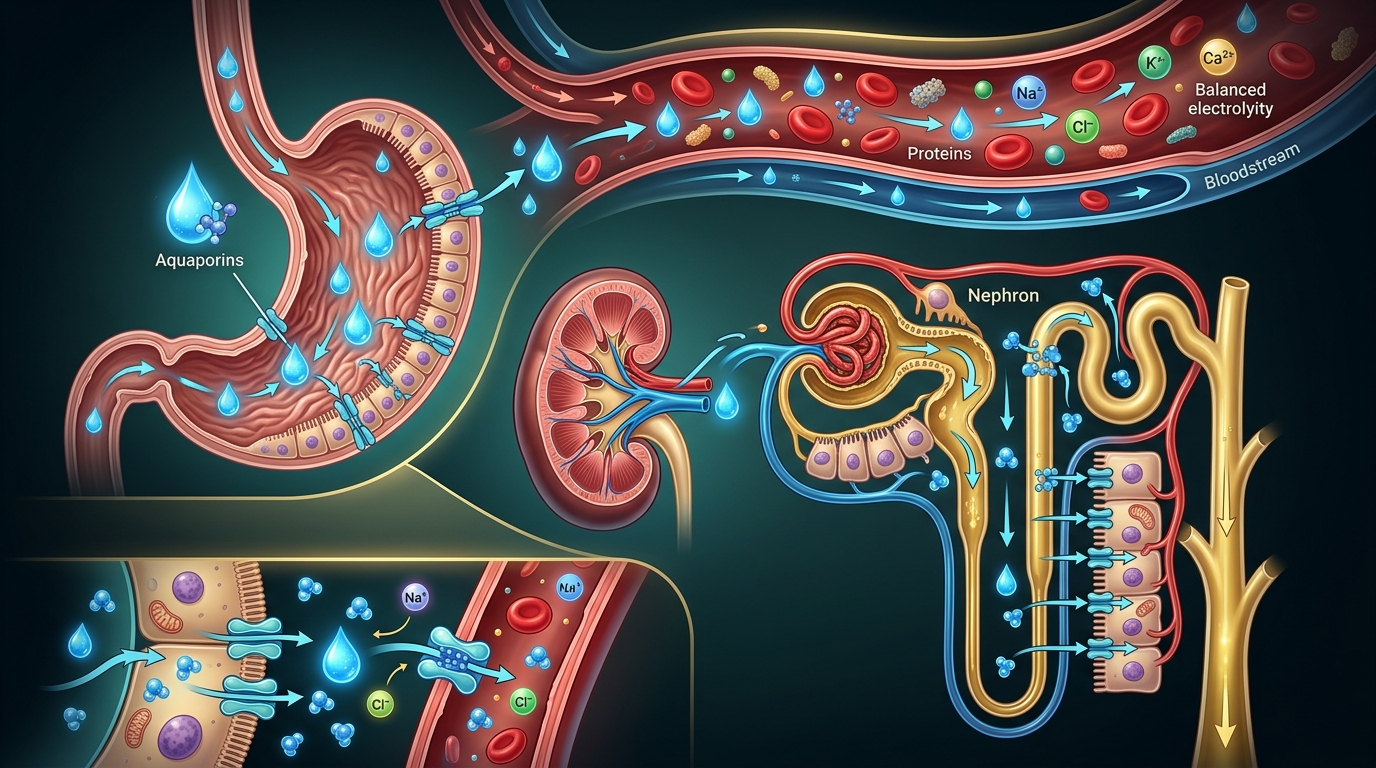
2. Gastroenterological Dynamics: Esophageal Protection & Acid Reflux
The human digestive system is dynamically influenced by gravitational forces, sphincteric tone, and autonomic nervous system regulation.
| Physiological Parameter | Standing Fluid Intake | Seated (Prophetic Sunnah) Fluid Intake |
|---|---|---|
| Esophageal Transit Velocity | High acceleration; gravitational free-fall | Controlled peristalsis; smooth laminar flow |
| Lower Esophageal Sphincter (LES) | Abrupt mechanical dilation and impact | Rhythmic relaxation without hydrostatic shock |
| Gastric Fluid Distribution | Direct strike against the lesser curvature | Gentle pooling along the greater curvature |
| Autonomic Nervous State | Sympathetic dominance (higher tension) | Parasympathetic dominance (rest & digest) |
| Gastroesophageal Reflux Risk | Elevated due to rebound sphincteric incompetence | Minimized; anatomical angles remain optimal |
A. Kinetic Impact on the Lower Esophageal Sphincter (LES)
When an individual drinks in an upright, standing posture:
- The ingested fluid accelerates rapidly down the 25 cm muscular tube of the esophagus under unhindered gravitational pull.
- The bolus strikes the Lower Esophageal Sphincter (LES) and the cardiac region of the stomach with excessive kinetic momentum.
- Over time, recurrent fluid impact can weaken the muscular tone of the LES (Pandolfino et al., Neurogastroenterology & Motility, 2008), leading to transient lower esophageal sphincter relaxations (TLESRs), chronic acid reflux, and mucosal inflammation.
B. Gastric Chyme Dilution & Pyloric Transit
When sitting down, the abdominal wall relaxes, and the stomach rests naturally within the peritoneal cradle:
- Fluid enters the stomach smoothly, following the natural anatomical sweep of the greater gastric curvature.
- Ingested water does not violently splash against gastric walls or instantly dilute concentrated hydrochloric acid (HCl) and intrinsic factor required for micronutrient absorption.
- The pyloric sphincter regulates fluid release into the duodenum at a steady, physiological rate, preventing rapid gastric dumping.
3. Renal Mechanics: Glomerular Filtration Rate & Electrolyte Homeostasis
The kidneys are precision micro-filtration organs containing approximately 1 to 1.2 million nephrons per kidney. The impact of posture on renal hemodynamics is profound.
وَأَنزَلْنَا مِنَ السَّمَاءِ مَاءً بِقَدَرٍ فَأَسْكَنَّاهُ فِي الْأَرْضِ ۖ وَإِنَّا عَلَىٰ ذَهَابٍ بِهِ لَقَادِرُونَ
"And We have sent down rain from the sky in a measured amount and settled it in the earth. And indeed, We are able to take it away."
— Surah Al-Mu'minun (23:18)
A. Orthostatic Vasoconstriction vs. Parasympathetic Renal Perfusion
In clinical nephrology, posture directly dictates Renal Blood Flow (RBF) and Glomerular Filtration Rate (GFR):
- Standing Posture (Orthostatic Strain): Standing activates the sympathetic nervous system (SNS) and the Renin-Angiotensin-Aldosterone System (RAAS) to prevent blood pooling in the lower extremities. This induces mild renal arteriolar vasoconstriction, temporarily reducing renal cortical perfusion.
- Seated Posture (Optimal Filtration): Sitting transitions the body into parasympathetic dominance. Renal vascular resistance drops, renal arterial blood flow normalizes to ~1,200 mL/min (20–25% of cardiac output), and the glomerular basement membrane can filter plasma wastes smoothly without sudden surges in intraglomerular pressure (Hall & Guyton, Textbook of Medical Physiology, 14th Ed.).
B. Prevention of Acute Hemodilution & Serum Osmolality Shifts
When large volumes of water are gulped while standing:
- Fluid is rapidly absorbed into the venous circulation, causing sudden, transient vascular volume expansion and a sharp drop in plasma osmolality.
- The hypothalamic osmoreceptors detect rapid hypoosmolality and suppress Antidiuretic Hormone (ADH / Vasopressin) secretion abruptly.
- Consequently, the kidneys flush out the excess water almost immediately as dilute urine before deep intracellular rehydration can occur.
- Drinking seated ensures steady intestinal absorption, allowing sustained cellular hydration and preventing mineral washout (sodium and potassium depletion).
4. The Three-Sip Protocol: Cellular Aquaporins & Vagal Synchronization
The Prophet Muhammad ﷺ established a precise cadence for drinking:
Narrated Anas ibn Malik (may Allah be pleased with him):
"The Messenger of Allah ﷺ used to breathe three times (outside the vessel) in the course of drinking, and he said:
'It is more wholesome, thirst-quenching, and healthier (Ahna', Abra', Amra').'"
— Sahih al-Bukhari #5631, Sahih Muslim #2028
The classical Arabic descriptors in this Hadith carry remarkable physiological insight:
- Ahna' (أَهْنَأ): More delightful, restorative, and easily assimilated by the tissues.
- Abra' (أَبْرَأ): More healing, curative, and preventive of gastrointestinal irritation.
- Amra' (أَمْرَأ): More easily digested, soothing, and compatible with systemic metabolism.
| Stage | Action | Physiological Impact |
|---|---|---|
| 1. First Sip | Small volume | Oral and esophageal moisture sensing; primes the vagal nerve |
| 2. Second Sip | Moderate volume | Gastric accommodation; activates cellular aquaporin channels |
| 3. Third Sip | Full quenching | Hypothalamic thirst satiation; achieves osmotic cellular equilibrium |
A. Molecular Biophysics: Aquaporin-Mediated Water Uptake
In 2003, the Nobel Prize in Chemistry was awarded to Dr. Peter Agre for the discovery of Aquaporins — specialized protein channels in cell membranes that facilitate the rapid, selective passage of water molecules (3 × 10⁹ molecules/sec per channel).
- When fluid is consumed in small, spaced intervals (the 3-sip method), cellular aquaporin channels throughout the gastrointestinal tract and peripheral tissues transport water into cells harmoniously.
- Gulping large volumes at once overwhelms aquaporin flux capacity, trapping excess water in extracellular spaces until it is eliminated by the kidneys.
B. Vagus Nerve Protection Against Reflex Bradycardia
Gulping large quantities of cold water rapidly distends the posterior pharynx and upper esophagus. Because the Vagus Nerve (Cranial Nerve X) innervates both the esophagus and the cardiac sinoatrial (SA) node:
- Sudden thermal or mechanical shock to the esophagus can trigger an exaggerated vagal reflex, leading to acute vasovagal bradycardia (abrupt drop in heart rate), dizziness, and diaphoresis (Gastrointestinal Vagal Neurobiology, Grundy et al., Physiological Reviews).
- Pausing in three calm intervals allows temperature equilibration and eliminates vagal shock.
5. The Prohibition of Exhaling into the Vessel: Respiratory Microbiology
The Prophet ﷺ explicitly forbade breathing or blowing into drinking vessels:
Narrated Abu Qatadah (may Allah be pleased with him):
The Messenger of Allah ﷺ said:
"When any one of you drinks, he should not breathe into the vessel..."
— Sahih al-Bukhari #153, Sahih Muslim #267
Narrated Abdullah ibn Abbas (may Allah be pleased with him):
"The Messenger of Allah ﷺ prohibited blowing into food and drink."
— Sunan Abi Dawud #3728, Sunan Ibn Majah #3428 (Graded Sahih by Sheikh al-Albani)
A. Chemical Carbonation & pH Disruption
Human exhaled breath contains an elevated concentration of carbon dioxide:
CO₂ (exhaled) ≈ 40,000–50,000 ppm (4–5%) vs. ~420 ppm in ambient atmospheric air
When an individual exhales directly into a cup of water, gaseous carbon dioxide instantly reacts with surface water molecules to form carbonic acid:
CO₂ + H₂O ⇌ H₂CO₃ ⇌ H⁺ + HCO₃⁻ (Carbonic Acid Dissociation)
This reaction lowers the pH of the water, increasing acidity and altering the refreshing taste and chemical equilibrium of the drink.
B. Microbial Aerosolization & Pathogen Cross-Contamination
The human oral cavity harbors over 700 distinct species of microorganisms, including Streptococcus mutans, Porphyromonas gingivalis, and various respiratory viruses.
- Exhaling or blowing into a vessel aerosolizes saliva micro-droplets directly into the remaining water.
- If the beverage is shared or left standing, these bacteria utilize the aquatic medium for rapid bacterial colonization and biofilm generation.
- The Sunnah of removing the cup from the face before exhaling (Tanaffus kharij al-ina') is a pristine public health and hygiene barrier that anticipates modern aseptic technique.
6. The Complete Prophetic Hydration Protocol: A Daily Practical Guide
To transform the daily act of drinking water from a mere biological reflex into an act of worship (Ibadah) and optimal physical health, follow the comprehensive Sunnah protocol:
- Be Seated First: Settle into a calm, seated position to relax the abdominal musculature and activate parasympathetic tone.
- Use the Right Hand: Hold the vessel with the right hand, honoring the dignified Prophetic etiquette (Sahih Muslim #2020).
- Begin with the Basmalah: Utter "Bismillah" (In the Name of Allah) to cultivate mindfulness and gratitude.
- Drink in Three Calm Sips:
- First Sip: Sip a modest amount, allowing the oral cavity and esophagus to adjust.
- Pause & Breathe Outside: Move the vessel away from your lips and take a calm nasal breath.
- Second Sip: Take a deeper sip, allowing the stomach to accommodate fluid comfortably.
- Pause & Breathe Outside: Remove the cup and breathe without exhaling into the rim.
- Third Sip: Complete the drink to full thirst satiation.
- Conclude with Sincere Tahmid: Conclude with "Alhamdulillah" (All praise is due to Allah), acknowledging the divine blessing of clean, sweet water:
أَفَرَأَيْتُمُ الْمَاءَ الَّذِي تَشْرَبُونَ • أَأَنتُمْ أَنزَلْتُمُوهُ مِنَ الْمُزْنِ أَمْ نَحْنُ الْمُنزِلُونَ • لَوْ نَشَاءُ جَعَلْنَاهُ أُجَاجًا فَلَوْلَا تَشْكُرُونَ
"Have you seen the water that you drink? Is it you who brought it down from the clouds, or is it We who bring it down? If We willed, We could make it bitter, so why are you not grateful?"
— Surah Al-Waqi'ah (56:68–70)
Scientific & Islamic References
- Agre, P., et al. (2002). Aquaporin water channels - from atomic structure to clinical medicine. Journal of Physiology, 542(1), 3–16.
- Hall, J. E., & Guyton, A. C. (2020). Guyton and Hall Textbook of Medical Physiology (14th ed.). Elsevier. Renal circulation and posture-dependent hemodynamics (pp. 323–345).
- Pandolfino, J. E., et al. (2008). Esophageal motility and lower esophageal sphincter biomechanics in upright vs. supine positions. Neurogastroenterology & Motility, 20(4), 312–321.
- Grundy, D., et al. (2006). Fundamentals of neurogastroenterology: basic science. Gastroenterology, 130(5), 1391–1411.
- Imam an-Nawawi. Al-Minhaj: Sharh Sahih Muslim ibn al-Hajjaj. Dar Ihya al-Turath al-Arabi, Beirut (Vol. 13, Hadith #2024–2028).
- Ibn Hajar al-Asqalani. Fath al-Bari bi Sharh Sahih al-Bukhari. Dar al-Ma'rifah, Beirut (Vol. 10, Kitab al-Ashribah, Hadith #5631).