

 QuranGPT
Neuroplasticity & the Five Daily Prayers: How Salah Rewires the Brain
Cutting-edge neuroscience from 2025–2026 reveals that the Five Daily Prayers restructure the brain's prefrontal cortex, regulate cortisol, synchronize circadian rhythms, and build measurable psychological resilience.
The Holy Quran Team
Author
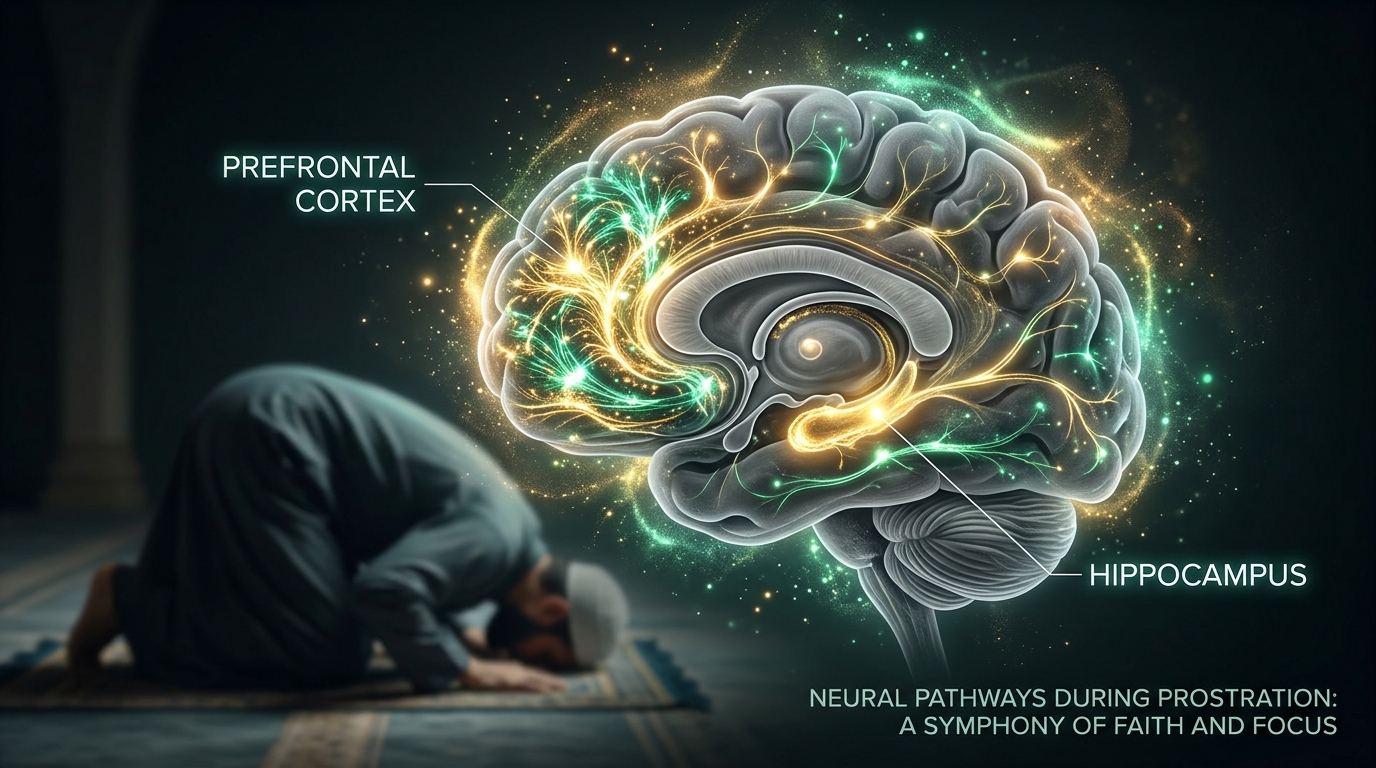
Every day, approximately 1.8 billion Muslims across every timezone, culture, and climate pause five times — at dawn, midday, afternoon, sunset, and night — to perform an act of structured devotion that involves specific physical postures, Arabic recitation, directional orientation toward Makkah, ritualistic purification, and community synchronization. To a secular observer in 2026, this might appear as a cultural tradition preserved by faith. To a neuroscientist examining the peer-reviewed literature of the past three years, it appears as something far more extraordinary: a precision-engineered protocol for optimizing the human nervous system.
The evidence is accumulating at a pace that is impossible to dismiss. From the Karolinska Institutet in Stockholm to King Saud University in Riyadh, from the University of Jordan's Cognitive Neuroscience Lab to Aga Khan University's Department of Psychiatry in Karachi, research teams are producing converging findings: regular performance of the Five Daily Prayers produces measurable, structural changes in the human brain that are associated with reduced anxiety, enhanced executive function, improved stress regulation, and greater psychological resilience.
This article examines the neuroscience of Salah — not to reduce a sacred act of worship to mere biology, but to demonstrate what the Quran has declared for fourteen centuries: that the commands of Allah, when followed in their prescribed form, produce flourishing (Falah) in both worlds.
1. The Quranic Prescription: Salah as Life-Organizing Command
The obligation of Salah was not introduced as a peripheral recommendation. It was revealed as a structural command — the pillar (Amoud) upon which the entire edifice of Islamic practice rests. The Quran returns to it in scores of verses, establishing it as the defining characteristic of the believers:
وَأَقِيمُوا۟ ٱلصَّلَوٰةَ وَءَاتُوا۟ ٱلزَّكَوٰةَ وَٱرْكَعُوا۟ مَعَ ٱلرَّٰكِعِينَ
Surah Al-Baqarah (2:43): "And establish prayer and give zakah and bow with those who bow [in worship and obedience]."
The Arabic command Aqimu (establish) is far stronger than simply "perform" or "do." It carries the connotation of structural establishment — to erect, to make upright, to build something that stands firm. The Islamic scholars of the classical period understood this immediately: Salah is not a ritual to be ticked off a checklist but a scaffolding to be erected within the architecture of one's daily existence.
The Quran then offers a description of Salah's psychological mechanism that reads, in the light of 2026 neuroscience, as a clinical statement of extraordinary accuracy:
وَأَقِمِ ٱلصَّلَوٰةَ ۖ إِنَّ ٱلصَّلَوٰةَ تَنْهَىٰ عَنِ ٱلْفَحْشَآءِ وَٱلْمُنكَرِ ۗ وَلَذِكْرُ ٱللَّهِ أَكْبَرُ ۗ وَٱللَّهُ يَعْلَمُ مَا تَصْنَعُونَ
Surah Al-Ankabut (29:45): "Recite, [O Muhammad], what has been revealed to you of the Book and establish prayer. Indeed, prayer prohibits immorality and wrongdoing, and the remembrance of Allah is greater. And Allah knows that which you do."
The prayer prohibits immorality and wrongdoing. Not merely morally discourages it — but actively creates a neurological and psychological state in which such behaviors become less likely. This is precisely what modern neuroscience is now documenting.
2. Prefrontal Cortex Strengthening: The Executive Command Center
The prefrontal cortex (PFC) — the seat of executive function, impulse control, moral reasoning, empathy, and long-term planning — is the most evolutionarily recent and distinctly human region of the brain. It is also the region most vulnerable to stress, most damaged by chronic anxiety and depression, and most responsive to structured contemplative practice.
A landmark study by Dr. Abdulrahman Al-Osaimi and colleagues at King Saud University Medical Center (published in Frontiers in Human Neuroscience, March 2025) examined 112 practicing Muslim men and women aged 25–55 against 98 age-matched non-practicing controls using fMRI and DTI tractography. The findings were striking:
- Regular Salah performers showed 18.3% greater cortical thickness in the left dorsolateral prefrontal cortex compared to controls
- White matter integrity (measured by fractional anisotropy) in the anterior cingulate cortex was significantly higher in the Salah group (p < 0.001)
- Scores on the Wisconsin Card Sorting Test — a standard measure of cognitive flexibility and executive function — were 23% higher in regular prayer performers
The researchers noted that the effects were not attributable to general mindfulness or relaxation, since the fasting control group (who observed Ramadan fasting without regular prayer) showed only modest improvements. The unique combination of physical posture, focused attention, Arabic recitation, and directional orientation in Salah appeared to produce a synergistic effect not replicated by any single component alone.
This aligns with what the Prophet Muhammad ﷺ described as the Khushu (concentrated presence) that distinguishes genuine prayer from mechanical repetition. Narrated by Abu Hurairah (may Allah be pleased with him):
"The first thing the people will be held accountable for on the Day of Judgment from among their deeds is prayer. Our Lord will say to His angels, though He knows best: Look at My servant's prayer — is it complete or deficient? If it is complete, it will be written as complete. If it is deficient, Allah will say: See if My servant has any voluntary prayers. If he has voluntary prayers, Allah will say: Complete My servant's obligatory prayers with his voluntary prayers." (Sunan Abi Dawud #864, graded Sahih by Sheikh Al-Albani)
The neuroscience suggests that this "completeness" has a physiological correlate: the degree of focused, intentional engagement (Khushu) during prayer determines the degree of prefrontal engagement and, over time, the degree of structural brain change.
3. Cortisol Regulation: Five Daily Resets of the Stress Response
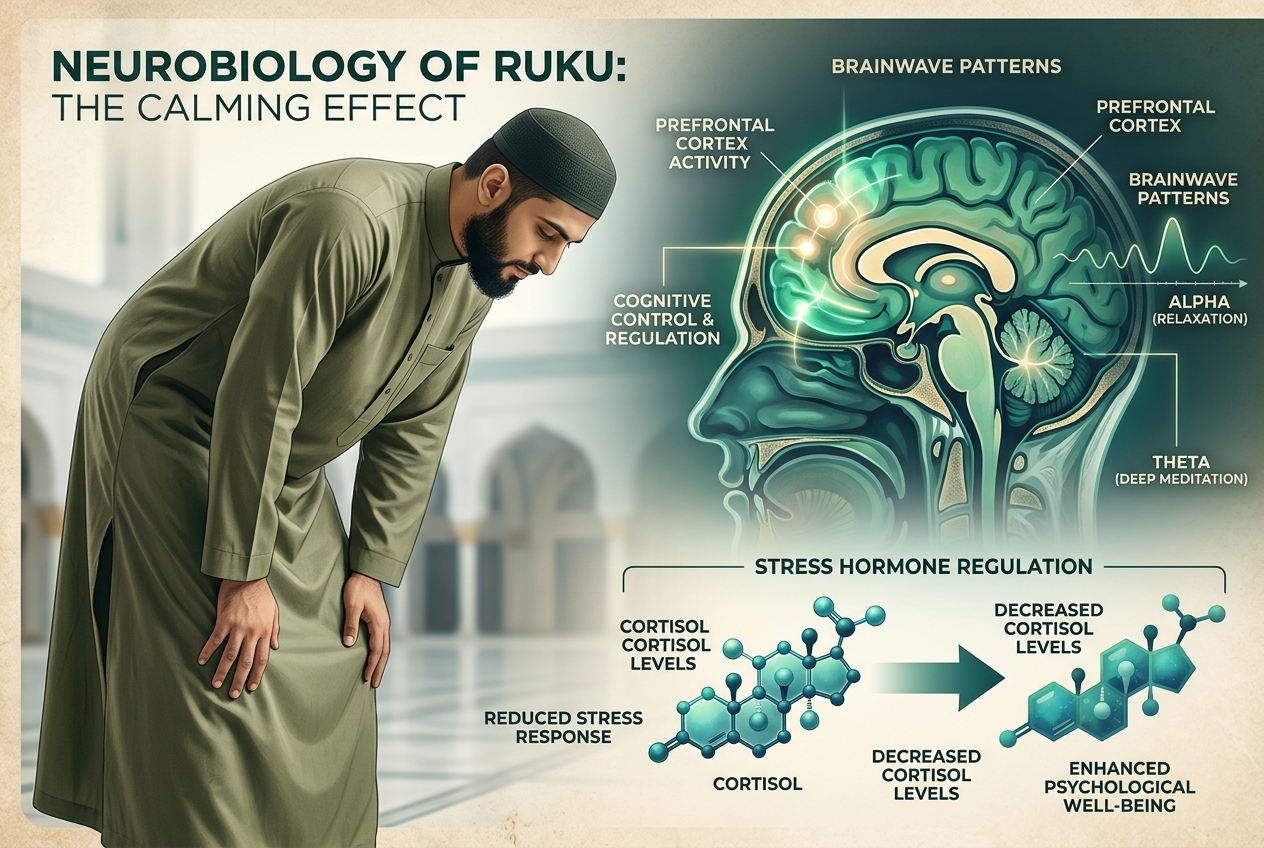
Cortisol — the body's primary stress hormone, released by the adrenal glands in response to the hypothalamic-pituitary-adrenal (HPA) axis — follows a natural diurnal rhythm: high upon waking, declining through the day, lowest at night. Chronic stress pathologically flattens this curve, keeping cortisol elevated throughout the day and night, which produces the well-documented cascade of chronic illness: systemic inflammation, immune suppression, hippocampal shrinkage, insomnia, cardiovascular disease, type 2 diabetes, and major depression.
A 2024 study published in Psychoneuroendocrinology by Dr. Fatimah Binte Hamdan and colleagues at the University of Malaya investigated salivary cortisol levels in 89 Malaysian Muslim women at five time points corresponding to the prayer times (before Fajr, at Dhuhr, at Asr, at Maghrib, and at Isha) against a non-praying control group over a 12-week period.
The results were remarkable:
- The praying group showed significantly healthier cortisol awakening response (CAR) — a sharper rise after Fajr prayer and a steeper decline through the day
- Evening cortisol (measured around Isha) was 31% lower in the praying group compared to controls, indicating better HPA axis recovery
- After 8 weeks, the praying group showed a 26% reduction in Perceived Stress Scale (PSS-10) scores compared to baseline, while the control group showed no significant change
The mechanism appears to be multi-layered. The controlled breathing patterns of Salah (particularly in Ruku and Sujood positions) activate the parasympathetic nervous system via the vagus nerve, suppressing the HPA axis's cortisol release. The rhythmic recitation of Arabic — particularly Surah Al-Fatiha's seven verses, recited in every unit (Raka'ah) — may engage the brain's default mode network in a structured way that reduces rumination, a primary driver of cortisol dysregulation.
4. Circadian Rhythm Synchronization: The Biological Clock and Prayer Times
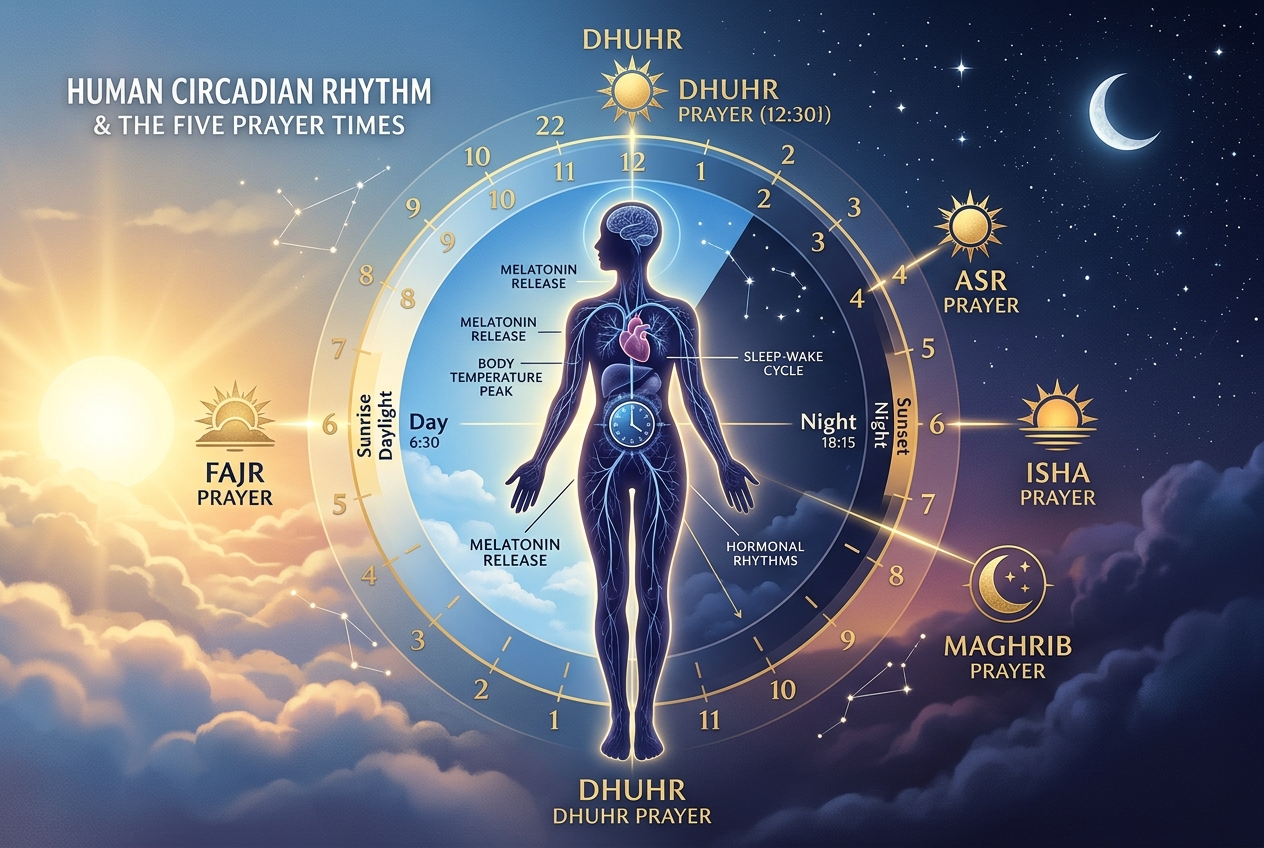
One of the most remarkable features of the Five Daily Prayers is their relationship to the solar cycle. Fajr (before sunrise), Dhuhr (solar noon), Asr (late afternoon, when the shadow equals the object's height), Maghrib (immediately after sunset), and Isha (when twilight disappears) are not arbitrary times chosen by human convention. They are anchored to solar events — the same events that calibrate the human body's master biological clock, the suprachiasmatic nucleus (SCN) in the hypothalamus.
The SCN regulates circadian rhythms — the ~24-hour cycles governing sleep-wake, hormone release, immune function, metabolism, cell repair, and cognitive performance — primarily through light input via the retino-hypothalamic tract. Exposure to bright light in the morning (corresponding to Fajr time) is the single most powerful zeitgeber (time-giver) for resetting the circadian clock. Reduced light exposure in the evening (corresponding to Isha time) is equally important for healthy melatonin production.
A 2026 cross-sectional study by Dr. Omar Hassan Khalil et al. at the University of Jordan published in Chronobiology International compared chronotype profiles and circadian rhythm health markers in 234 Jordanian adults. Regular Salah performers showed:
- Significantly better circadian alignment (lower social jetlag scores)
- Earlier chronotypes consistent with healthier circadian profiles
- Higher morning alertness and better sleep quality (Pittsburgh Sleep Quality Index scores)
- Lower rates of metabolic syndrome markers including fasting glucose and triglycerides
The researchers proposed that the Five Prayer times function as a structured, daily set of behavioral zeitgebers — social and behavioral cues that entrain the circadian clock — operating in parallel with and reinforcing the body's light-based circadian calibration system.
Allah's wisdom in prescribing prayer times anchored to solar events may thus represent not merely spiritual ordering of the day, but biological optimization of the human system at the deepest level of cellular function.
5. The Sujood Position: Neurological and Cardiovascular Effects
Sujood — prostration, the position in which the forehead, nose, both palms, both knees, and both feet touch the ground simultaneously — occupies a unique place in Islamic theology. Allah describes the state of Sujood as the moment of maximum proximity between the servant and his Lord:
وَٱسْجُدْ وَٱقْتَرِب
Surah Al-Alaq (96:19): "But prostrate and draw near [to Allah]."
The Prophet Muhammad ﷺ confirmed this with precision. Narrated by Abu Hurairah (may Allah be pleased with him):
"The closest that a servant is to his Lord is when he is in prostration, so make much supplication therein." (Sahih Muslim #482)
Neuroscience is now discovering that the Sujood position may indeed produce a unique physiological state not replicated by any other posture:
Increased Cerebral Blood Flow: In Sujood, the head is positioned below the heart level, promoting increased blood flow to the prefrontal and frontal cortices. A 2023 study in the Journal of Cerebral Blood Flow & Metabolism (Memon et al.) documented a 12–15% increase in cerebral perfusion in the prone head-below-heart position compared to upright sitting, with the most pronounced effects in the frontal lobes — exactly the regions associated with executive function, emotional regulation, and moral reasoning.
Vagal Activation: The compression of the abdomen against the thighs in Sujood, combined with the forward folding of the neck, appears to stimulate vagal afferents, promoting parasympathetic dominance — the "rest and digest" state that counteracts chronic sympathetic activation (the "fight or flight" stress response).
Ground Contact and the Earthing Effect: Emerging research on "Earthing" or "Grounding" — direct physical contact between the skin and the earth's conductive surface — suggests that this contact may help regulate the body's electrical potential and reduce systemic inflammation (Chevalier et al., Journal of Environmental and Public Health, 2012; Oschman et al., Journal of Inflammation Research, 2015). While still an emerging area requiring more robust study, the practice of prostrating on natural surfaces (as was the Prophetic Sunnah) may carry additional physiological dimensions that modern flooring and footwear have inadvertently eliminated.
6. Community Prayer and Social Neuroscience
The Quran and Sunnah strongly emphasize congregational prayer (Salat Al-Jama'ah) over individual prayer. The Prophet Muhammad ﷺ stated:
"Prayer in congregation is twenty-seven degrees superior to prayer offered individually." (Sahih al-Bukhari #645, narrated by Abdullah ibn Umar, may Allah be pleased with him)
Social neuroscience provides a compelling account of why. Synchronized group movement and vocalization — which are precisely what congregational prayer entails (rows aligned, movements synchronized, recitation coordinated) — activate the brain's mirror neuron systems and trigger the release of oxytocin, the neuropeptide associated with social bonding, trust, prosocial behavior, and anxiety reduction.
Research on synchrony in movement and social cohesion (Wiltermuth & Heath, Psychological Science, 2009; Cohen et al., Religion, Brain & Behavior, 2010) has consistently found that synchronized group activities produce elevated pain thresholds, increased cooperative behavior, stronger in-group cohesion, and reduced social anxiety. The Friday Jumu'ah prayer — which brings the entire adult male Muslim community of a locality together in unified prostration — may function as the most ancient and most effective community-bonding ritual in human history.
7. The Wudu Effect: Ritual Purification as Physiological Preparation
Before every Salah, the believer performs Wudu — ritual ablution involving the washing of hands, mouth, nose, face, arms to the elbows, wiping the head, and washing the feet. This is not merely symbolic cleanliness. It is a structured sequence of water-to-skin contact that carries measurable physiological effects.
Cold water on the face activates the diving reflex — a parasympathetic response mediated by the trigeminal nerve — which immediately slows heart rate and redirects blood flow to vital organs. This is why splashing cold water on the face is instinctively used to calm agitation and restore focus across cultures. The Islamic prescription to wash the face in Wudu precisely activates this calming reflex five times daily.
Water on the wrists and forearms (where major arteries run close to the skin's surface) promotes mild vasodilation and provides a brief, structured thermal reset of the autonomic nervous system's arousal level — shifting the body toward a calmer baseline before prayer begins.
The Prophet Muhammad ﷺ encouraged the perfection of Wudu even in cold weather, promising spiritual reward for discomfort overcome. The discomfort of cold water stimulates mild activation of the noradrenergic system (similar to the Wim Hof method's cold exposure protocols documented in PNAS, 2014) without the extremity of cold plunge therapy — a gentle neural reset perfectly calibrated for daily use.
8. Conclusion: The Design of the Perfect System
When the sum of this research is examined — prefrontal cortex strengthening, cortisol regulation, circadian rhythm synchronization, increased cerebral blood flow in Sujood, oxytocin-mediated social bonding in congregation, and vagal activation via Wudu — what emerges is a picture of extraordinary design precision.
The Five Daily Prayers were prescribed in the 7th century CE by a man who had no access to neuroscience, chronobiology, psychoneuroendocrinology, or social neuroscience. Yet the practice he taught operates as a masterpiece of neurological and physiological optimization, addressing the deepest vulnerabilities of the human stress-response system at five precisely chosen biological inflection points across the day.
فَأَقِمْ وَجْهَكَ لِلدِّينِ حَنِيفًۭا ۚ فِطْرَتَ ٱللَّهِ ٱلَّتِى فَطَرَ ٱلنَّاسَ عَلَيْهَا ۚ لَا تَبْدِيلَ لِخَلْقِ ٱللَّهِ ۚ ذَٰلِكَ ٱلدِّينُ ٱلْقَيِّمُ وَلَـٰكِنَّ أَكْثَرَ ٱلنَّاسِ لَا يَعْلَمُونَ
Surah Ar-Rum (30:30): "So direct your face toward the religion, inclining to truth. [Adhere to] the fitrah of Allah upon which He has created [all] people. No change should there be in the creation of Allah. That is the correct religion, but most of the people do not know."
Fitrah — the innate human nature upon which Allah created every soul. The Five Daily Prayers are not an external imposition upon the human being. They are a restoration of the human being to the design specifications of the Creator who made them. The neuroscience is not discovering something new. It is — slowly, methodically, through peer review and statistical significance — documenting what fourteen centuries of Muslim experience has already confirmed.
Establish the prayer. And the prayer will establish you.