

 QuranGPT
The Twilight of a Cosmic Sentinel: NASA's Swift Space Observatory Prepares for Atmospheric Reentry After Two Decades of Gamma-Ray Discoveries
A comprehensive astrophysics and space mission report on NASA's Neil Gehrels Swift Observatory, analyzing the cancellation of the 'Swift Boost' orbital re-boosting mission, its legendary 22-year legacy cataloging cosmic gamma-ray bursts, and controlled atmospheric reentry physics.
The Holy Quran Team
Author
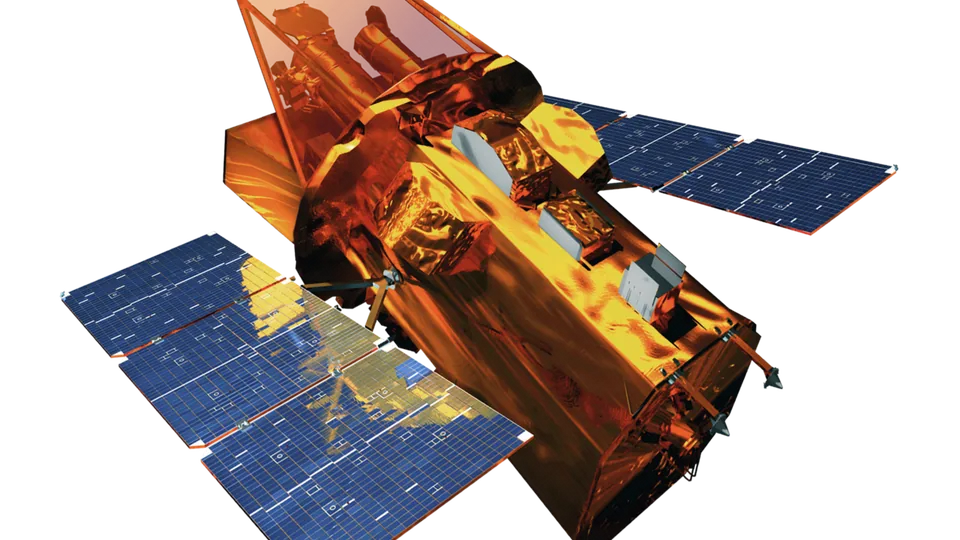
In a poignant moment for the global astronomical community, the National Aeronautics and Space Administration (NASA) has officially announced the conclusion of the Neil Gehrels Swift Observatory mission after more than two decades of revolutionary deep-space astrophysics, confirming that the spacecraft will undergo a controlled orbital decay and atmospheric reentry over the coming months.
Launched on November 20, 2004, the 1,470-kilogram robotic space observatory was initially designed for a two-year nominal mission. However, its exceptional engineering reliability and agile autonomous slew capabilities allowed it to operate continuously for nearly 22 years, revolutionizing humanity's understanding of Gamma-Ray Bursts (GRBs)—the most luminous, violent electromagnetic explosions in the universe.
The decision follows the technical cancellation of the proposed $30 Million "Swift Boost" commercial servicing mission, which had aimed to dock an autonomous propulsion tug to elevate the telescope's altitude from its current degrading 390-kilometer low Earth orbit (LEO).
1. Technological Architecture of the Swift Robotic Slewing Engine
Swift was uniquely engineered as an agile, multi-wavelength rapid-response space telescope capable of autonomously swiveling across the sky within 20 to 75 seconds of detecting a high-energy cosmic explosion:
graph TD
    A["Deep Space Gamma-Ray Burst (GRB) Occurs in Distant Galaxy"] --> B["BAT (Burst Alert Telescope): Wide-Field Hard X-Ray Sensor Detects Flash"]
    B --> C["On-Board Autonomous Flight Computer Calculates Sky Coordinates in 12 Seconds"]
    C --> D["High-Speed Reaction Wheels Rapidly Slew Spacecraft Toward Target (<60s)"]
    D --> E["Narrow-Field XRT (X-Ray Telescope) & UVOT (UV/Optical Telescope) Capture Afterglow"]
    E --> F["Immediate Global Broadcast to Terrestrial Observatories via GCN Network"]
Tri-Instrument Payload:
- Burst Alert Telescope (BAT): A wide-field coded-aperture mask array capable of monitoring one-sixth of the entire sky simultaneously for fleeting, millisecond gamma-ray transients.
- X-Ray Telescope (XRT): High-resolution grazing-incidence Wolter-I optics capturing the fading thermal X-ray glow of collapsing stellar cores.
- Ultraviolet/Optical Telescope (UVOT): Measuring precise photometric light curves and redshift distances of host galaxies billions of light-years away.
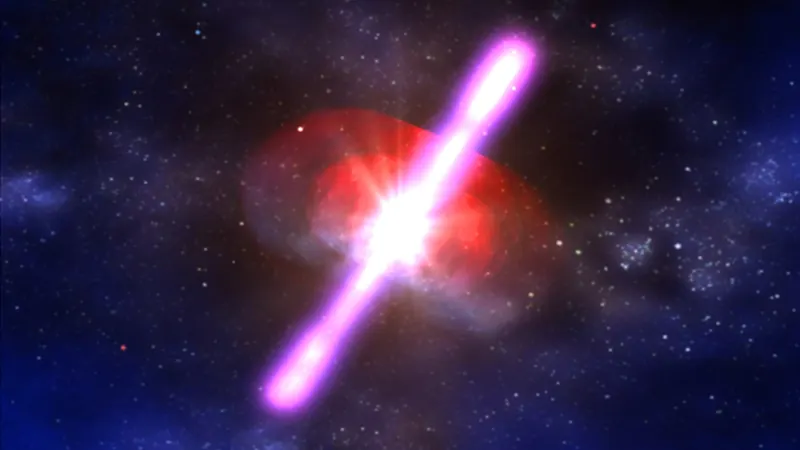 NASA's Neil Gehrels Swift Observatory captured thousands of gamma-ray bursts across 22 years in orbit.
2. Monumental Scientific Discoveries Across Two Decades
Swift’s continuous operation reshaped modern high-energy astrophysics and cosmology:
| Milestone Discovery / Event | Year | Scientific Impact on Astronomy |
|---|---|---|
| Solving the Short GRB Mystery | 2005 | Proved that millisecond short GRBs are caused by colliding binary neutron stars (kilonovae). |
| GRB 090423: Ancient Cosmic Dawn | 2009 | Captured a stellar collapse from when the universe was only 630 million years old (Redshift $z = 8.2$). |
| Tidal Disruption Events (TDEs) | 2011 | Recorded the exact moment a supermassive black hole ripped apart and swallowed a passing star. |
| The "BOAT" (Brightest of All Time) | 2022 | Detected GRB 221009A, a once-in-10,000-year explosion that ionized Earth's upper ionosphere. |
3. Atmospheric Reentry Physics and Controlled Orbital Decay
As solar maximum activity in 2024-2026 heated and expanded Earth’s upper thermosphere, aerodynamic drag on the spacecraft increased exponentially:
- Current Orbital Altitude: Decaying at approximately 450 meters per day from an altitude of 390 kilometers.
- Atmospheric Demise: Upon reaching the dense mesosphere (approximately 80 km altitude), extreme aerodynamic compression heating exceeding 2,500°C will vaporize the solar arrays and aluminum structural trusses.
- Uninhabited Ocean Splashdown: Any surviving dense titanium components (such as reaction wheel flywheels) are projected to impact safely in the uninhabited waters of the South Pacific Ocean (Point Nemo).
4. Conclusion: The Eternal Legacy of Neil Gehrels Swift
Though its physical hardware will soon dissolve into a brilliant shooting star over the Pacific, Swift’s scientific data archive—comprising over 1,600 detected gamma-ray bursts and millions of multi-wavelength observations—will continue to fuel astronomical research for centuries.
Swift demonstrated that when human ingenuity dares to gaze into the dynamic, explosive cosmos, the universe yields its deepest secrets—inspiring future generations of astrophysicists to build the next generation of space observatories to explore the infinite frontier.