

 QuranGPT
The Miracle of Human Fingerprints in the Quran: Surah Al-Qiyamah (75:4) & Forensic Science
Discover how the Quran singled out human fingertips (Bananah) in Surah Al-Qiyamah (75:4) 1400 years before modern forensic dactyloscopy proved their absolute individuality.
The Holy Quran Team
Author
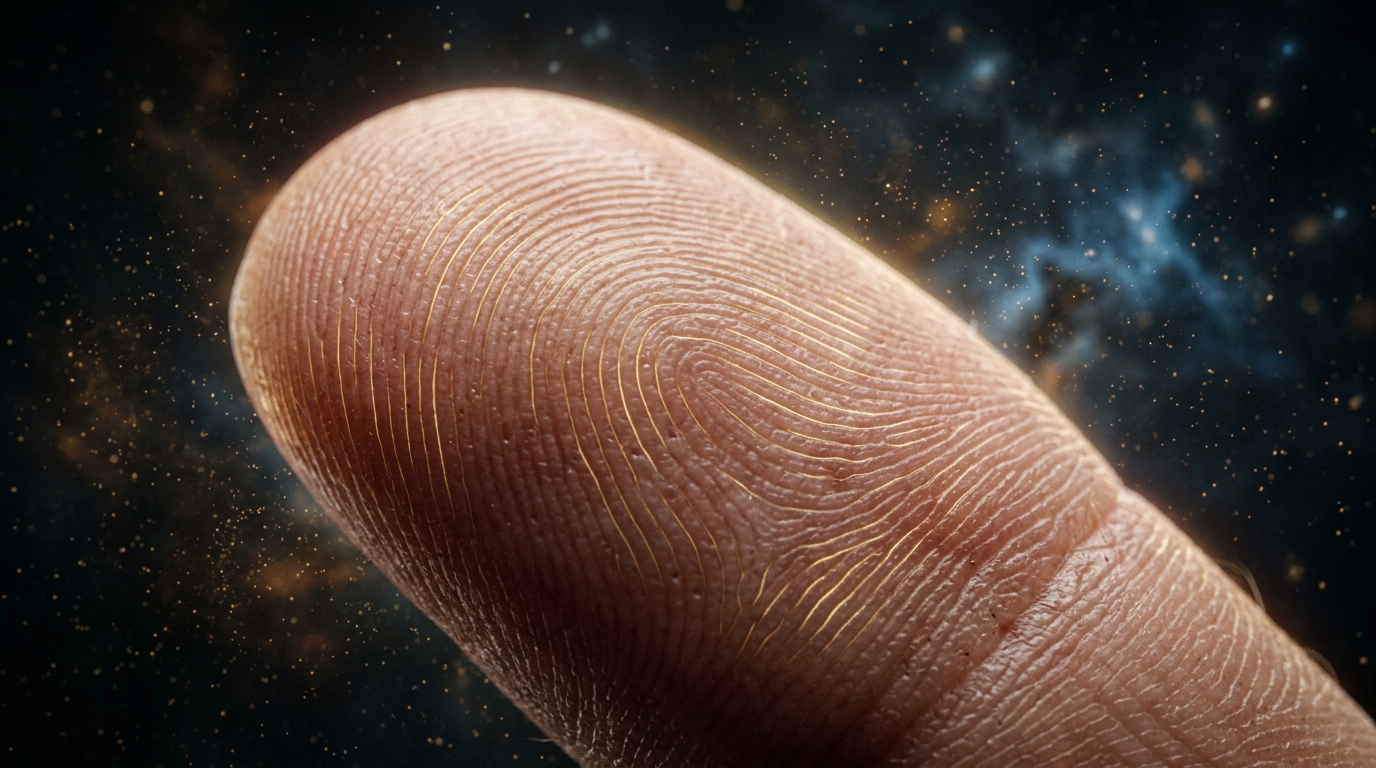
When 7th-century skeptics in the Arabian peninsula questioned the reality of bodily resurrection, their doubts centered on the apparent impossibility of reassembling decayed remains. They asked: once bones turn to dust and disintegrate into the soil, how could an individual be reconstituted with exact personal identity?
In response, the Quran delivered a profound rhetorical and scientific statement in Surah Al-Qiyamah (75:3–4). Rather than simply asserting the reconstruction of massive skeletal frameworks, the divine revelation singled out the most delicate, intricate, and uniquely identifying extremity of the human anatomy: the fingertips (Bananah).
أَيَحْسَبُ الْإِنسَانُ أَلَّن نَّجْمَعَ عِظَامَهُ
"Does man think that We will not assemble his bones?"
— Surah Al-Qiyamah (75:3)
بَلَىٰ قَادِرِينَ عَلَىٰ أَن نُّسَوِّيَ بَنَانَهُ
"Yes, [We are] Able to reconstruct his fingertips in perfect order."
— Surah Al-Qiyamah (75:4)
Why did the Creator specifically emphasize the fingertips when demonstrating the absolute perfection of resurrection? For over twelve centuries, classical commentators recognized this verse as an affirmation of Allah’s infinite precision down to the smallest anatomical joints. Yet it was not until the late 19th century that modern forensic science discovered the breathtaking reality: the human fingertip carries an indelible, unforgeable, and mathematically unique physical signature that distinguishes every human being who has ever lived.
🔍 The Classical Linguistic Exegesis of Banan (بَنَان)
In classical Arabic lexicography, words carry immense surgical precision. Classical authorities such as Ibn Manzur in Lisan al-Arab and Ibn Faris in Mu'jam Maqayis al-Lughah define Banan (بَنَان) specifically as the tips of the fingers and toes, the terminal joints (Al-Anamil), and the fine extremities of the limbs.
The verb used in the verse, Nusawwiya (نُسَوِّيَ), originates from the root sa-wa-ya (س-و-ي), meaning to fashion in perfect proportions, to restore to complete symmetry, and to balance every intricate contour without flaw.
Classical Tafsir Insights
- Tafsir Ibn Kathir (d. 774 AH):
Imam Ibn Kathir notes in his commentary on Surah Al-Qiyamah (75:4) that the disbelievers thought reassembling bones was impossible. Allah answered that His power is not merely sufficient to gather large bones, but capable of bringing back the finest, most delicate extremities—the fingertips and joints—in complete perfection. - Tafsir al-Qurtubi (d. 671 AH):
Imam al-Qurtubi explains that the human hand is composed of small, delicate joints and fine lines. Reconstructing these minute elements proves complete sovereign mastery over the entire organism. - Tafsir al-Sa'di (d. 1376 AH):
Sheikh Abdur-Rahman al-Sa'di states that taswiyat al-banan signifies putting together every subtle detail of the human form, leaving nothing omitted or disordered on the Day of Reckoning.
🔬 The Scientific Timeline: From Obscurity to Forensic Dactyloscopy
Throughout ancient and medieval history, human hands and fingers were viewed merely as tools for grasping. While ancient Babylonians and Chinese artisans occasionally used thumbprints on clay seals for contracts, the biological principle of friction ridge uniqueness (dermatoglyphics) remained completely unknown to medical science until modern times.
The systematic scientific recognition that no two humans possess identical fingerprints took over a millennium after the Quranic revelation:
| Milestone Year | Pioneer / Publication | Key Scientific & Forensic Breakthrough |
|---|---|---|
| 610 CE | The Holy Quran | Surah Al-Qiyamah (75:4) highlights the reconstruction of Bananah (fingertips) as the pinnacle of individual anatomical restoration. |
| 1823 | Jan Evangelista Purkyně | Professor of Anatomy at the University of Breslau; published the first physiological treatise classifying 9 distinct friction ridge patterns. |
| 1858 | Sir William Herschel | Civil servant in Bengal, India; first to systematically implement palm and finger impressions on legal contracts to eliminate identity fraud. |
| 1880 | Dr. Henry Faulds | Scottish physician working in Tokyo; published a landmark paper in Nature demonstrating that fingerprints are permanent, unique, and vital for crime investigation. |
| 1892 | Sir Francis Galton | Published Finger Prints; established Galton details (minutiae) and calculated the mathematical probability of two identical prints at 1 in 64 billion. |
| 1897–1901 | Sir Edward Henry & Juan Vucetich | Formulated the standardized Henry Classification System, adopted by Scotland Yard and police agencies worldwide. |

🧬 Embryological Morphogenesis: Why Every Fingerprint Is Unique
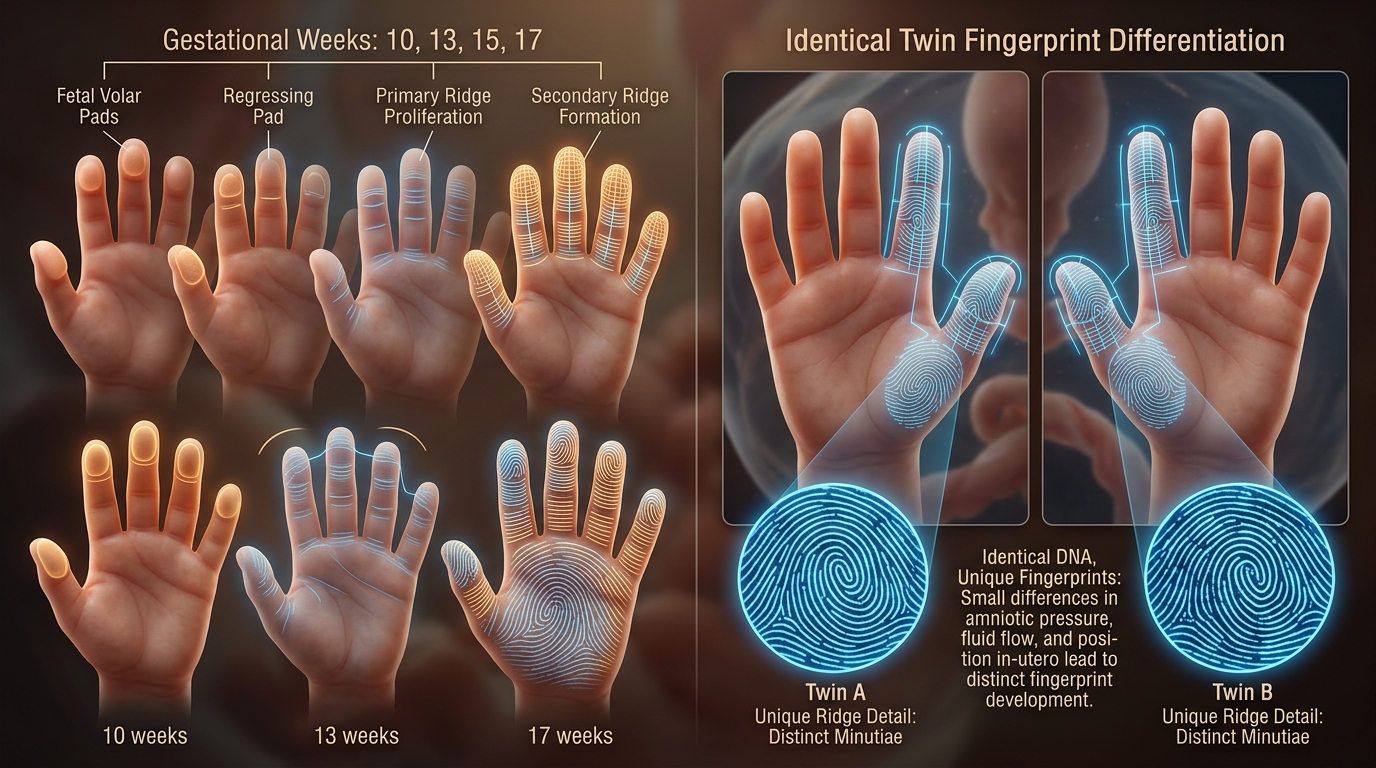
How does the human body forge this personal identity card before birth? Modern embryology reveals that fingerprint patterns are formed deep within the womb between the 10th and 24th weeks of gestation.
1. Volar Pad Topography
Around the 10th week of fetal development, small localized swelling cushions called volar pads emerge on the fetal palms and fingertips. As the fetus grows, these pads begin to regress and flatten at differing rates and geometric angles.
2. Dermal Ridge Proliferation
Between the 13th and 17th weeks, primary epidermal ridges begin to push down into the underlying dermis. Mechanical stress, fluid dynamics within the amniotic sac, micro-capillary blood supply, and cellular tension create chaotic yet organized wave fronts, forming the three foundational friction patterns:
- Loops (approx. 60–65% of patterns): Ridges enter from one side, curve, and exit from the same side.
- Whorls (approx. 30–35% of patterns): Circular or spiral ridge pathways with two or more delta points.
- Arches (approx. 5% of patterns): Continuous tented or plain wave lines spanning from side to side.
3. Galton Minutiae Points
Within these patterns lie microscopic variations known as minutiae:
- Bifurcations: Where a single ridge branches into two paths.
- Ridge Endings: Where a friction ridge terminates abruptly.
- Islands / Dots: Short, isolated ridge segments.
- Crossovers & Enclosures: Small bridge connections between adjacent ridges.
👥 The Identical Twin Proof: Epigenetic Individuality
One of the most compelling biological proofs of fingerprint uniqueness is observed in monozygotic (identical) twins.
Identical twins share 100% identical nuclear DNA profiles. Standard forensic DNA testing cannot distinguish between monozygotic twins without specialized ultra-deep epigenetic or whole-genome sequencing.
However, their fingerprints are distinctly different.
Even though identical twins share the same genetic code, subtle differences in:
- Exact physical position in the amniotic sac,
- Micro-variations in umbilical blood flow and amniotic fluid pressure,
- Stochastic (random) mechanical forces acting upon fetal volar pads,
cause their friction ridges to differentiate during the second trimester. Even in two individuals with identical genetic code, Allah’s creative design ensures that every human fingertip remains individually distinct.
⚖️ Resurrection & The Reconstitution of Human Identity
When a human body decomposes, the soft dermal tissues and friction ridges vanish rapidly. To the skeptic, recreating a specific individual with their exact life identity appears impossible.
In authentic Islamic theology, bodily resurrection (Al-Ba'th) is an exact physical and spiritual recreation. The Prophet Muhammad ﷺ described this continuous link between our earthly form and the resurrection:
Narrated Abu Hurairah (may Allah be pleased with him):
The Messenger of Allah ﷺ said:
"There is nothing of the human body that does not decay except one bone: the base of the tailbone ('Ajb adh-Dhanab). From it, mankind will be reassembled on the Day of Resurrection."
— [Sahih al-Bukhari #4935; Sahih Muslim #2955] (Graded Sahih / Authentic)
سَنُرِيهِمْ آيَاتِنَا فِي الْآفَاقِ وَفِي أَنفُسِهِمْ حَتَّىٰ يَتَبَيَّنَ لَهُمْ أَنَّهُ الْحَقُّ
"We will show them Our signs in the horizons and within themselves until it becomes clear to them that it is the truth."
— Surah Fussilat (41:53)
When the Quran declared 1400 years ago that Allah is capable of "reconstructing his fingertips in perfect order" (an nusawwiya bananah), it pointed mankind directly to the single biological feature that defines human individuality, biometric authenticity, and unforgeable personal identity.
📌 Summary: Core Takeaways
| Feature | The Quranic Revelation (610 CE) | Modern Forensic Science (1892–2026) |
|---|---|---|
| Anatomical Focus | Specifically highlights Bananah (fingertips) in Surah Al-Qiyamah (75:4). | Dactyloscopy establishes fingertips as the universal biometric identifier. |
| Level of Precision | Uses the verb Nusawwiya (reconstructing with absolute perfection and symmetry). | Ridge minutiae are mathematically unique to 1 in 64 billion probability. |
| Twin Independence | Emphasizes individual resurrection of every distinct soul. | Proves identical twins with identical DNA have completely distinct fingerprints. |
| Permanence | Signifies that individual identity remains intact upon resurrection. | Ridges formed at 17 weeks gestation remain permanent throughout life and decay. |
❓ Frequently Asked Questions (FAQ)
What does the word "Bananah" mean in Surah Al-Qiyamah (75:4)?
In classical Arabic lexicons (Lisan al-Arab, Taj al-Arus), Banan (بَنَان) refers to the tips of the fingers and toes, the terminal joints, and the delicate extremities of the human hand.
Why did the Quran mention fingertips instead of eyes or the face?
While the face and eyes represent visible physical appearance, the fingertips contain the exact, unalterable, and mathematically unique physical blueprint of each individual human being. Mentioning the fingertips emphasizes that Allah reconstructs mankind down to the most microscopic personal detail.
Do identical twins have the same fingerprints?
No. While identical (monozygotic) twins share the exact same DNA sequence, their fingerprints are completely distinct due to stochastic micro-environmental variations during fetal development in the womb between the 10th and 17th weeks.
When was fingerprint uniqueness scientifically proven?
Although physiological classifications began with Jan Purkyně in 1823 and Dr. Henry Faulds in 1880, Sir Francis Galton’s 1892 landmark book Finger Prints scientifically and mathematically proved fingerprint uniqueness.