

 QuranGPT
JWST Reveals 'Little Red Dots': Primordial Supermassive Black Holes & Cosmic Dawn
An exhaustive astrophysics analysis of the James Webb Space Telescope's discovery of 'Little Red Dots', primordial black hole seeds, cosmic dawn physics, and Quranic cosmology.
The Holy Quran Team
Author
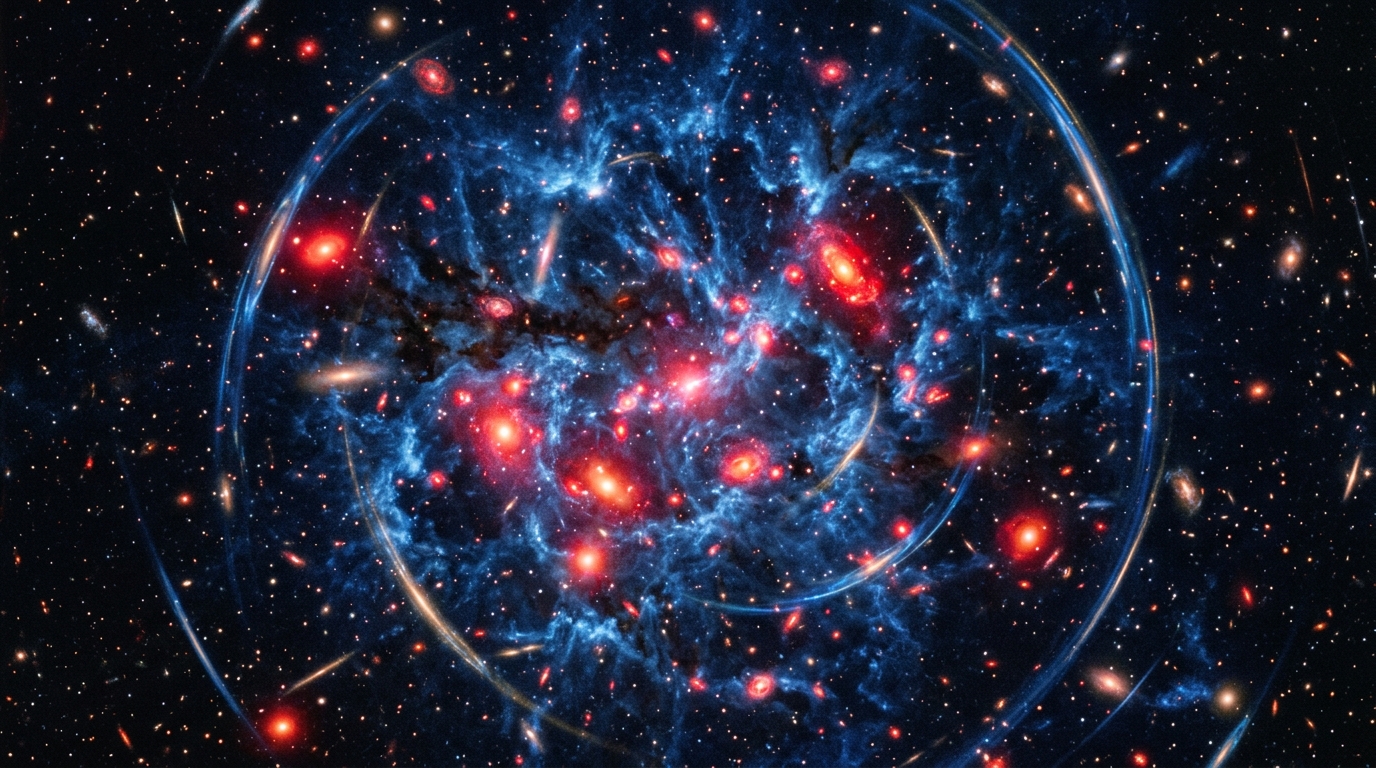
In 2026, observational astrophysics was fundamentally reshaped by deep-field data from the James Webb Space Telescope (JWST). Astronomers analyzing images of the primordial universe—dating back to less than 600 million years after the Big Bang ($z > 6 - 9$)—uncovered an unexpected population of compact, intensely red celestial objects termed "Little Red Dots" (LRDs).
These enigmatic cosmic structures are up to 100 times smaller than typical galaxies yet harbor supermassive black holes containing millions of solar masses ($10^7 - 10^8 M_\odot$), challenging conventional models of cosmic structure formation and stellar evolution.
This report offers a comprehensive investigation into the astrophysics of Little Red Dots, heavy black hole seed theories, cosmic dawn spectroscopy, and the profound Quranic descriptions of primordial cosmic expansion and deep stellar mysteries.
1. Executive Summary: The Little Red Dots (LRDs) Astrophysics Matrix
                 JWST LITTLE RED DOTS OBSERVATION MATRIX

   • Observational Instrument: JWST NIRCam & NIRSpec Deep Field Surveys
   • Redshift Epoch: z = 4.5 to 8.5 (Cosmic Dawn: 400 - 800 Million Years Post-Big Bang)
   • Physical Compactness: Effective Radius r_e < 100 to 500 parsecs (Extremely dense)
   • Central Black Hole Masses: 10^6 to 10^8 Solar Masses (Over-massive relative to host)
   • Primary Astrophysical Puzzle: How did supermassive black holes grow so massive so fast?
   • Primary Competing Theories: Direct Collapse Black Holes (DCBH) vs. Extreme Accretion
2. The Core Astrophysical Conundrum: The "Impossible" Early Black Holes
Under standard cosmological models (Eddington accretion limit), black holes originate from the death of the earliest Population III stars ($~100 M_\odot$) and require billions of years of steady matter accretion to reach millions or billions of solar masses.
However, JWST's spectroscopic observations of Little Red Dots reveal that fully formed supermassive black holes were already thriving during the infancy of the universe:
            COMPARING COSMIC SEED FORMATION THEORIES

  [Standard Stellar Remnant Path]       [Direct Collapse Black Hole (DCBH)]
  - Initial Seed: ~100 M_☉              - Initial Seed: ~100,000 M_☉
  - Growth Time: > 1.2 Billion Years    - Growth Time: < 300 Million Years
  - Inconsistent with JWST 2026 Data    - Strong Fit for "Little Red Dots" Spectrum
Key Spectroscopic Markers:
- Broad H-alpha & H-beta Emission Lines: Revealing high-velocity ionized gas ($v > 2,000 - 4,000\text( km/s)$) orbiting dense central gravitational wells.
- Extreme Dust Obscuration & V-Shaped Continuum: Dense surrounding clouds of primordial cosmic dust that absorb ultraviolet light and re-emit in red/infrared wavelengths.
- Absence of Strong X-Ray Signatures: Suggesting Compton-thick, cocooned accretion geometries that conceal typical high-energy radiation.
3. Quranic Cosmology: The Genesis and Expansion of the Universe
The revelation of primordial cosmic structures in the deepest reaches of spacetime resonates powerfully with Quranic verses describing the origin, expansion, and intricate design of the cosmos.
1. The Initial Singularity and Expansion:
"Have those who disbelieved not considered that the heavens and the earth were a joined entity (Ratqan), and We separated them (Fataqnahuma) and made from water every living thing? Then will they not believe?"
— Surah Al-Anbiya (21:30)
The Arabic word رَتْق (Ratq) signifies a unified, densely fused entity, while فَتْق (Fatq) denotes an explosive tearing apart or expansion—an accurate physical description of the cosmic singularity and subsequent rapid expansion.
2. Continuous Cosmic Expansion:
"And the heaven We constructed with strength, and indeed, We are [its] expander (Lamusi'un)."
— Surah Adh-Dhariyat (51:47)
The continuous active participle مُوسِعُونَ (Musi'un) directly conveys ongoing, continuous cosmic expansion, a reality confirmed by Hubble, redshift surveys, and now validated in the earliest cosmic epochs by JWST.
4. Gravitational Collapse and Cosmic Voids
The Quran also draws humanity's gaze toward the collapse of celestial bodies and the staggering gravitational realities of deep space:
"So I swear by the retreating stars (Al-Khunnas), those that run their courses and disappear (Al-Jawar al-Kunnas)."
— Surah At-Takwir (81:15-16)
The root كَنَسَ (Kanasa) denotes sweeping up, vacuuming, or hiding from view—an evocative description of black holes that invisibly sweep up surrounding matter, light, and gas into extreme gravitational singularity points.
5. Strategic Implications for 2026 Observational Cosmology
               FUTURE DEEP SPACE OBSERVATION PIPELINE

  [JWST NIRSpec Surveys] ──► [Nancy Grace Roman Space Telescope] ──► [Euclid & ELT]
  - Identify 1,000+ LRDs     - Wide-Field High-Z Galaxy Surveys      - High-Res Direct
  - Resolve Host Stellar Mass- Map Primordial Dark Matter Haloes     Spectroscopy
- Revising Early Universe Dark Matter Halos: Incorporating Direct Collapse Black Hole seeds into N-body cosmological simulations.
- Refining the Epoch of Reionization: Measuring how ultraviolet radiation from these newly discovered compact AGN contributed to clearing the primordial hydrogen fog.
- Synergy with Gravitational Wave Observatories: Anticipating space-based gravitational wave detectors (e.g., LISA) to capture the merger echoes of these massive primordial seeds.
6. Frequently Asked Questions (FAQ)
Q1: What are "Little Red Dots" in JWST astronomy?
Little Red Dots are extremely compact, highly red-shifted celestial objects observed in the early universe ($z > 5$) that contain unexpectedly massive central black holes and dense gas envelopes.
Q2: Why are these discoveries rewriting astrophysics?
They prove that supermassive black holes formed hundreds of millions of years faster than previously believed, supporting Direct Collapse Black Hole theories over gradual stellar accumulation.
Q3: How do these findings relate to Quranic verses on creation?
The Quran explicitly points to the initial unified singularity (Ratq), the ongoing expansion of the cosmos (Lamusi'un), and the invisible sweeping nature of collapsed celestial bodies (Al-Kunnas).
7. Conclusion
The James Webb Space Telescope's discovery of Little Red Dots is opening a transformative chapter in cosmological science. As human instruments peer back toward the dawn of time, every discovery illuminates the majestic, interconnected harmony of the universe described in the Holy Quran.