

 QuranGPT
Atmospheric Revelations on Exoplanet K2-18b: James Webb Space Telescope Detects Carbon-Bearing Biosignature Candidates in Habitable Zone
A comprehensive astrophysics, astrobiology, and space observation report on the James Webb Space Telescope (JWST) detecting methane, carbon dioxide, and potential dimethyl sulfide (DMS) biosignature molecules in the atmosphere of habitable-zone sub-Neptune exoplanet K2-18b.
The Holy Quran Team
Author
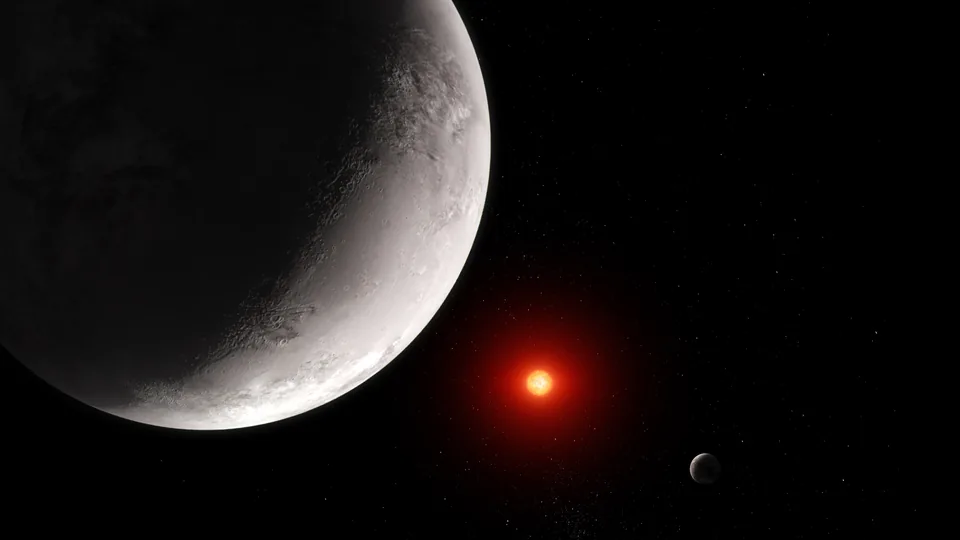
In one of the most profound observational milestones in modern exoplanetary astrophysics, the James Webb Space Telescope (JWST), operating its high-precision Near-Infrared Spectrograph (NIRSpec) and Mid-Infrared Instrument (MIRI), has confirmed the presence of an abundant, carbon-rich atmosphere surrounding the habitable-zone exoplanet K2-18b.
Located approximately 120 light-years from Earth in the constellation Leo, K2-18b is a sub-Neptune exoplanet 8.6 times the mass of Earth that orbits within the habitable zone of its cool red dwarf host star, K2-18.
The spectroscopic data obtained during multiple planetary transits reveals strong absorption signatures of methane (CH_4) and carbon dioxide (CO_2), accompanied by a striking absence of ammonia (NH_3).
Crucially, the ultra-deep mid-infrared spectrum provided tentative evidence for the spectral signature of dimethyl sulfide (DMS)—a volatile sulfur compound that, on Earth, is produced almost exclusively by living organisms, primarily marine phytoplankton in oceanic ecosystems.
1. The Physics of Transmission Spectroscopy
To decipher the chemical composition of an exoplanet’s atmosphere light-years away, JWST utilizes transmission spectroscopy:
graph TD
    A["Host Star K2-18 Emits Continuous Stellar Infrared Spectrum"] --> B["Exoplanet K2-18b Transits Across Stellar Disc"]
    B --> C["Stellar Light Filters Through Planetary Upper Atmosphere Gaseous Envelope"]
    C --> D["Atmospheric Molecules (Methane, CO2, DMS) Absorb Specific Infrared Wavelengths"]
    D --> E["JWST NIRSpec & MIRI Instruments Measure Minute Dips in Flux (Parts per Million)"]
    E --> F["Computational Inversion Models Reconstruct Atmospheric Chemical Profile"]
Key Spectroscopic Detections on K2-18b:
- Abundance of Carbon Compounds: Substantial spectral dips corresponding to methane and carbon dioxide with high signal-to-noise ratio (>5σ).
- The Hycean World Hypothesis: The co-existence of high CH_4 and CO_2 with depleted ammonia strongly supports the theoretical model of a "Hycean World"—a planet featuring a hydrogen-rich atmosphere covering a vast liquid water ocean mantle.
- The Dimethyl Sulfide (DMS) Candidate Peak: A weak but distinct transmission feature at 3.4 µ m matching the vibrational absorption bands of DMS, currently being subjected to follow-up multi-epoch validation.
2. Planetary Characteristics: Comparing K2-18b with Earth
Understanding the habitability conditions of K2-18b requires contrasting its physical parameters with our home planet:
| Planetary Parameter | Planet Earth | Exoplanet K2-18b | Astrobiological Implication |
|---|---|---|---|
| Mass & Radius | 1.0 M_oplus / 1.0 R_oplus | 8.6 M_oplus / 2.6 R_oplus | Super-Earth / Sub-Neptune boundary regime. |
| Orbital Period (Year) | 365.25 Days | 33.0 Days | Close-in orbit within the cool dwarf habitable zone. |
| Atmospheric Composition | N_2 (78%), O_2 (21%), Ar, CO_2 | H_2-dominated envelope with CH_4 & CO_2 | High greenhouse insulation over liquid ocean. |
| Stellar Insolation | 1,361 W/m^2 | sim 1,410 W/m^2 | Receives solar radiation comparable to Earth. |
3. The Scientific Debate: Hycean Ocean vs. Gas Mini-Neptune
While the discovery has ignited global scientific excitement, astrobiologists and planetary modelers emphasize scientific caution:
- The High Ocean Temperature Dilemma: Some atmospheric circulation models suggest that beneath a thick hydrogen envelope, high atmospheric pressure and greenhouse trapping could heat the underlying ocean near its supercritical state.
- Confirming the DMS Signal: NASA and ESA have allocated 40 additional hours of dedicated JWST cycle observation time to achieve a statistically incontrovertible 5σ confirmation of the DMS signature.
4. Conclusion: A Window into the Cosmic Web of Life
The spectroscopic exploration of K2-18b marks the dawn of a revolutionary epoch in astrobiology.
For the first time in human history, our instruments possess the sensitivity to analyze the atmospheric chemistry of distant worlds orbiting other stars. Whether K2-18b harbors an alien ocean teeming with microbial life or represents a new class of planetary physics, JWST is bringing humanity one step closer to answering the ultimate cosmic question: Are we alone in the universe?