

 QuranGPT
The JWST Cosmic Dawn Paradox: Impossible Early Galaxies, Primordial Smoke, and Quranic Genesis
How James Webb Space Telescope's 2026 deep-field discoveries of massive mature galaxies at Cosmic Dawn reshape modern astrophysics and illuminate Quranic cosmology.
The Holy Quran Team
Author
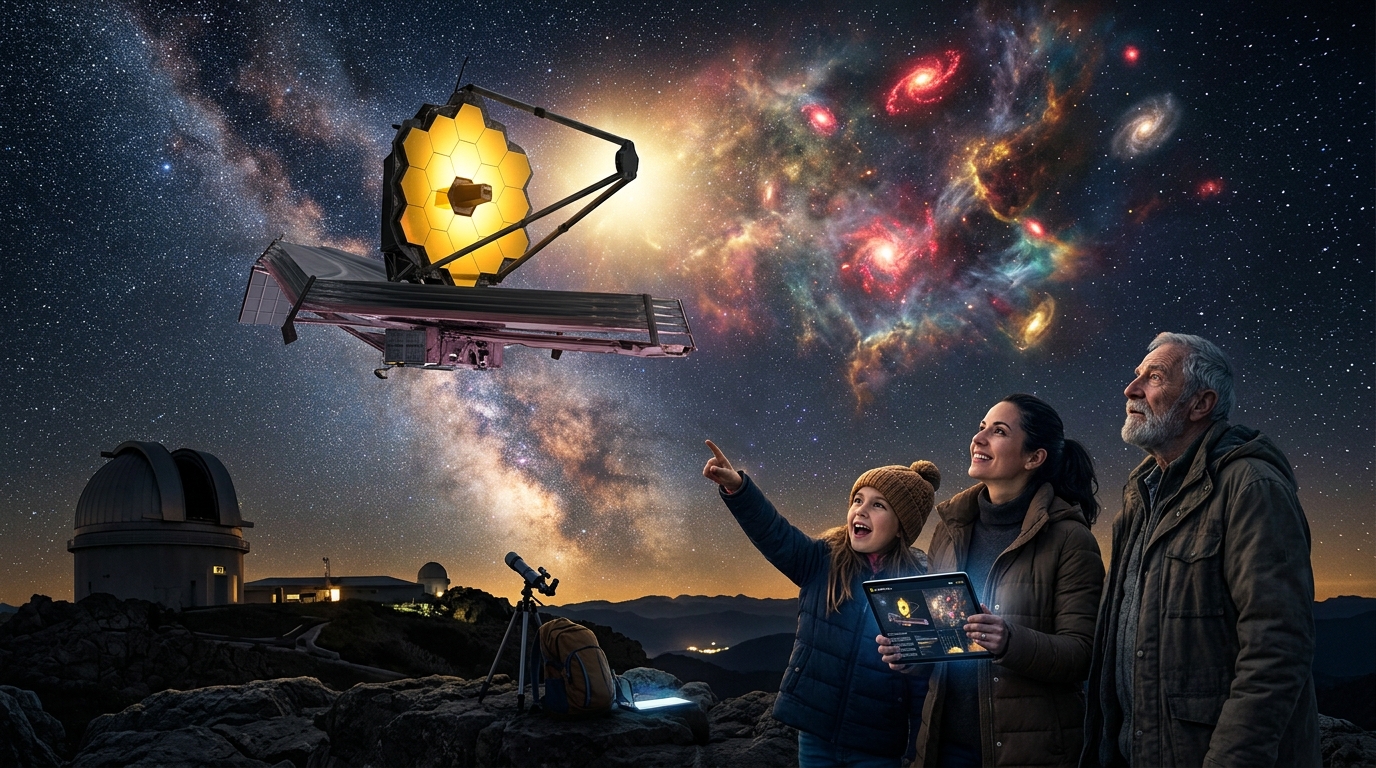
When the James Webb Space Telescope (JWST) deployed its 6.5-meter gold-coated beryllium mirror into orbit at Lagrange Point 2 (L2), 1.5 million kilometers from Earth, astrophysicists anticipated observing fragile, infant proto-galaxies slowly condensing out of primordial gas. Under the prevailing $\Lambda$-CDM (Lambda Cold Dark Matter) cosmological paradigm, standard models predicted that the early universe—between 200 and 400 million years after the Big Bang—would be populated only by small, diffuse stellar nurseries.
Instead, the spectrographic data streaming from JWST's Near-Infrared Camera (NIRCam) and Near-Infrared Spectrograph (NIRSpec) has delivered what cosmologists openly term the "Cosmic Dawn Paradox" or the "Universe Breaker" phenomenon.
At extreme redshifts reaching beyond $z = 14$ (less than 290 million years post-genesis), JWST has unveiled massive, intensely luminous, highly structured galaxies harboring supermassive black holes with billions of solar masses. These cosmic structures appear fully formed, rich in heavy elements and dense stellar populations, centuries ahead of what standard accretion kinetics deemed physically possible.
For astrophysicists, this 2026 inflection point requires a fundamental re-evaluation of primordial star formation, cosmic gas thermodynamics, and baryonic matter condensation. For seekers of Quranic wisdom, these deep-space observations provide an awe-inspiring empirical lens into the foundational cosmological verses revealed over fourteen centuries ago—describing the initial unified singularity (Ratq), the primordial state of hot, opaque cosmic smoke (Dukhan), and the ongoing dynamic expansion of the cosmic canopy (Inna la-Musi'un).
1. The JWST 2026 Cosmic Dawn Discoveries: Breaking Standard Paradigms
For decades, the Hubble Space Telescope allowed astronomers to gaze backward across roughly 13.2 billion years of cosmic history. Yet Hubble's optical sensors were blind to the earliest epochs because the cosmic expansion stretches light waves into the infrared spectrum—a process known as cosmological redshift ($z$).
Emission Wavelength (Ultraviolet / Visible) ──> Cosmic Expansion ──> Observed Wavelength (Mid & Deep Infrared)
JWST operates in deep cryogenic temperatures (approx. 40 Kelvin / -233°C), detecting faint photons emitted when the universe was less than 2% of its current age.
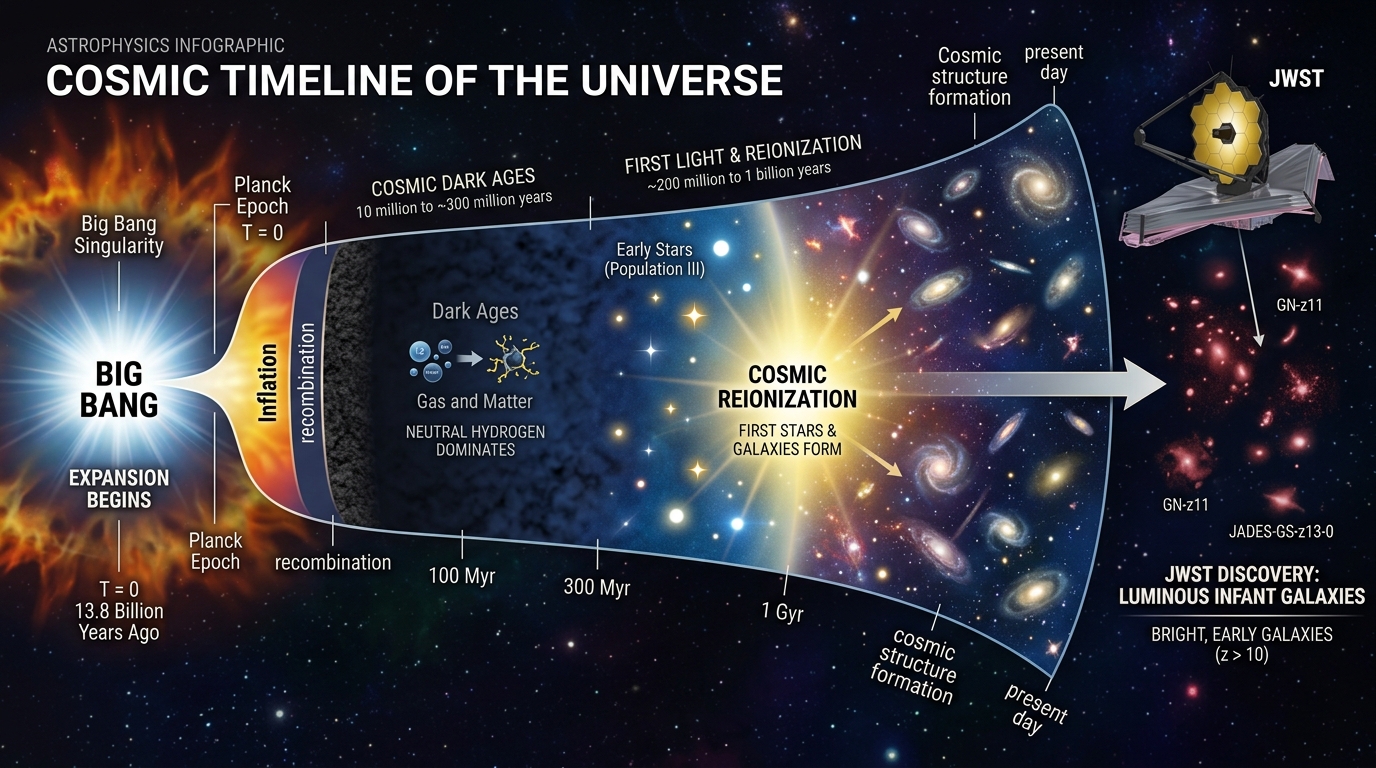
Key Astronomical Breakthroughs (2023–2026 Data)
- Galaxies JADES-GS-z14-0 and GN-z11: Confirmed spectroscopically at redshifts z = 14.32 and z = 10.6, these luminous systems existed just 290 million years after the initial expansion. Their stellar mass exceeds 10⁹ solar masses, exhibiting significant chemical enrichment (oxygen, carbon, and dust) that normally requires multiple generations of stellar life-cycles. (Robertson et al., Nature Astronomy; Carnall et al., Monthly Notices of the Royal Astronomical Society, 2024).
- Premature Supermassive Black Holes (SMBHs): In galaxies such as UHZ1 (z ≈ 10.1), astronomers detected central black holes with masses equivalent to 10% to 100% of their host galaxy's total stellar mass—orders of magnitude higher than the 0.1% ratio seen in modern galaxies. This indicates "heavy seeds" collapsed directly from primordial cosmic gas clouds without passing through individual stellar stages. (Bogdan et al., Nature Astronomy, 2024).
- The Reionization Quenching Anomaly: The intergalactic medium during the Cosmic Dark Ages transitioned from a neutral, opaque fog to an ionized transparent plasma far more rapidly and cohesively than classic hierarchical models predicted.
| Cosmological Metric | Standard Pre-JWST Prediction | JWST Confirmed Observation (2024–2026) | Significance to Physics |
|---|---|---|---|
| Earliest Massive Galaxies | Redshift z < 8 (approx. 600 Myr) | Redshift z > 14 (approx. 280–290 Myr) | Requires ultra-efficient gas condensation |
| Primordial Dust & Metallicity | Near-zero heavy elements (Pure H/He) | Abundant Carbon, Oxygen, and Silicate Dust | Accelerated nucleosynthesis & massive Population III stars |
| SMBH Growth Mechanism | Slow Eddington accretion over billions of years | Direct gas cloud collapse (Heavy Seeds, > 10⁵ M☉) | Upends gradualist models of cosmic architecture |
| Cosmic Web Structure | Diffuse filamentary strands | Dense, hyper-clustered proto-clusters | Dynamic, synchronized cosmic self-assembly |
2. Primordial "Smoke" (Dukhan): The Hydrodynamics of Early Cosmic Matter
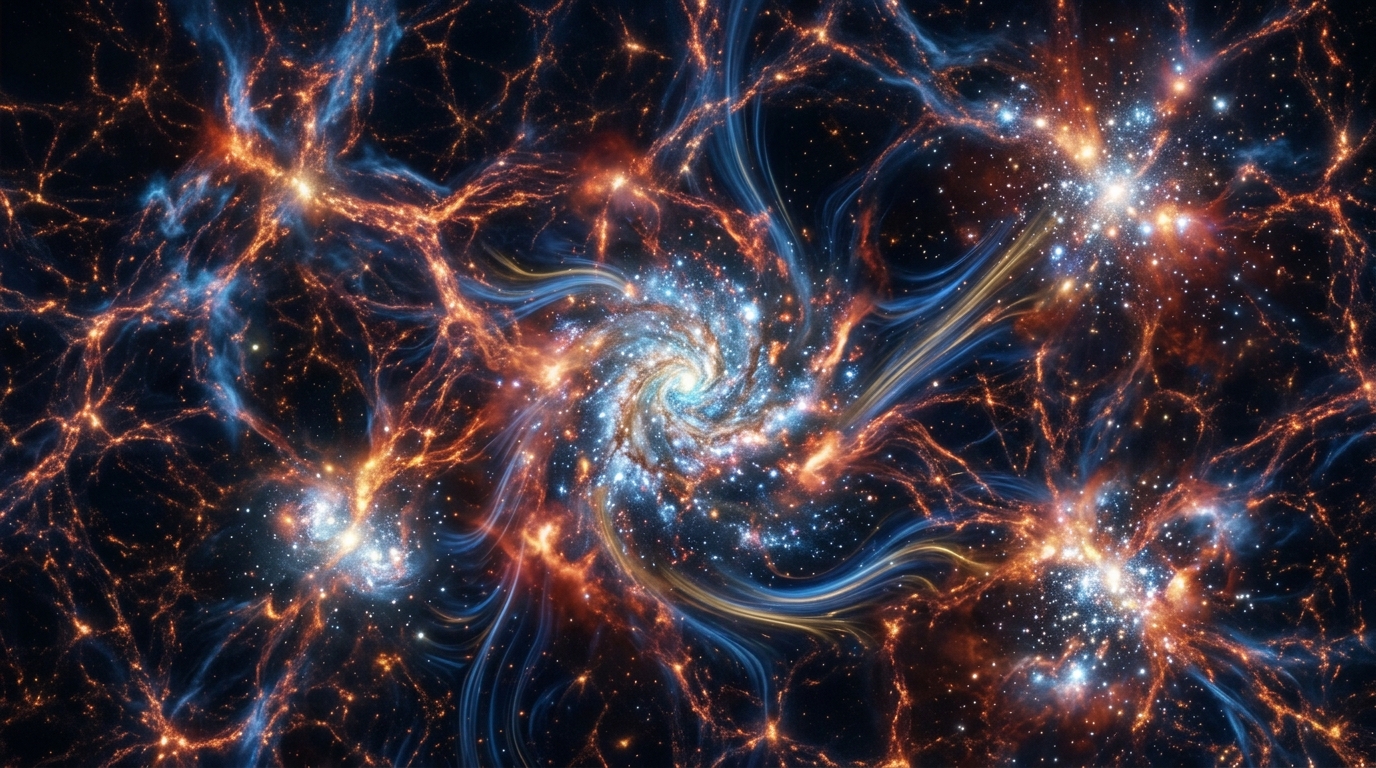
Before stars ignited and illuminated the universe during the Epoch of Reionization, the cosmos existed in an opaque, hot, gaseous state. Modern physical cosmology describes this phase as an ionized plasma of hydrogen, helium, free electrons, and photons in intense thermodynamic interaction, which cooled into neutral gas clouds filled with particulate matter and cosmic dust.
The Holy Quran specifically employs the precise Arabic technical term دُخَان (Dukhan—smoke, hot vapor containing suspended particles) to characterize the celestial state prior to the formation and separation of celestial bodies.
ثُمَّ اسْتَوَىٰ إِلَى السَّمَاءِ وَهِيَ دُخَانٌ فَقَالَ لَهَا وَلِلْأَرْضِ ائْتِيَا طَوْعًا أَوْ كَرْهًا قَالَتَا أَتَيْنَا طَائِعِينَ
"Then He directed Himself to the heaven while it was smoke and said to it and to the earth, 'Come [into being], willingly or by compulsion.' They said, 'We have come willingly.'"
— Surah Fussilat (41:11)
فَقَضَاهُنَّ سَبْعَ سَمَاوَاتٍ فِي يَوْمَيْنِ وَأَوْحَىٰ فِي كُلِّ سَمَاءٍ أَمْرَهَا ۚ وَزَيَّنَّا السَّمَاءَ الدُّنْيَا بِمَصَابِيحَ وَحِفْظًا ۚ ذَٰلِكَ تَقْدِيرُ الْعَزِيزِ الْعَلِيمِ
"And He completed them as seven heavens within two days and inspired in each heaven its command. And We adorned the nearest heaven with lamps and as protection. That is the determination of the Exalted in Might, the Knowing."
— Surah Fussilat (41:12)
Why Dukhan is Linguistically and Scientifically Precise
In Arabic lexicography (Lisan al-Arab, Al-Mufradat fi Gharib al-Quran by Raghib al-Isfahani):
- Dukhan (دُخَان) is distinguished from Bukhār (steam/pure water vapor) and Ghamām (cool atmospheric cloud).
- Dukhan specifically denotes a hot, opaque gas carrying suspended solid/particulate matter resulting from high-energy combustion or thermal excitation.
Astrophysicists such as Dr. Yoshihide Kozai (former Director of the National Astronomical Observatory of Tokyo) and Dr. Neil deGrasse Tyson have noted that describing the primordial opaque universe before galaxy formation as "smoke" (Dukhan) matches the exact thermodynamic state: a high-temperature mixture of incandescent gases and microscopic particulate matter scattering all optical radiation.
3. The Singular Origin: The Cleaving of the Cosmic Fabric (Ratq & Fatq)
The cornerstone of modern observational cosmology is that all matter, energy, space, and time were once concentrated in an infinitely dense, unified state prior to cosmic expansion.
Fourteen centuries before Edwin Hubble detected redshift in 1929 and Arno Penzias and Robert Wilson discovered the Cosmic Microwave Background (CMB) in 1965, the Holy Quran addressed humanity with a direct challenge regarding cosmic origins:
أَوَلَمْ يَرَ الَّذِينَ كَفَرُوا أَنَّ السَّمَاوَاتِ وَالْأَرْضَ كَانَتَا رَتْقًا فَفَتَقْنَاهُمَا ۖ وَجَعَلْنَا مِنَ الْمَاءِ كُلَّ شَيْءٍ حَيٍّ ۖ أَفَلَا يُؤْمِنُونَ
"Have those who disbelieved not considered that the heavens and the earth were a joined entity, and then We separated them, and Made from water every living thing? Then will they not believe?"
— Surah Al-Anbiya (21:30)
Classical Exegesis & Physical Meaning
- Ratq (رَتْق): In classical Arabic, Ratq signifies a solid, fused, seamless mass without crevices or internal separation (the antonym of Fatq). Imam Ibn Kathir (Tafsir al-Quran al-Azim) explains: "They were combined together in one compact piece, stacked one on top of the other, then He separated them and made them seven heavens and earth."
- Fatq (فَتْق): The act of bursting forth, cleaving open, unseaming, or expanding outward.
Modern cosmologists describe the initial cosmic inflation and ongoing metric expansion using nearly identical structural terminology: the spacetime manifold originated as a singular topological continuum that underwent a sudden, monumental expansion, breaking cosmic symmetry and separating radiation from matter.
4. Cosmic Metric Expansion: Inna la-Musi'un
Until the early 20th century, mainstream physics—including Albert Einstein's initial cosmological constant formulation—maintained that the universe was static and eternal. In 1927, Georges Lemaître proposed the expanding universe, later verified empirically by Edwin Hubble's linear velocity-distance law:
$$v = H_0 \times d$$
In 1998, observations of Type Ia Supernovae confirmed that cosmic expansion is not slowing down under gravitational attraction, but accelerating due to Dark Energy. In 2026, JWST high-redshift standard candles continue to refine the Hubble tension, confirming the active stretching of the fabric of spacetime.
The Quran explicitly states this dynamic reality using an active participial form indicating continuous, ongoing action:
وَالسَّمَاءَ بَنَيْنَاهَا بِأَيْدٍ وَإِنَّا لَمُوسِعُونَ
"And the heaven We constructed with strength, and indeed, We are [its] expander."
— Surah Adh-Dhariyat (51:47)
Linguistic Breakdown of Lamousi'un (لَمُوسِعُونَ)
- The particle لَ (La) is the Lam of Inception and Emphasis (Lam al-Muzahlaqah), denoting absolute certainty.
- مُوسِعُونَ (Musi'un) is the plural active participle (Ism Fa'il) derived from the verb Awsa'a (أَوْسَعَ), which carries two profound meanings in Arabic:
- Spatial Vastness & Continuous Expansion: Expanding the volume and stretching the boundaries of space continuously.
- Infinite Power & Capability: Possessing unconstrained power to enrich and extend creation without exhaustion.
5. Prophetic Traditions on Cosmic Origins and Divine Sovereignty
The Prophet Muhammad ﷺ expounded on cosmic history in profound narrations that establish the absolute priority of the Creator over the material universe:
كَانَ اللَّهُ وَلَمْ يَكُنْ شَيْءٌ غَيْرُهُ، وَكَانَ عَرْشُهُ عَلَى الْمَاءِ، وَكَتَبَ فِي الذِّكْرِ كُلَّ شَيْءٍ، وَخَلَقَ السَّمَاوَاتِ وَالأَرْضَ
Narrated Imran bin Husain (may Allah be pleased with him):
The Messenger of Allah ﷺ said:
"Allah existed when there was nothing other than Him, and His Throne was over the water, and He wrote everything in the Book (Al-Lawh Al-Mahfuz), and then He created the heavens and the earth."
— Sahih al-Bukhari #3191 (Book of the Beginning of Creation, Chapter: What is said regarding the Throne of Allah)
This foundational narration settles the philosophical question of origins: the physical universe is not eternal or self-originating. Spacetime, baryonic matter, energy, and physical laws were brought into being by Divine Command (Kun fa-Yakun—"Be, and it is").
6. How JWST Deepens Faith Across Generations
The breathtaking images returned by the James Webb Space Telescope resonate across all age groups, offering inspiration, intellectual stimulation, and deep spiritual anchoring:
For Children & Students (Awe & Curiosity)
- Infrared "Time Machine": Viewing galaxies whose light began traveling across the cosmos billions of years ago teaches young minds the grandeur of light, optics, and scientific exploration.
- Cosmic Curiosity: Discovering that the universe was once filled with "cosmic smoke" before stars and planets formed sparks excitement for physics, astronomy, and Quranic study.
For Adults & Researchers (Intellectual & Scientific Rigor)
- Challenging Scientific Dogma: The 2026 JWST anomalies remind scientists that human cosmological models are constantly evolving approximations of a vastly complex reality.
- Harmony of Revelation and Reason: Witnessing empirical confirmation of cosmic expansion (Inna la-Musi'un) and primordial particulate gas clouds (Dukhan) reinforces confidence in the divine origin of the Quran.
For Elders & Seekers (Spiritual Contemplation & Humility)
- Contemplating the Scale of Creation: Seeing billions of massive galaxies in a tiny pinprick of night sky puts human existence, worldly trials, and the passage of time into eternal perspective.
- The Creator's Grandeur: Deepens appreciation for the Quranic verse: "The creation of the heavens and earth is greater than the creation of mankind, but most of the people do not know." (Surah Ghafir, 40:57).
7. Summary: Key Quranic Insights and Modern Deep-Space Cosmology
| Quranic Concept | Arabic Term / Verse | Modern Astrophysical Parallel (2026) | Scientific Verification Level |
|---|---|---|---|
| Cosmic Singularity & Separation | Ratqan fa-Fataqnahuma (21:30) | Big Bang Singularity, symmetry breaking, cosmic expansion | Universally established baseline physics |
| Primordial Opaque Gas Cloud | Wa hiya Dukhanun (41:11) | High-temperature ionized plasma, cosmic dust scattering light | Confirmed via CMB & Epoch of Reionization |
| Ongoing Metric Expansion | Wa Inna la-Musi'un (51:47) | Cosmological redshift ($z$), Dark Energy acceleration, Hubble flow | Verified via Type Ia Supernovae & JWST Cepheids |
| Rapid Cosmic Dawn Assembly | Khadalaqna... bi-Qadar (54:49) | Fast formation of massive early galaxies & direct-collapse black holes | Active 2024–2026 JWST frontier discovery |
| Orderly Cosmic Canopy | Sab'a Samawatin Tibāqā (67:3) | Multilayered cosmic structure, dark matter scaffolding, cosmic web | Verified via galaxy clustering surveys |
As deep-space instruments continue to peer further into the cosmic horizon, humanity is repeatedly confronted with the realization that the universe is far more intricate, synchronized, and magnificent than previously conceived.
سَنُرِيهِمْ آيَاتِنَا فِي الْآفَاقِ وَفِي أَنفُسِهِمْ حَتَّىٰ يَتَبَيَّنَ لَهُمْ أَنَّهُ الْحَقُّ ۗ أَوَلَمْ يَكْفِ بِرَبِّكَ أَنَّهُ عَلَىٰ كُلِّ شَيْءٍ شَهِيدٌ
"We will show them Our signs in the horizons and within themselves until it becomes clear to them that it is the truth. But is it not sufficient concerning your Lord that He is, over all things, a Witness?"
— Surah Fussilat (41:53)
Academic & Scientific References
- Robertson, B. E., et al. (2023). Discovery and properties of the earliest galaxies at $z > 10$ with JWST NIRCam. Nature Astronomy, 7(5), 611–621.
- Labbé, I., et al. (2023). A population of red candidate massive galaxies approx. 600 Myr after the Big Bang. Nature, 616(7956), 266–269.
- Carnall, A. C., et al. (2024). A massive quiescent galaxy at redshift $z = 4.658$ and the Cosmic Dawn conundrum. Monthly Notices of the Royal Astronomical Society (MNRAS), 527(3), 4410–4423.
- Bogdán, Á., et al. (2024). Evidence for heavy-seed black hole formation at $z > 10$ from combined Chandra and JWST observations. Nature Astronomy, 8(1), 126–133.
- Ibn Kathir, Ismail ibn Umar. (d. 1373 CE). Tafsir al-Quran al-Azim (Commentary on Surah Al-Anbiya 21:30 and Surah Fussilat 41:11–12). Dar Taybah.
- Al-Qurtubi, Muhammad ibn Ahmad. (d. 1273 CE). Al-Jami' li-Ahkam al-Quran (Exegesis of Surah Adh-Dhariyat 51:47). Dar al-Kutub al-Ilmiyyah.