

 QuranGPT
Jabir ibn Hayyan: Father of Chemistry and Founder of Experimental Science
Explore how Jabir ibn Hayyan (Geber) invented distillation, crystallization, and systematic chemical experimentation in 8th century Baghdad — establishing the foundations of modern chemistry 1,000 years before Western science.
The Holy Quran Team
Author
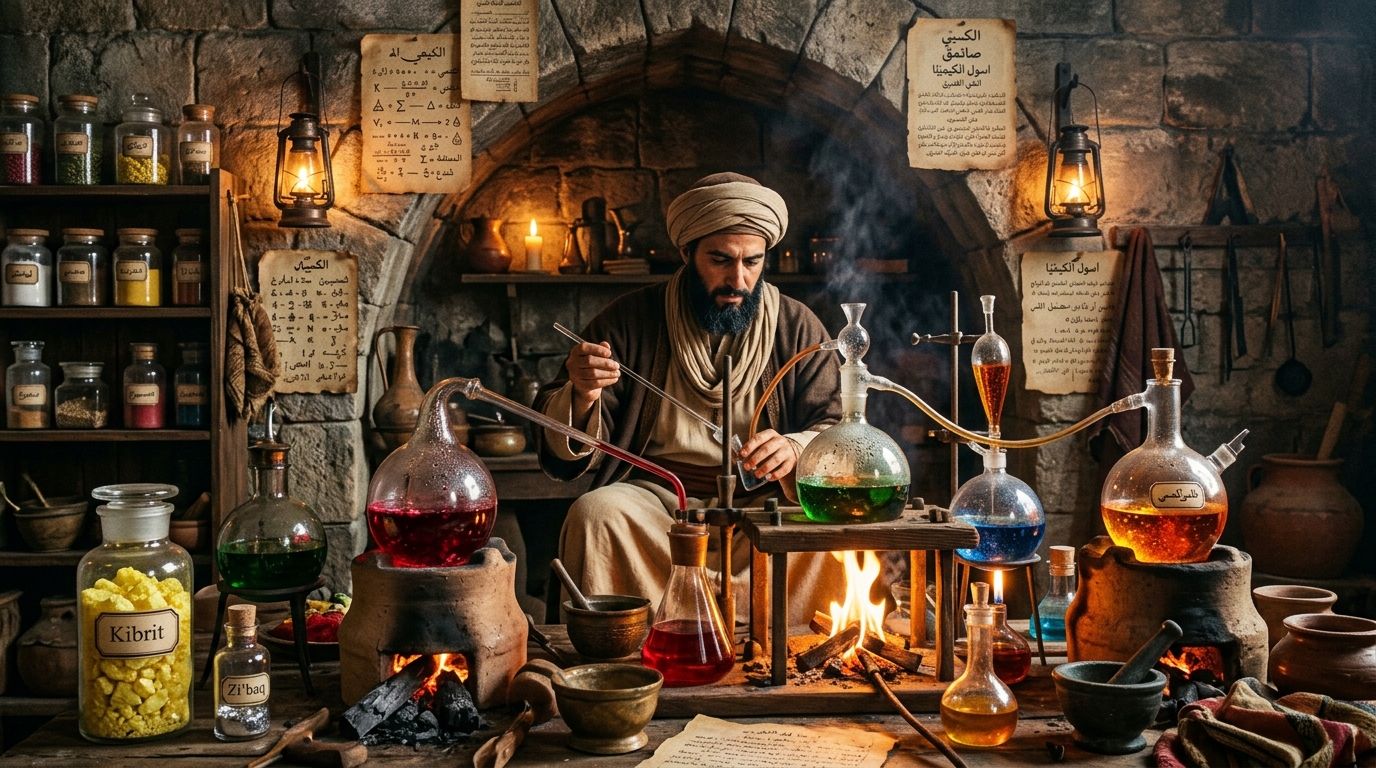
In the 8th century CE, while most of the world practiced alchemy based on Greek mythology and mysticism, a brilliant Muslim scientist in Kufa, Iraq was doing something radically different: he was conducting systematic experiments, carefully recording results, and developing a rational, empirical framework for understanding matter and chemical change.
His name was Abu Musa Jabir ibn Hayyan — known in medieval Europe as Geber — and he is rightly called the Father of Chemistry.
1. Who Was Jabir ibn Hayyan?
Born around 721 CE in Tus, Khorasan (modern Iran), Jabir studied under Imam Ja'far al-Sadiq, a descendant of the Prophet Muhammad ﷺ and a renowned scholar of both religion and natural sciences. Jabir worked under the patronage of the Abbasid Caliph Harun al-Rashid in Baghdad, producing over 3,000 treatises on chemistry, alchemy, cosmology, mathematics, and philosophy.
"The first essential in chemistry is that you should perform practical work and conduct experiments, for he who performs not practical work nor makes experiments will never attain the least degree of mastery."
— Jabir ibn Hayyan
This single statement — "perform practical work and conduct experiments" — is the founding principle of all modern science.

Jabir ibn Hayyan invented the alembic, crystallization, and systematic distillation, isolating hydrochloric and nitric acids for the first time.
2. Inventions That Built Modern Chemistry
Jabir ibn Hayyan's laboratory innovations transformed our understanding of matter:
2.1 The Alembic and Distillation
Jabir invented the alembic (al-anbiq) — a still for purifying liquids through evaporation and condensation. His distillation processes produced:
- Pure alcohol (ethanol) for medical and chemical use
- Essential oils and perfumes
- Purified acids from mineral substances
- Rose water (ma' al-ward) — still used in Islamic medicine today
Modern chemistry, petroleum refining, pharmaceuticals, and perfume production all rest on distillation — a gift from Jabir's laboratory.
2.2 Crystallization and Precipitation
Jabir developed systematic methods for crystallization — forming pure solid crystals from solutions — and precipitation — creating solid products from chemical reactions in liquids.
These techniques enabled:
- Purification of salts and minerals
- Separation of chemical compounds
- Preparation of pure medicinal substances
2.3 Calcination and Reduction
He documented how metals transform when heated (calcination) and how metal oxides can be reduced back to pure metals — the fundamental basis of metallurgy and modern materials science.
        JABIR'S CHEMICAL PROCESS FRAMEWORK

   Raw Material ──► Dissolution ──► Separation ──► Purification
                                         │
                                         ▼
                              Crystallization/Precipitation
                                         │
                                         ▼
                              Pure Compound (New Substance)
3. Key Chemical Substances Prepared by Jabir
| Substance | Arabic Name | Modern Use |
|---|---|---|
| Hydrochloric acid | Māʾ al-mulūkī | Industrial manufacturing |
| Nitric acid | Māʾ al-nār | Fertilizers, explosives |
| Aqua regia | Māʾ al-malik | Gold refining |
| Sulfuric acid | Zayt al-zāj | Batteries, chemicals |
| Ammonium chloride | Nushādir | Soldering, medicine |
| Silver nitrate | Qamar al-fudda | Photography, medicine |
| Sodium carbonate | Natrun | Soap, glass making |
Many of these substances were entirely unknown to Greek and Roman chemistry. Jabir produced them through careful experimentation and documented their properties in detail.
4. The Islamic Scientific Method: Before Bacon and Descartes
Western historians credit Francis Bacon (1620 CE) with inventing the scientific method. But Jabir ibn Hayyan's methodology, practiced 900 years earlier, contained every key element:
- Systematic observation — recording experimental conditions precisely
- Controlled variation — changing one variable at a time
- Quantitative measurement — weighing and measuring precisely
- Reproducibility — writing procedures others could repeat
- Hypothesis and testing — proposing theories and verifying them
Jabir explicitly stated: "A theory without experimental proof means nothing in the art of chemistry." This is not medieval alchemy — this is modern scientific epistemology.
5. Jabir's Theory of Sulfur-Mercury Composition
Jabir developed the Sulfur-Mercury Theory of metals — the idea that all metals are composed of varying ratios of sulfur (representing combustibility/malleability) and mercury (representing fusibility/luster).
While not accurate by modern standards, this was a rational, testable, systematic theory — the first attempt to explain material composition through unified principles rather than mythology. It dominated European and Islamic chemistry for 600 years and influenced the later development of atomic theory.
6. Impact on European Science
When Jabir's works were translated into Latin (under the pseudonym "Geber") between the 12th and 14th centuries, they transformed European science:
- Roger Bacon (13th century) based his experimental philosophy directly on Jabir's methods
- Paracelsus (16th century) adopted Jabir's mineral medicines
- Robert Boyle, founder of modern chemistry, built on Jabir's separation techniques
- The very word "alchemy" comes from Arabic al-kimiya — Jabir's field
7. Faith and Chemistry: Jabir's Islamic Worldview
For Jabir, chemistry was not separate from faith. In his worldview — rooted deeply in Islamic theology — matter itself was Allah's creation, with properties and behaviors that reflected divine wisdom. To understand the transformation of matter was to understand Sunan Allah (the patterns of Allah in creation).
The Quran states:
سَنُرِيهِمْ آيَاتِنَا فِي الْآفَاقِ وَفِي أَنفُسِهِمْ حَتَّىٰ يَتَبَيَّنَ لَهُمْ أَنَّهُ الْحَقُّ
"We will show them Our signs in the horizons and within themselves until it becomes clear to them that it is the Truth."
(Surah Fussilat 41:53)
For Jabir, every chemical experiment was an exploration of Allah's signs — ayat — embedded in the physical world.
Conclusion: The Laboratory That Changed the World
The laboratory of Jabir ibn Hayyan in 8th century Kufa was the birthplace of modern chemistry. Every pharmaceutical drug synthesized, every fuel refined, every metal smelted, every acid produced in the world today traces its intellectual lineage back to the methods, instruments, and principles that this brilliant Muslim scientist established.
His insistence on experiment over speculation, measurement over mysticism, and systematic documentation over oral tradition made him not just a great Islamic scholar — but one of the founding fathers of all empirical science.