

 QuranGPT
Islamic Mathematics: How Muslim Scholars Gave the World Zero, Algebra, and the Decimal System
A deep exploration of how Islamic mathematicians — Al-Khwarizmi, Al-Kindi, Omar Khayyam, and others — built the entire numerical and algebraic framework on which all modern mathematics, computing, and science is based.
The Holy Quran Team
Author
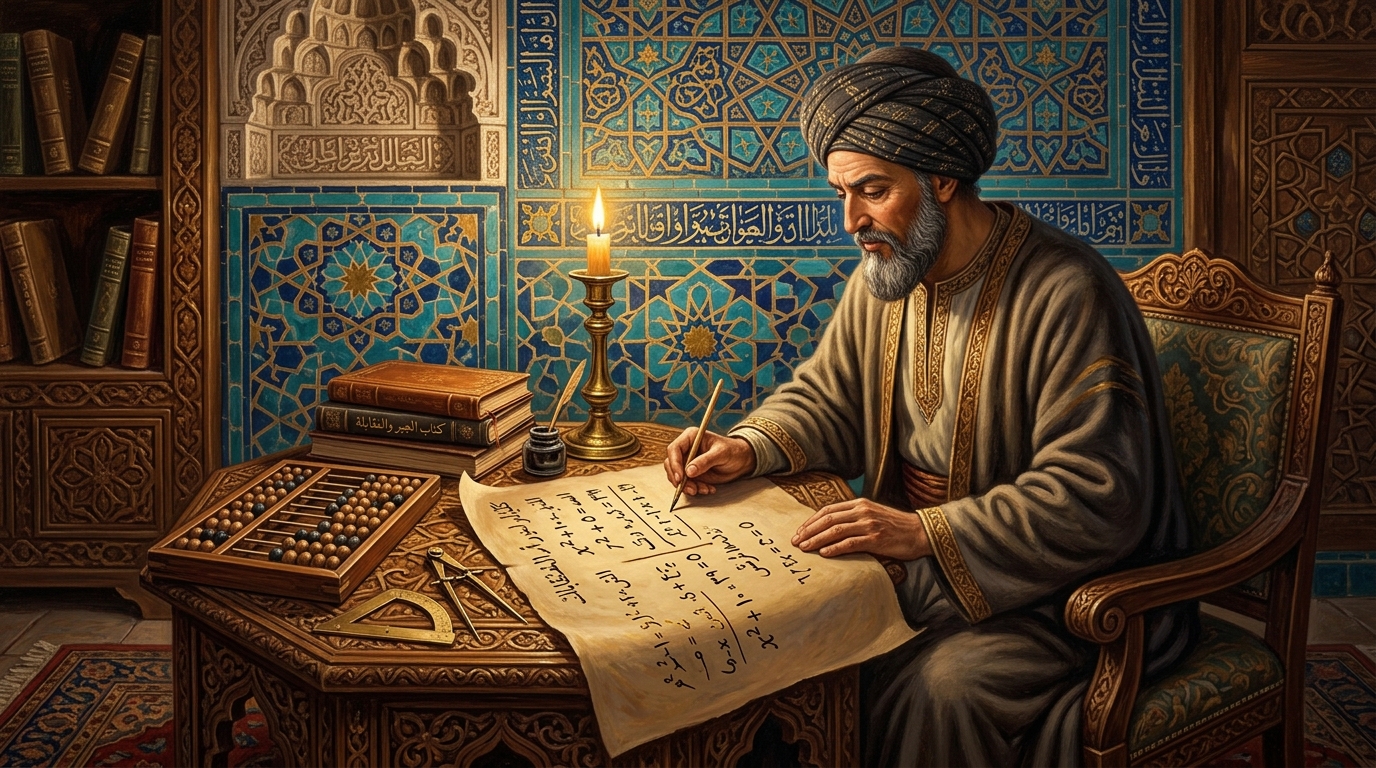
Every time you write the number 0, solve an algebraic equation, use a computer, or navigate with GPS, you are using tools that emerged directly from the mathematics developed by Muslim scholars in the Islamic Golden Age (8th–13th centuries CE).
The words "algebra" and "algorithm" are both Arabic. The decimal number system you use every day was transmitted to Europe through Arabic manuscripts. The concept of zero as a number — not just a placeholder — was formalized in the Islamic world.
This is not a peripheral contribution to mathematics. It is the foundation itself.
1. The Islamic Mathematical Revolution: Why It Happened
The Islamic Golden Age produced an explosion of mathematical innovation for profound reasons:
Religious Imperatives:
- Inheritance law (Fara'id) required precise fractional arithmetic
- Qibla calculation required spherical trigonometry
- Prayer time determination required solar angle mathematics
- Zakat calculation required percentage and proportion calculations
يُوصِيكُمُ اللَّهُ فِي أَوْلَادِكُمْ ۖ لِلذَّكَرِ مِثْلُ حَظِّ الْأُنثَيَيْنِ
"Allah instructs you regarding your children: for the male, what is equal to the share of two females..."
(Surah An-Nisa 4:11)
The precise calculation of inheritance shares — across siblings, parents, and spouses in complex family structures — demanded sophisticated algebra. Al-Khwarizmi wrote his most famous book explicitly to solve these calculations.
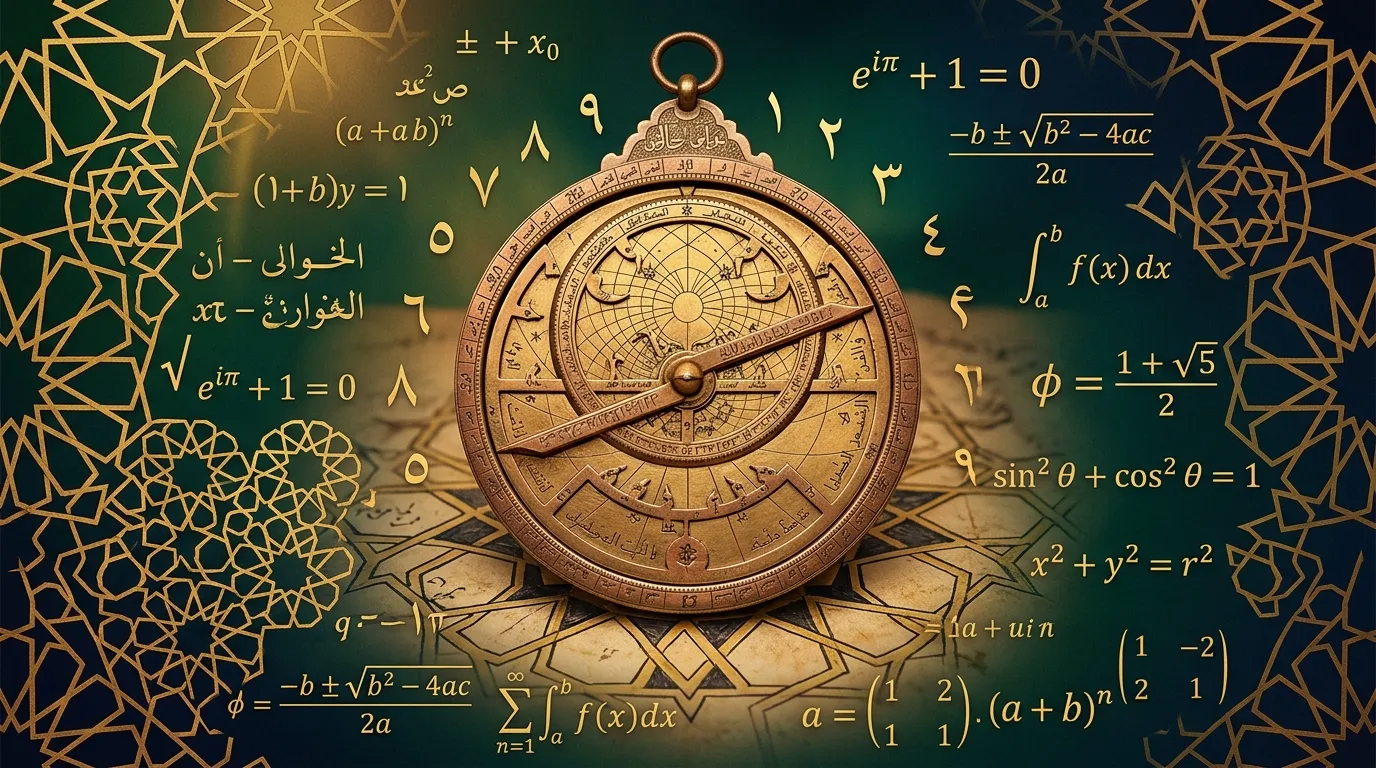
Al-Khwarizmi and Islamic mathematicians formalized algorithmic computation and polynomial algebra, laying the foundation for modern mathematics.
2. Muhammad al-Khwarizmi: The Man Who Invented Algebra
Abu Abdallah Muhammad ibn Musa al-Khwarizmi (780–850 CE) worked at the House of Wisdom (Bayt al-Hikmah) in Baghdad. His book:
"Kitab al-Mukhtasar fi Hisab al-Jabr wal-Muqabala"
(The Compendious Book on Calculation by Completion and Balancing)
gave the world algebra — its title being the origin of the word itself (al-Jabr → algebra).
What Al-Khwarizmi's Algebra Established:
- Six canonical equation types covering all linear and quadratic forms
- Systematic solution methods that apply to any equation of each type
- Geometric proofs for each algebraic solution
- The concept of "balancing" (muqabala) — moving terms across the equals sign
Every algebra class in the world today — from 7th grade to university level — begins with the framework Al-Khwarizmi established.
3. The Algorithm: How Al-Khwarizmi's Name Became a Concept
Al-Khwarizmi also wrote a separate treatise on Hindu-Arabic numerals — explaining the decimal positional number system (1-9 and 0) that was far superior to Roman numerals.
When this book was translated into Latin, it was titled:
"Algoritmi de Numero Indorum"
("Al-Khwarizmi concerning the Hindu numbers")
The Latin transliteration of "Al-Khwarizmi" became "Algoritmi" — and eventually "algorithm" — any systematic, step-by-step procedure for solving a problem.
Every software program, every AI model, every Google search runs on algorithms — a concept whose very name is a tribute to this 9th century Muslim mathematician.
4. Zero: The Number That Changed Everything
The concept of zero as a fully functional number — not just an absence — was transmitted to the Islamic world from Indian mathematics and then formalized, extended, and transmitted to Europe through Islamic scholarship.
Al-Khwarizmi's treatise on Hindu-Arabic numerals, translated into Latin in the 12th century, introduced Europeans to zero and the positional decimal system for the first time.
IMPACT OF ZERO ON HUMAN CIVILIZATION

Before Zero (Roman Numerals):
   MCMXCIX = 1999    (9 symbols to write one number)
   No concept of negative numbers
   No concept of infinity
   Multiplication/division: extremely difficult

After Zero (Hindu-Arabic via Islamic Transmission):
   1999 = 4 digits
   Negative numbers: trivially expressible
   Calculus: possible (Newton, Leibniz)
   Computing: binary (0 and 1) = entire digital world
Without zero, calculus is impossible. Without calculus, modern physics is impossible. Without modern physics, technology as we know it is impossible. The entire digital age traces back to zero — and zero reached Europe through Islamic mathematics.
5. Al-Khayyam and the Cubic Equation: 500 Years Before Europe
Omar Khayyam (1048–1131 CE) — known in the West mainly as a poet — was one of the greatest mathematicians of the medieval world. He:
- Developed a geometric method for solving cubic equations — 500 years before European mathematicians (Cardano, 1545 CE) found algebraic solutions
- Created the most accurate solar calendar of his era (the Jalali Calendar, accurate to within 1 day per 5,000 years — more accurate than the Gregorian calendar adopted by Europe 500 years later)
- Proved that Euclid's parallel postulate was independent of the other axioms — anticipating non-Euclidean geometry by 700 years
6. Al-Battani and Trigonometry: Building the Mathematics of Circles
While Al-Battani is primarily known as an astronomer, his mathematical contributions to trigonometry were transformative:
| Trigonometric Development | Al-Battani's Contribution |
|---|---|
| Sine function | First systematic use in astronomy |
| Cosine function | Defined and tabulated |
| Tangent function | Introduced for angle calculations |
| Cotangent | Introduced and tabulated |
| Spherical trigonometry laws | Derived for astronomical use |
His trigonometric tables were the definitive reference for European astronomers (including Copernicus and Kepler) for 600 years.
7. The House of Wisdom: A Global Mathematics Research Institute
The Bayt al-Hikmah in Baghdad under Caliphs Al-Mansur, Harun al-Rashid, and Al-Ma'mun was the largest intellectual institution the world had seen:
- Library of 500,000+ manuscripts
- Scholars from Arabia, Persia, India, Syria, and Greece
- Systematic translation of all Greek mathematical texts into Arabic
- Original research building upon and surpassing Greek foundations
- Student scholarships and state funding for pure research
The mathematical knowledge produced here formed the curriculum of European universities for 400 years after the Islamic texts were translated into Latin.
8. Modern Mathematics' Islamic Heritage: Hidden in Plain Sight
The influence is embedded in the terminology we use every day:
| Modern Mathematical Term | Origin |
|---|---|
| Algebra | Al-Jabr (Arabic) |
| Algorithm | Al-Khwarizmi (Arabic name) |
| Cipher / Zero | Sifr صفر (Arabic for zero) |
| Sine | From Arabic Jayb → Latin Sinus |
| Cosine | From Arabic Jayb al-Tamam |
| Nadir | Arabic Nadir (lowest point) |
| Zenith | Arabic Samt al-Ra's (top of the head) |
Conclusion: The Foundation Upon Which All Modern Knowledge Rests
Islamic mathematics is not a footnote in the history of science. It is the foundation layer on which everything modern civilization depends:
- The computer you are reading this on runs algorithms
- The GPS that guides your car uses Islamic-transmitted trigonometry
- The banking system that manages your money uses algebra
- The number system you count with was transmitted through Islamic scholarship
All glory belongs to Allah — who commanded human beings:
"My Lord, increase me in knowledge."
(Surah Ta-Ha 20:114)
And the great Muslim mathematicians obeyed, building a mathematical legacy that literally powers the modern world.