

 QuranGPT
Islamic Hospitals and the Bimaristan: How Muslims Invented the Modern Hospital System
Explore how the Islamic bimaristan created the world's first organized hospital system with specialized wards, trained medical staff, pharmacy departments, and free universal care — 1,000 years before modern healthcare systems.
The Holy Quran Team
Author
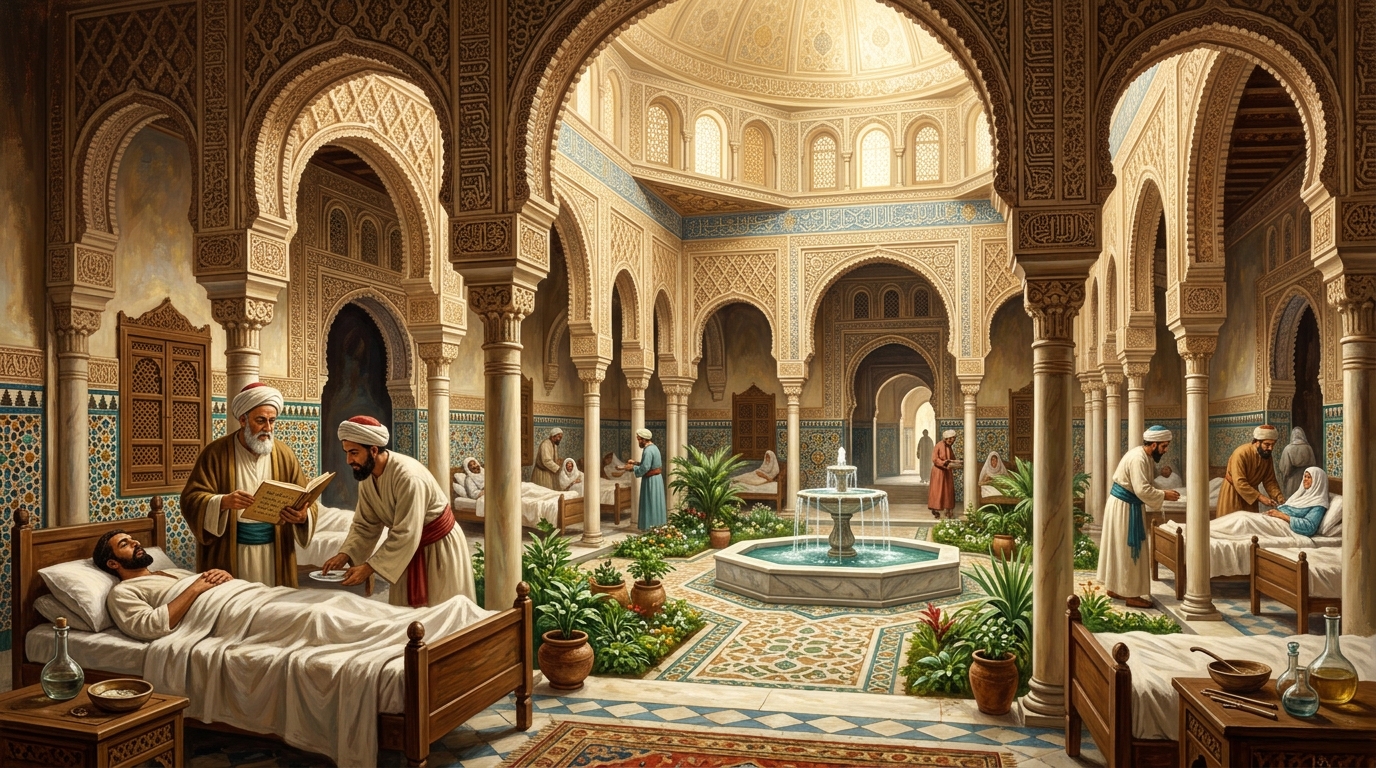
When you visit a hospital today, you experience a complex institution with specialized departments, trained nursing staff, pharmacy services, medical records, patient wards organized by disease type, and a commitment to treating patients regardless of ability to pay.
This entire institutional model — the modern hospital — was invented by Muslims in the medieval Islamic world, under the name Bimaristan (Persian: bimar = sick, stan = place).
The first Bimaristan was built in Baghdad in 805 CE. By the 12th century, the Islamic world had dozens of hospitals providing free care to all citizens, offering specialized treatment for different conditions, training medical students, and advancing pharmacology through institutional research.
Europe did not develop comparable institutions until the 13th century — and meaningful universal hospital care not until the 20th century.
1. The Islamic Foundation: Healing as Worship
The Prophet Muhammad ﷺ established the religious obligation to care for the sick:
"Visit the sick, feed the hungry, and free the captive."
(Sahih al-Bukhari 5649)
"There is no Muslim who visits a sick Muslim in the morning except that seventy thousand angels pray for him until evening."
(Jami' at-Tirmidhi 969)
This ethical imperative — that caring for the sick is a divine duty, not a commercial transaction — directly shaped the free, universal access model of the Islamic hospital.
The Quranic principle of human dignity also applied:
وَلَقَدْ كَرَّمْنَا بَنِي آدَمَ
"And We have certainly honored the children of Adam."
(Surah Al-Isra 17:70)
Every sick person, regardless of faith, wealth, or status, deserved treatment as a creation of Allah with inherent dignity.
The Bimaristan provided free, holistic care including music therapy, aromatic courtyards, and clinical counseling for mental illnesses.
2. The Baghdad Bimaristan: The World's First Modern Hospital (805 CE)
Caliph Harun al-Rashid ordered the construction of the first major Bimaristan in Baghdad in 805 CE, directed by Jibrail ibn Bukhtishu, a leading physician.
Key Features of the Baghdad Bimaristan:
- Separate wards for different diseases (fevers, ophthalmology, surgery, etc.)
- Male and female separate treatment areas
- Permanent, salaried medical staff — physicians, pharmacists, nurses
- Rotating doctors so patients always had access to a physician
- On-site pharmacy preparing prescribed medications
- Medical library for staff continuing education
- Student training program — the first hospital-based medical education
This was not just a hospital. It was a medical teaching hospital — integrating patient care, physician training, and pharmacy in a single institution. Modern hospital systems were not organized this way until the 19th century.
3. The Cairo Bimaristan al-Mansuri (1284 CE): A Hospital for 8,000 Patients
The Al-Mansuri Bimaristan in Cairo, built by Sultan Qalawun in 1284 CE, was the largest hospital in the medieval world — capable of treating 8,000 patients simultaneously.
Al-Mansuri's Revolutionary Features:
| Feature | Description | Modern Equivalent |
|---|---|---|
| Specialized wards | Separate buildings for surgery, fevers, eye diseases, bowel diseases | Hospital departments |
| Music therapy | Musicians performed for psychiatric patients daily | Music therapy programs |
| Storytellers | Professional storytellers for convalescent patients | Occupational therapy |
| Discharge grants | Patients received money on discharge to support recovery | Discharge planning |
| Outpatient clinic | Free daily consultation without admission | Outpatient department |
| Mobile medical units | Physicians visiting patients unable to reach the hospital | Home healthcare |
| Free pharmacy | All prescribed medicines dispensed at no cost | NHS/universal pharmacy |
Sultan Qalawun's waqf endowment (Islamic charitable trust) for the hospital specified:
"The hospital shall be open to all, free of charge, with no distinction of religion, nationality, or status, whether sick one day or many years, whether male or female, whether a soldier or a prince, whether a subject or a foreigner."
This is universal healthcare as formal institutional policy — in 1284 CE.
4. Revolutionary Mental Health Care: 600 Years Before Western Psychiatry
The most striking aspect of the Islamic bimaristan was its treatment of mental illness.
In medieval Europe, mentally ill individuals were:
- Considered possessed by demons
- Subjected to exorcism rituals
- Locked in dungeons or madhouses (Bedlam)
- Executed as witches or heretics
In the Islamic bimaristan, mental illness was treated as a medical condition — a disorder of the brain and nervous system requiring compassionate medical treatment:
- Separate psychiatric wards — the world's first dedicated mental health units
- Music and art therapy — the earliest documented therapeutic arts programs
- Gentle physical treatment — warm baths, pleasant surroundings, outdoor gardens
- Pharmacological treatment — plant-based medications for calming and sleep
- Social reintegration — patients were prepared for return to normal life
The Damascus Bimaristan (1154 CE) was specifically celebrated for its gentle treatment of the mentally ill — a stark contrast to European practices of the same era.
Ibn Jubayr, a Spanish Muslim traveler who visited the Damascus Bimaristan in 1184 CE, wrote:
"Another of the wonders of the city is the bimaristan... The insane were treated with care and kindness, and they were given all the medicines that would help to restore their minds."
Modern psychiatry — established as a formal discipline only in the 19th century — is still working toward the humane, non-stigmatizing approach that Islamic hospitals practiced 800 years ago.
5. The Islamic Hospital's Medical Education System
The bimaristan was not just a treatment facility — it was a medical school. The educational model:
- Theoretical training — students studied Kitab al-Hawi (al-Razi), Canon of Medicine (ibn Sina), and Kitab al-Tasrif (al-Zahrawi)
- Clinical rounds — senior physicians demonstrated diagnosis and treatment at bedsides
- Case documentation — students kept records of patient presentations and treatments
- Examinations — qualifying tests before independent practice
- Licensure — formal certification (ijaza) before a physician could treat patients independently
This is the clinical medical education model — theoretical study + supervised clinical practice + examination + licensure — that was adopted in European medical schools beginning in the 13th century and remains the global standard today.
6. The Islamic Pharmacy: Dispensing Science
Every bimaristan had an attached pharmacy (Saydaniyya) with:
- A trained pharmacist (Saydanani) — a separate profession from physician
- Standardized drug preparations — recipes ensuring consistent potency
- Quality control — testing of drugs before dispensing
- Formulary records — documentation of all medications issued
- Free dispensing — all prescribed medicines provided at no cost to patients
The separation of the physician's prescribing role from the pharmacist's dispensing role — a foundational principle of modern pharmacy practice — was established in Islamic medicine by Caliph Al-Mu'tasim's decree in the 9th century, preventing conflicts of interest in drug prescribing.
7. The Waqf System: Islamic Charitable Trust Funding Healthcare
All major bimaristanat were funded through waqf — Islamic endowments where wealthy donors dedicated property in perpetuity for religious or charitable purposes. This meant:
- Hospitals were financially independent of government (immune from political budget cuts)
- Funding was permanent — properties generating income indefinitely
- Management was accountable — trustees required to fulfill the donor's charitable intent
This is structurally identical to the endowment model used by Harvard Medical School, the Gates Foundation, and most major medical research institutions today — an Islamic innovation 1,000 years old.
Conclusion: The Hospital System That Islam Built
The modern hospital — with its departments, pharmacy, medical education, universal access, and psychiatric care — is the descendant of the Islamic bimaristan. The ethical principles that animate modern healthcare — universal access regardless of ability to pay, humane treatment of mental illness, separation of prescribing from dispensing, clinical education — were all established in Islamic civilization, rooted in Quranic values and Prophetic guidance.
The next time you enter a hospital, remember: the institution you're entering was first built by Muslims, for everyone, funded by charity, guided by the belief that every human being deserves healing — because every human being is honored by the One who created them.
"Allah has not sent down a disease except that He has sent down a cure for it."
(Sahih al-Bukhari 5678)