

 QuranGPT
Islamic Astronomical Observatories: How Muslim Scholars Built the World's Most Advanced Stargazing Institutions
Explore the magnificent Islamic observatories of Baghdad, Maragheh, and Samarkand — how Muslim astronomers revolutionized celestial mechanics, star catalogues, and the calendar system centuries before Copernicus.
The Holy Quran Team
Author
When Nicolaus Copernicus published his heliocentric theory in 1543, the astronomical tables he used to verify his calculations were not European. They were Islamic Zij tables — star almanacs compiled by Muslim astronomers in the great observatories of the Islamic Golden Age, 300 to 600 years earlier.
This is the story of those observatories: magnificent institutions of state-funded scientific inquiry where Muslim scholars measured the heavens with unprecedented precision, produced star catalogues still referenced today, and laid the mathematical foundation on which all of modern astronomy is built.
1. The Quranic Mandate: Why Muslims Were Commanded to Study the Stars
The Holy Quran repeatedly commands believers to observe and reflect upon the cosmos:
وَهُوَ الَّذِي جَعَلَ لَكُمُ النُّجُومَ لِتَهْتَدُوا بِهَا فِي ظُلُمَاتِ الْبَرِّ وَالْبَحْرِ
"And it is He who made the stars for you that you might be guided by them through the darkness of the land and sea."
(Surah Al-An'am 6:97)
For Muslims, determining the Qibla direction, calculating prayer times, fixing the Islamic calendar, and verifying the beginning of Ramadan all required precise astronomical knowledge. Religious obligation became the engine of scientific revolution.

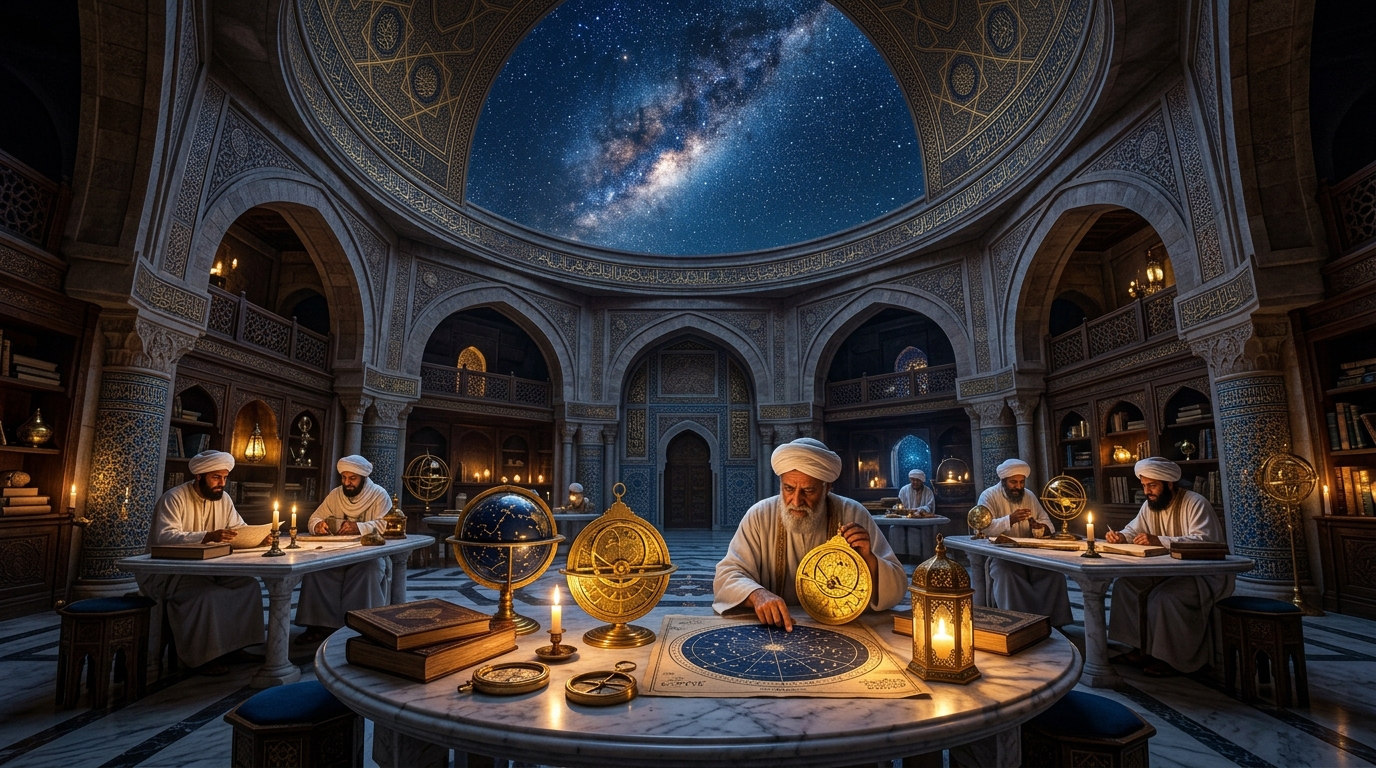
Astronomers at the Maragheh and Ulugh Beg observatories drafted the Zij tables with arcminute precision, influencing Copernicus centuries later.
2. The Baghdad Observatory and Bayt al-Hikmah (830 CE)
The House of Wisdom (Bayt al-Hikmah) under Caliph Al-Ma'mun housed the first dedicated Islamic astronomical observatory. Here, scholars like Al-Khwarizmi, Al-Farghani, and Yahya ibn Abi Mansur made the first systematic measurements of the Earth and heavens.
Key Baghdad Observatory Achievements:
- First accurate measurement of Earth's circumference — 24,000 miles (actual: 24,902 miles)
- Corrected Ptolemy's star positions across 200+ stars
- Produced Al-Ma'mun's Zij — the first comprehensive Islamic star table
- Measured the solar year to within 2 seconds of the modern value
3. Al-Battani: The Arab Ptolemy (858–929 CE)
Abu Abdallah Muhammad ibn Jabir al-Battani (Latinized: Albategnius) made astronomical observations so precise that Copernicus, Tycho Brahe, and Kepler all cited him by name in their own works.
Working from his private observatory in Raqqa, Syria, Al-Battani:
        AL-BATTANI'S ASTRONOMICAL CORRECTIONS

   Ptolemy's Solar Year  ──► 365 days 5h 55m 12s
   Al-Battani's Value   ──► 365 days 5h 46m 24s ✓
   Modern Actual Value  ──► 365 days 5h 48m 45s

   Al-Battani's error: only 2 minutes 21 seconds in a year!
He also:
- Discovered the annual motion of the Sun's apogee (later key to Kepler's laws)
- Proved Ptolemy's claim of annular solar eclipses wrong through direct observation
- Introduced trigonometric functions (sine, cosine) as tools for astronomical calculation
4. The Maragheh Observatory: The World's First Research Institution (1259 CE)
The Maragheh Observatory in northwest Iran, built under Nasir al-Din al-Tusi after the Mongol invasion, was arguably the world's first organized scientific research institute. It housed:
- A library of 400,000 volumes
- Multiple astrolabes, quadrants, and armillary spheres
- A team of Chinese, Persian, Arabic, and Syriac astronomers working collaboratively
- A dedicated workshop for instrument manufacturing
Al-Tusi's mathematical innovation, the "Tusi Couple" — a pair of rotating circles used to model planetary motion without Ptolemy's problematic equant — became the mathematical foundation that Copernicus used (almost verbatim) 250 years later.
"The similarity between al-Tusi's geometrical device and Copernicus's 'Tusi Couple' is so striking that historians have called it 'the Copernican Revolution's Islamic Origins.'"
— George Saliba, Islamic Science and the Making of the European Renaissance, MIT Press
5. Ulugh Beg's Samarkand Observatory (1428 CE): The Most Precise Star Catalogue Before the Telescope
Sultan Ulugh Beg built the Samarkand Observatory in present-day Uzbekistan — a three-story building housing a sextant with a 40-meter radius arc, the largest precision instrument of the medieval world.
His Zij-i Sultani (1437 CE) catalogued 1,018 stars with positions accurate to 1 arc-minute — surpassing every prior catalogue, including Ptolemy's Almagest (2nd century CE).
When European astronomers first got access to the Zij-i Sultani, they were astonished. Tycho Brahe's catalogue, considered a revolution in accuracy, was barely more precise than Ulugh Beg's 150-year-old work.
6. Key Instruments Invented by Islamic Astronomers
| Instrument | Inventor/Refiner | Function |
|---|---|---|
| Astrolabe | Ibrahim al-Fazari (~770 CE) | Star positions, time, Qibla direction |
| Quadrant (Rub' al-Mujayyab) | Al-Khwarizmi | Solar altitude, latitude |
| Mural Quadrant | Al-Battani | Fixed arc for precise star altitude |
| Parallactic Ruler | Nasir al-Din al-Tusi | Stellar parallax measurement |
| Equatorial Armillary Sphere | Jabir ibn Aflah | Planetary position tracking |
7. Islamic Astronomy's Direct Legacy in Modern Science
The evidence that modern astronomy is built on Islamic foundations is embedded in language itself. The names of hundreds of stars visible tonight carry their Arabic names:
- Aldebaran — from Arabic Al-Dabarān (The Follower)
- Betelgeuse — from Arabic Yad al-Jauzāʾ (Hand of Orion)
- Rigel — from Arabic Rijl Jauzāʾ al-Yusrā (Left Foot of Orion)
- Altair — from Arabic Al-Nasr al-Tā'ir (The Flying Eagle)
- Fomalhaut — from Arabic Fam al-Ḥūt (Mouth of the Fish)
Every time an astronomer names a star, they recite the legacy of Islamic science.
Conclusion: The Stars That Muslim Scholars Charted Still Guide Us
From the Baghdad observatories of 830 CE to Ulugh Beg's magnificent Samarkand institution of 1428 CE, Islamic astronomers charted the heavens with extraordinary precision — guided by their faith that understanding Allah's creation (Sunan Allah fi al-Kawn) is among the highest acts of knowledge.
The stars they measured, catalogued, and named still illuminate our night skies. The mathematical tools they invented still power our astronomical software. Their observatories were the direct predecessors of the European Renaissance — a fact that history is slowly, but rightfully, beginning to restore to its proper place.