

 QuranGPT
Invisible in Plain Sight: The Viral Video of the Palestinian Man, Surah Yaseen (36:9), and the Science of Inattentional Blindness
A comprehensive analysis of the viral video showing a Palestinian man standing motionless in plain sight before searching soldiers, examining Surah Yaseen (36:9), Prophetic Seerah parallels, cognitive psychology of inattentional blindness, and divine protection.
The Holy Quran Team
Author
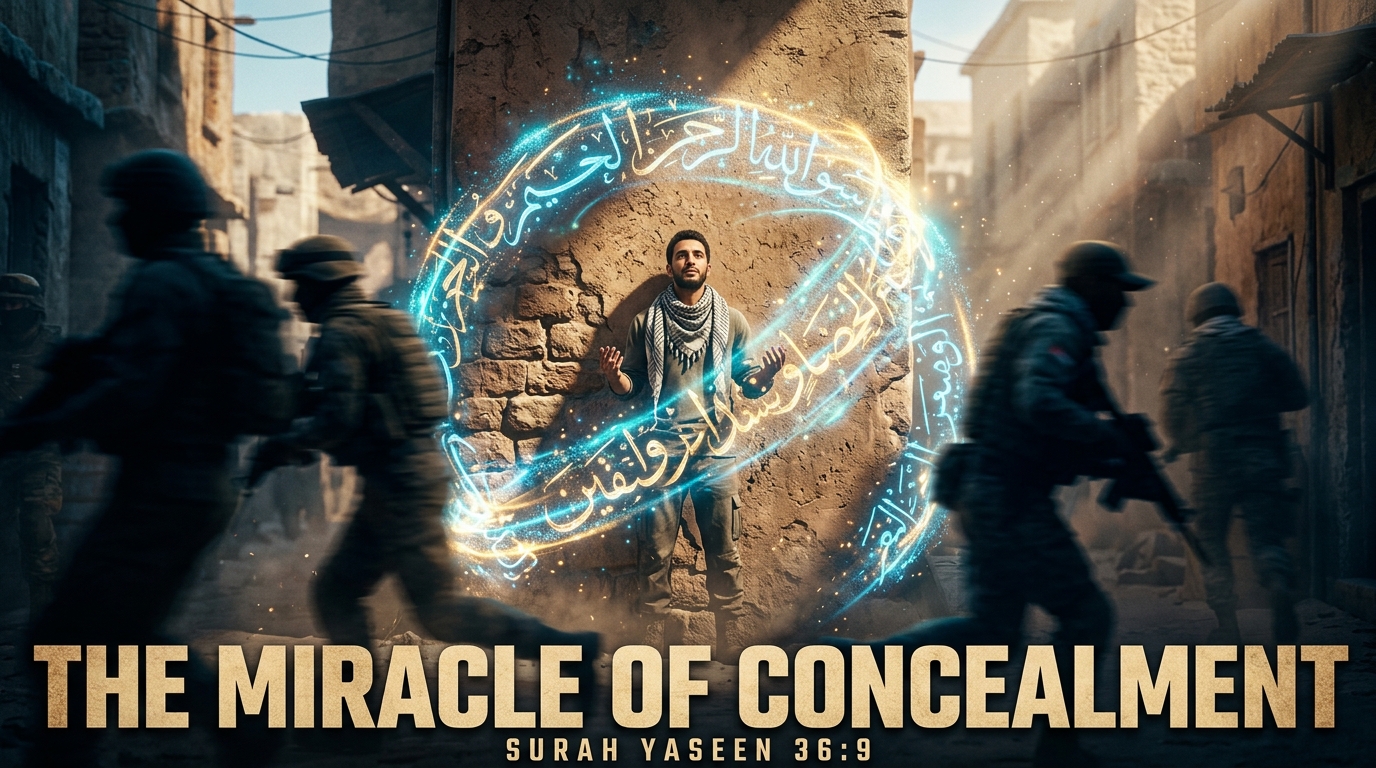
In recent months, a remarkable piece of video footage circulating across global social media platforms—highlighted by outlets such as The Daily ID on Instagram and independent documentation channels—captured international attention and sparked millions of heartfelt reactions.
The video depicts a Palestinian man standing completely motionless against an urban wall with his hands raised in surrender as armed soldiers conduct a rapid search operation through the immediate corridor. Despite the individual standing in broad daylight and in open view just feet away, the troops move briskly past him, scanning other doorways and angles, seemingly oblivious to his physical presence before moving on. You can view the viral footage and community discussions directly on The Daily ID Instagram Reel.
Across commentary sections and community forums worldwide, observers expressed astonishment, with many describing the scene as though the man had suddenly "disappeared" or been shielded by an invisible veil. For millions of Muslims, the scene immediately evoked one of the most powerful and frequently recited verses of the Holy Quran: Surah Yaseen, Verse 9 (36:9)—the timeless verse of divine shielding and concealment.
This article provides an in-depth, multi-dimensional exploration of this viral phenomenon, bridging authentic Quranic exegesis (Tafsir), historical parallels from the Prophetic Biography (Seerah), and modern cognitive neuroscience and optical psychology regarding how extreme stress and inattentional blindness shape human vision.
1. The Incident: What the Footage Shows
The viral video, shared widely across social media and documented on Instagram by The Daily ID, records an intense, high-stakes military sweep in a residential alleyway:
| Tactical Phase | Observable Behavior | Operational Outcome |
|---|---|---|
| 1. The Positioning | Civilian stands pinned flat against a weathered textured wall with hands raised in surrender. | Absolute physical stillness maintained; zero sudden micro-movements. |
| 2. The Pass-By | Armed soldiers in combat gear advance through the corridor, scanning forward and upper angles. | Troops bypass him within arm's reach without turning their focus to the wall. |
| 3. The Outcome | Troops clear the corridor and exit the frame. | The motionless man remains completely unharmed, untouched, and undetected. |
Key Behavioral Factors:
- Absolute Physical Stillness: The individual maintains rigorous bodily stillness, avoiding sudden micro-twitches, jerking movements, or eye-contact shifts.
- Environmental Fusion: His clothing, posture, and back-to-wall orientation align closely with the natural vertical lines and concrete texture of the surrounding building.
- High-Stress Scanning Patterns: The advancing troops are visibly fixated on distant focal points—windows, rooftop perimeters, and far doorways—rather than inspecting the immediate lateral wall plane.
While skeptics examine the footage through the lens of optical luck and tactical error, believers perceive a profound spiritual manifestation: how the Almighty orchestrates psychological and physical factors to protect the vulnerable in their most fragile moments.
2. The Spiritual Reality: Surah Yaseen (36:9) and the Barrier of Concealment
The verse most universally associated with this phenomenon is found in the opening section of Surah Yaseen (Chapter 36):
وَجَعَلْنَا مِن بَيْنِ أَيْدِيهِمْ سَدًّا وَمِنْ خَلْفِهِمْ سَدًّا فَأَغْشَيْنَاهُمْ فَهُمْ لَا يُبْصِرُونَ
English Translation:
"And We have placed a barrier before them and a barrier behind them and covered them so that they cannot see."
(Surah Yaseen, 36:9)
Exegetical Breakdown (Tafsir):
Classical Quranic commentators, including Imam Ibn Kathir, Imam al-Tabari, and Imam al-Qurtubi, explain the rich linguistic layers embedded within this verse:
| Quranic Term | Linguistic Root | Exegetical Meaning |
|---|---|---|
| سَدًّا (Saddan) | S-D-D (A firm barrier/rampart) | An impenetrable obstruction that blocks vision and prevents forward or backward movement. |
| فَأَغْشَيْنَاهُمْ (Fa-aghshaynahum) | Gh-Sh-Y (To envelop or veil) | To cast an overwhelming veil, darkness, or cognitive cloud over their sight. |
| فَهُمْ لَا يُبْصِرُونَ (Fahum la yubsirun) | B-S-R (To perceive/see) | Their physical eyes may remain wide open, yet their brain fails to perceive the reality directly in front of them. |
The Occasion of Revelation (Asbab al-Nuzul):
Scholars of Tafsir record that this verse was revealed regarding members of the Quraysh (such as Abu Jahl and his conspirators) who repeatedly swore to harm the Prophet Muhammad (peace and blessings be upon him) while he was praying near the Ka'bah. Whenever they approached with weapons or stones, Allah cast a sudden veil over their vision, causing them to wander in confusion unable to see the Messenger standing directly before them (Tafsir Ibn Kathir, Surah Yaseen).
3. The Historical Prophetic Parallel: The Night of the Hijrah
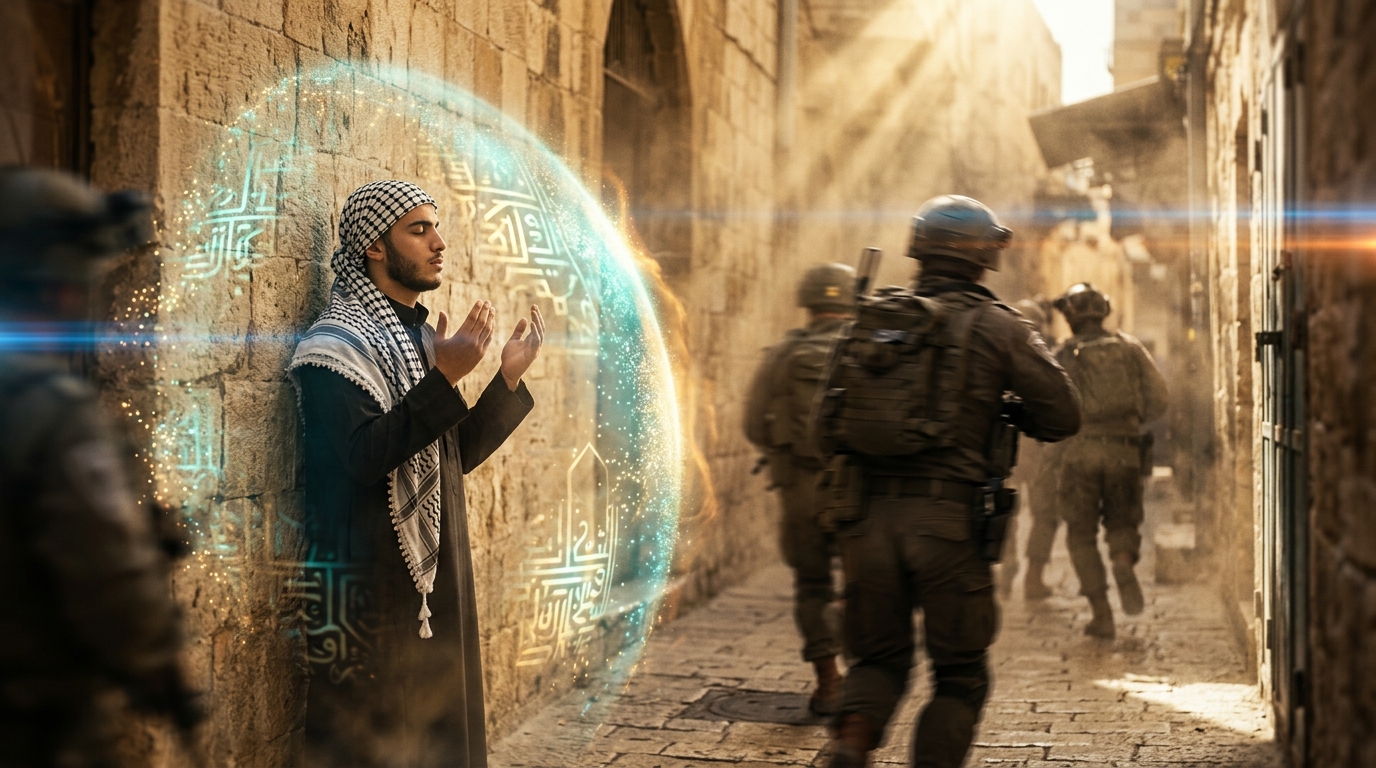
The viral scene in Palestine bears an uncanny thematic parallel to one of the most famous events in Islamic history: The Night of the Migration (Hijrah) from Makkah to Madinah.
| Dimension | Historical Event (The Plot) | Divine Manifestation (The Concealment) |
|---|---|---|
| The Mortal Danger | Armed assassins from every Quraysh tribe surround the Prophet's house, sworn to strike simultaneously. | The conspirators stand with drawn weapons outside the door, watching the doorway. |
| The Miraculous Deliverance | Prophet Muhammad (ﷺ) steps out reciting Surah Yaseen (36:9) and scatters dust over their heads. | The assassins' vision is veiled by Divine decree; the Prophet (ﷺ) departs safely unnoticed. |
The Authentic Historical Narrative:
When the leaders of Makkah plotted to assassinate the Prophet (ﷺ), they placed a cordon of armed warriors outside his door to strike him the moment he stepped out. The Prophet (ﷺ) instructed Ali ibn Abi Talib (may Allah be pleased with him) to sleep in his cloak upon his bed.
As recorded in Sirat Ibn Hisham and classical chronicles of the Seerah:
- The Prophet (ﷺ) opened the door and walked directly through the circle of assassins.
- He recited the opening verses of Surah Yaseen up to: «وَجَعَلْنَا مِن بَيْنِ أَيْدِيهِمْ سَدًّا وَمِنْ خَلْفِهِمْ سَدًّا فَأَغْشَيْنَاهُمْ فَهُمْ لَا يُبْصِرُونَ».
- He scattered a handful of dust over their heads as a sign of their blindness.
- The assassins remained standing in their places, completely unaware of his passage, until hours later when they realized he had safely departed.
This foundational narrative established for the Muslim consciousness that when Allah wills protection for a servant, the physical sight of an adversary can be entirely neutralized, even when standing in plain view.
4. Modern Cognitive Science: How Inattentional Blindness Works
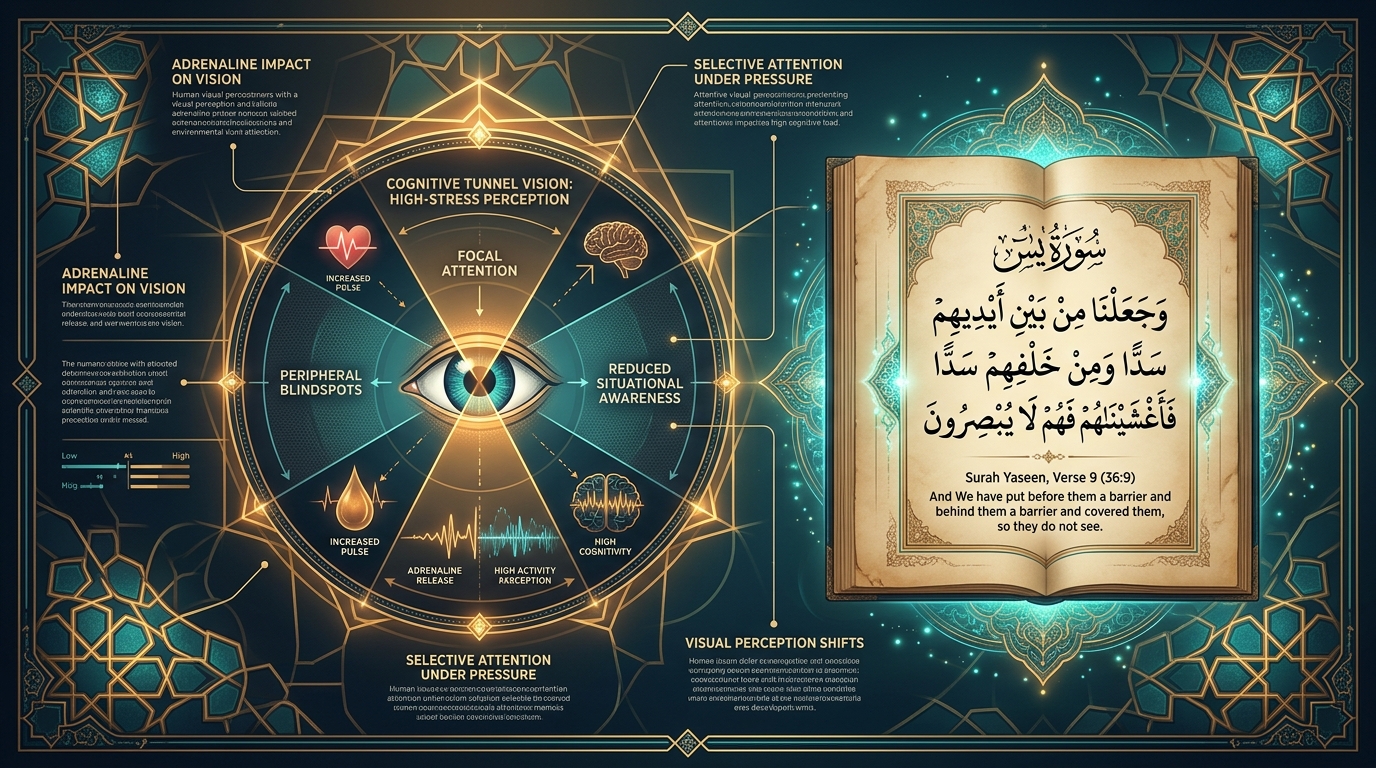
While the spiritual significance of the event resonates deeply with faith, modern cognitive psychology and vision neuroscience offer a fascinating empirical explanation of how the human brain can fail to see what is directly in front of the eyes.
1. Inattentional Blindness (The Mack & Rock / Simons & Chabris Paradigm)
In cognitive science, inattentional blindness is the psychological phenomenon whereby an individual fails to perceive an unexpected stimulus that is in plain sight, purely because their attention is engaged on other tasks or threats.
- The Famous "Invisible Gorilla" Study (1999):
Harvard psychologists Christopher Simons and Daniel Chabris demonstrated that when participants were asked to count basketball passes between players in white shirts, over 50% of viewers completely failed to notice a person in a gorilla suit walking into the center of the screen, thumping their chest, and walking off. - Application to Tactical Military Scenarios:
When soldiers enter an alleyway under high alert, their brains are under immense cognitive load. Their attentional spotlight is hunting for specific threat cues: movement, weapons, raised rifle barrels, or figures in distant windows. A stationary, motionless man standing flat against a wall does not match the active mental template of a threat, causing the visual cortex to literally discard the visual data before it reaches conscious awareness.
| Visual Mechanism | Neurological Effect Under Adrenaline | Impact on Scene Perception |
|---|---|---|
| Foveal Cone Tunneling | Adrenaline restricts conscious visual processing into a narrow 2–3° forward corridor. | Searchers fixate exclusively on distant doors, windows, and perimeter corners. |
| Magnocellular Motion Pathway | Retinal pathways prioritize rapid angular movement and high contrast. | Motionless posture produces zero optical motion vectors, suppressing detection. |
| Saccadic Suppression | The brain suspends visual intake for milliseconds during rapid eye jumps. | Eyes skip over intermediate flat surfaces between rapid focal points. |
| Cognitive Filtering | The brain's threat filter matches active hostile templates. | A non-moving figure blending into the wall is filtered out as background noise. |
2. Magnocellular Visual Pathways and Motion Detection
The human peripheral retina relies heavily on the magnocellular pathway, which is specialized for detecting rapid motion and high-contrast shifts.
- If the Palestinian man had made a sudden flinching movement, run, or reached into his pocket, the soldiers' peripheral motion sensors would have triggered an instant visual orienting reflex.
- By maintaining perfect, statue-like stillness, he produced zero optical motion vectors, allowing his silhouette to blend seamlessly into the peripheral background.
3. Saccadic Masking (Blind During Eye Jumps)
Human eyes do not scan the world smoothly like a video camera; they jump in rapid movements called saccades. During a saccade, the brain temporarily suspends visual intake (a phenomenon called saccadic suppression) to prevent blurry vision. In high-speed tactical sweeps, soldiers frequently jump their gaze past intermediate wall planes directly toward corners and doorways.
5. The Theological Harmony: Asbab (Physical Means) and Qadar (Divine Decree)
In authentic Islamic theology, there is no contradiction between scientific mechanisms and Divine intervention.
| Domain | Physical Causes (Asbab) | Divine Decree (Qadar) |
|---|---|---|
| Adversary Perception | Inattentional blindness, saccadic suppression, and cognitive tunnel vision. | The Almighty controls the neurological limits and cognitive filters of human minds. |
| Victim's Composure | Statue-like physical stillness, environmental blending, and suppression of panic. | The Almighty descends Sakinah (divine tranquility) onto the heart to prevent panic. |
-
Allah Controls the Means (Khaliq al-Asbab):
The Almighty is the Creator of the human visual cortex, the sympathetic nervous system, and the laws of cognitive attention. When Allah decides to protect a person, He can orchestrate both the inner tranquility (Sakinah) of the victim to remain perfectly still and the cognitive tunnel vision of the adversary. -
The Gift of Sakinah (Tranquility under Terror):
The natural biological reaction to approaching armed soldiers is panic, shaking, or running—actions that guarantee immediate detection. For an unarmed man to remain completely motionless with hands raised requires extraordinary inner composure:Quranic Verse • آية قرآنية30px۞هُوَ الَّذِي أَنزَلَ السَّكِينَةَ فِي قُلُوبِ الْمُؤْمِنِينَ لِيَزْدَادُوا إِيمَانًا مَّعَ إِيمَانِهِمْ ۗ وَلِلَّهِ جُنُودُ السَّمَاوَاتِ وَالْأَرْضِ ۚ وَكَانَ اللَّهُ عَلِيمًا حَكِيمًا
✦"It is He who sent down tranquility (Sakinah) into the hearts of the believers that they would increase in faith along with their faith. And to Allah belong the soldiers of the heavens and the earth, and Allah is ever Knowing and Wise."
(Surah Al-Fath, 48:4)
6. Frequently Asked Questions (FAQ)
Q1: Is reciting Surah Yaseen (36:9) recommended during times of fear or danger?
Answer: Yes. Throughout Islamic history, scholars and pious predecessors have recommended reciting the opening verses of Surah Yaseen, especially verse 36:9, when seeking protection from oppressors, harm, or danger, following the noble example of the Prophet (peace and blessings be upon him) during the Night of the Hijrah.
Q2: Does cognitive science diminish the miraculous nature of the event?
Answer: Not at all. In Islamic epistemology, physical laws and neurological phenomena are instruments of the Divine will. The fact that the human brain can be rendered blind to objects directly in front of it under stress is itself a testament to the miraculous design of human perception crafted by the Creator.
Q3: Why is stillness so critical in surviving high-threat encounters?
Answer: Both modern tactical survival training and biological science confirm that the human visual system is fundamentally motion-activated. Maintaining composure and stillness prevents triggering peripheral threat reflexes in adversaries experiencing high adrenaline.
Conclusion: The Unseen Shield of the Oppressed
The viral footage of the Palestinian man standing untouched in an alleyway serves as a vivid contemporary parable of faith, composure, and providence.
Whether analyzed through the lens of cognitive psychology and inattentional blindness or viewed through the timeless spiritual majesty of Surah Yaseen (36:9), the event stands as a powerful reminder:
فَسَيَكْفِيكَهُمُ اللَّهُ ۚ وَهُوَ السَّمِيعُ الْعَلِيمُ
"And Allah will suffice you against them. And He is the Hearing, the Knowing."
(Surah Al-Baqarah, 2:137)
When human strength is exhausted and vulnerability is total, the unseen shields of Divine decree remain ever capable of veiling the eyes of power and protecting the hearts of the steadfast.