

 QuranGPT
Ibn al-Haytham: Father of Optics Who Invented the Scientific Method 600 Years Before Newton
How Ibn al-Haytham (Alhazen) overturned Greek optical theory, invented the camera obscura, and established systematic experimental physics in 11th century Cairo — becoming the founding father of optics and the scientific method.
The Holy Quran Team
Author
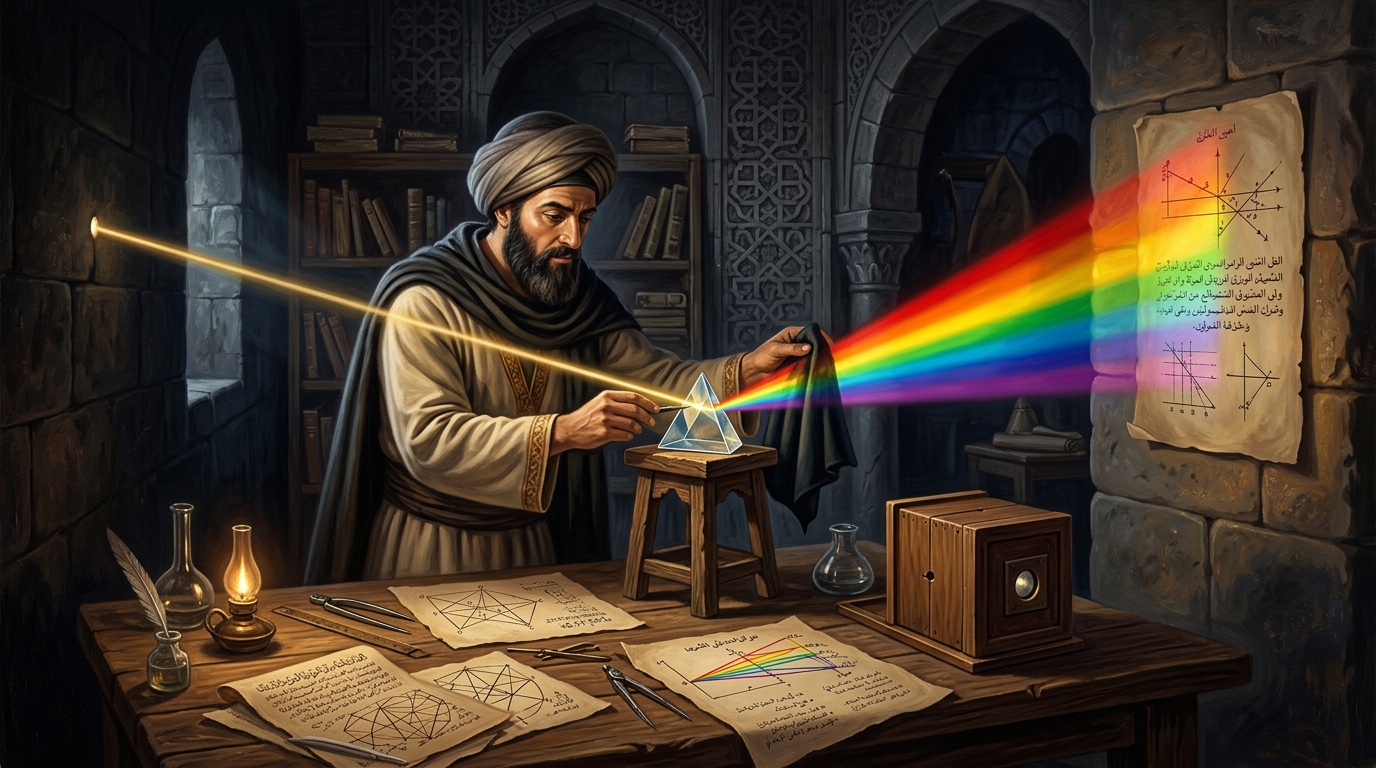
When you use a camera, look through a telescope, understand why the sky is blue, or have your vision tested by an optometrist, you are using science that traces directly to a single brilliant Muslim physicist who worked in 11th century Cairo.
Abu Ali al-Hasan ibn al-Hasan ibn al-Haytham (965–1040 CE), known in Europe as Alhazen, is the most important physicist between Archimedes (3rd century BCE) and Galileo (17th century CE). He is the Father of Modern Optics — the science of light and vision — and arguably the inventor of the experimental scientific method itself.
1. The Great Inversion: Overturning 800 Years of Greek Theory
For 800 years before Ibn al-Haytham, the dominant theory of vision — taught by Euclid, Plato, and Galen — was the Emission Theory: the eye emits rays of light that travel outward and "touch" objects, enabling vision.
Ibn al-Haytham proved this was fundamentally wrong. In his masterpiece Kitab al-Manazir (Book of Optics, 1011 CE), he established the correct Intromission Theory: light from external sources enters the eye. Vision occurs when light rays from objects enter the eye — not when the eye emits rays.
"If the eye emitted rays, then closing our eyes in complete darkness would enable us to see by our own emission. It does not. Therefore, light must come from outside and enter the eye."
— Ibn al-Haytham, Kitab al-Manazir, Book I
This logical, experiment-based disproof of 800 years of Greek authority was a revolution in scientific epistemology — the idea that authority must yield to evidence.
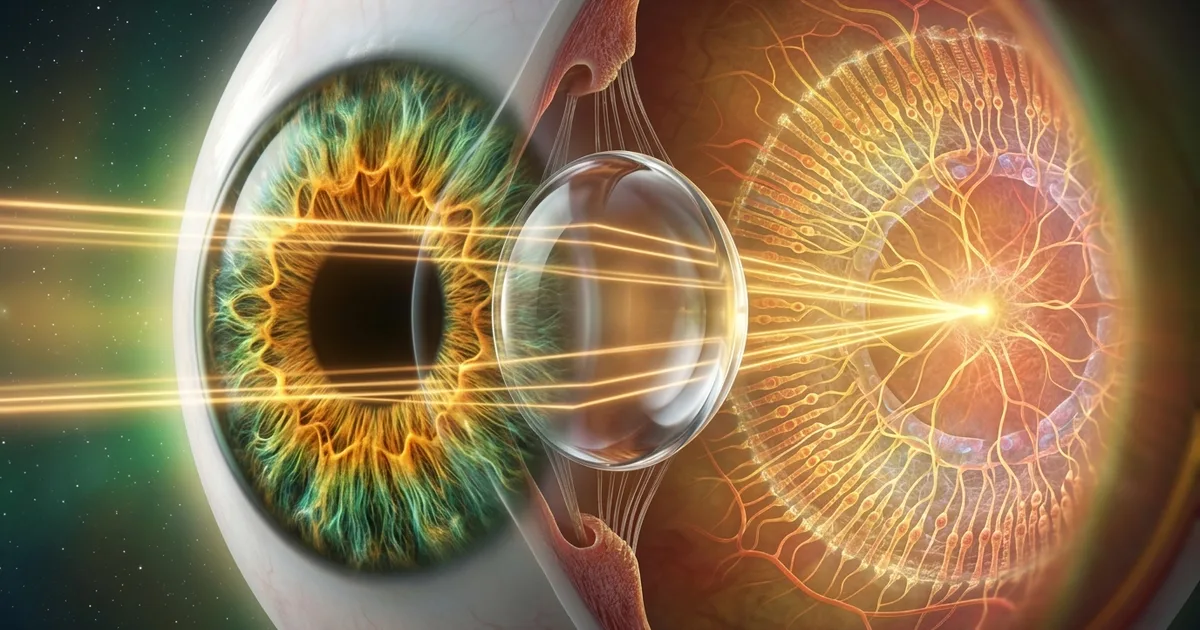
In Kitab al-Manazir, Ibn al-Haytham correctly mapped the cornea, retina, and optic nerve, proving intromission theory.
2. The Camera Obscura: Inventing the Ancestor of Photography
Ibn al-Haytham conducted the first systematic experiments with the camera obscura (Qamara, Arabic for "dark room") — a dark room with a small hole through which external light enters, projecting an inverted image on the opposite wall.
Ibn al-Haytham's Camera Obscura Experiments:
        CAMERA OBSCURA EXPERIMENTAL SETUP

   External Scene ──► Small Hole ──► Dark Room
                         │
                         ▼
   Inverted image projected on opposite wall

   CONCLUSIONS:
   1. Light travels in straight lines
   2. Each point of an object emits rays in all directions
   3. The hole selects one ray per object point → forms image
   4. Eyes work identically to camera obscura
The direct technological descendants:
- Renaissance artists used camera obscura for painting perspective
- 19th century photography captured the camera obscura image chemically
- 20th century cinema — motion pictures — are camera obscura + chemistry + timing
- Digital cameras and smartphone cameras — modern electronic camera obscura
3. Kitab al-Manazir: The Seven-Volume Revolution
Ibn al-Haytham's Kitab al-Manazir (Book of Optics) consisted of seven volumes:
| Volume | Subject | Impact |
|---|---|---|
| 1-2 | Theory of vision, anatomy of the eye | Founded modern ophthalmology |
| 3 | Binocular vision and depth perception | Founded optometry |
| 4-5 | Reflection (mirrors, curved surfaces) | Founded catoptrics |
| 6-7 | Refraction (lenses, prisms, rainbows) | Founded dioptrics and lens optics |
Translated into Latin as Perspectiva in the 13th century, it became the standard optics textbook in European universities for 300 years — used by Roger Bacon, Leonardo da Vinci, Johannes Kepler, and René Descartes.
4. Ibn al-Haytham's Experimental Method: The First Scientist
What made Ibn al-Haytham truly revolutionary was not just his optical discoveries but his methodology — the systematic procedure he used to arrive at them:
- Pose a problem clearly and precisely
- Establish prior observations from careful measurement
- Form a hypothesis based on reason, not authority
- Design a controlled experiment to test the hypothesis
- Record results precisely and reproducibly
- Modify the hypothesis if results contradict it
- Repeat until hypothesis and experiment agree
This is the modern scientific method. It is the procedure used in every laboratory on Earth today. And Ibn al-Haytham formalized it in writing in 1011 CE — 600 years before Francis Bacon claimed credit for it in Europe (1620 CE).
5. The Anatomy of the Eye: Ibn al-Haytham's Optical Biology
Ibn al-Haytham studied the eye as a physical optical instrument — the first scholar to do so rigorously. He:
- Correctly identified the cornea, lens, vitreous humor, and retina
- Established that the lens focuses light onto the retina (though he incorrectly placed perception in the optic nerve rather than the visual cortex)
- Proved that the eye forms an inverted, real image — like a camera obscura
- Explained binocular vision and depth perception through geometric analysis
His description of the eye's anatomy was so accurate that it was used as the reference standard in European medicine until the 17th century.
6. Explaining Natural Phenomena Through Optics
Ibn al-Haytham applied his optical theory to explain natural phenomena previously attributed to mysticism:
The Rainbow: Ibn al-Haytham proposed the first scientific geometric model of rainbow formation through light refraction in water droplets — confirmed and elaborated by Kamal al-Din al-Farisi 300 years later and by Descartes 600 years later.
Twilight and Atmospheric Refraction: He explained why the sky remains bright after sunset — light refracts through the atmosphere — and even estimated the height of Earth's atmosphere at approximately 52,000 cubits (~15.3 km), remarkably close to the modern value of the troposphere height (~12 km).
The Moon Illusion: Why does the moon appear larger at the horizon? Ibn al-Haytham provided the first psychological-optical explanation — it is a visual perception phenomenon, not an actual size change.
7. Legacy in the Islamic Tradition
For Ibn al-Haytham, scientific inquiry was inseparable from Islamic faith. He opened his Kitab al-Manazir with:
"We should, that is to say, restart the subject from the beginning, and should revise the principles and premises upon which we shall build, and proceed in an orderly manner in examining the evidence from the senses..."
This was the Islamic scholarly tradition of Ijtihad (independent analytical reasoning) applied to natural science — refusing to accept inherited Greek authority, insisting on original investigation guided by the light of reason that Allah gave humanity.
The Quran states:
أَفَلَا يَنظُرُونَ إِلَى الْإِبِلِ كَيْفَ خُلِقَتْ
"Do they not look at the camels — how they are created?"
(Surah Al-Ghashiyah 88:17)
Ibn al-Haytham looked. And he saw light — the light of Allah's creation — with unprecedented clarity.
Conclusion: The Eye That Changed How We See the World
Ibn al-Haytham was not simply a great medieval scientist. He was the inventor of the experimental method that made modern science possible. Every laboratory that runs a controlled experiment, every scientist who tests a hypothesis against data, every engineer who designs a lens — they all work within the framework that this brilliant Muslim physicist established in 11th century Cairo.
The cameras that capture our memories, the telescopes that explore the cosmos, the medical imaging that saves lives — all are the technological legacy of Ibn al-Haytham's revolutionary insight that light comes into the eye, not from it.
"The duty of the man who investigates the writings of scientists, if learning the truth is his goal, is to make himself an enemy of all that he reads."
— Ibn al-Haytham
This is the spirit of science. It was born in Islam.