

 QuranGPT
The History of Mathematics: From Ancient Numerals to the Islamic Golden Age and Modern Computing
An exhaustive academic study tracing the evolution of mathematics, algebraic foundations in the Islamic Golden Age, Quranic cosmic metrics, and modern algorithmic computation.
The Holy Quran Team
Author
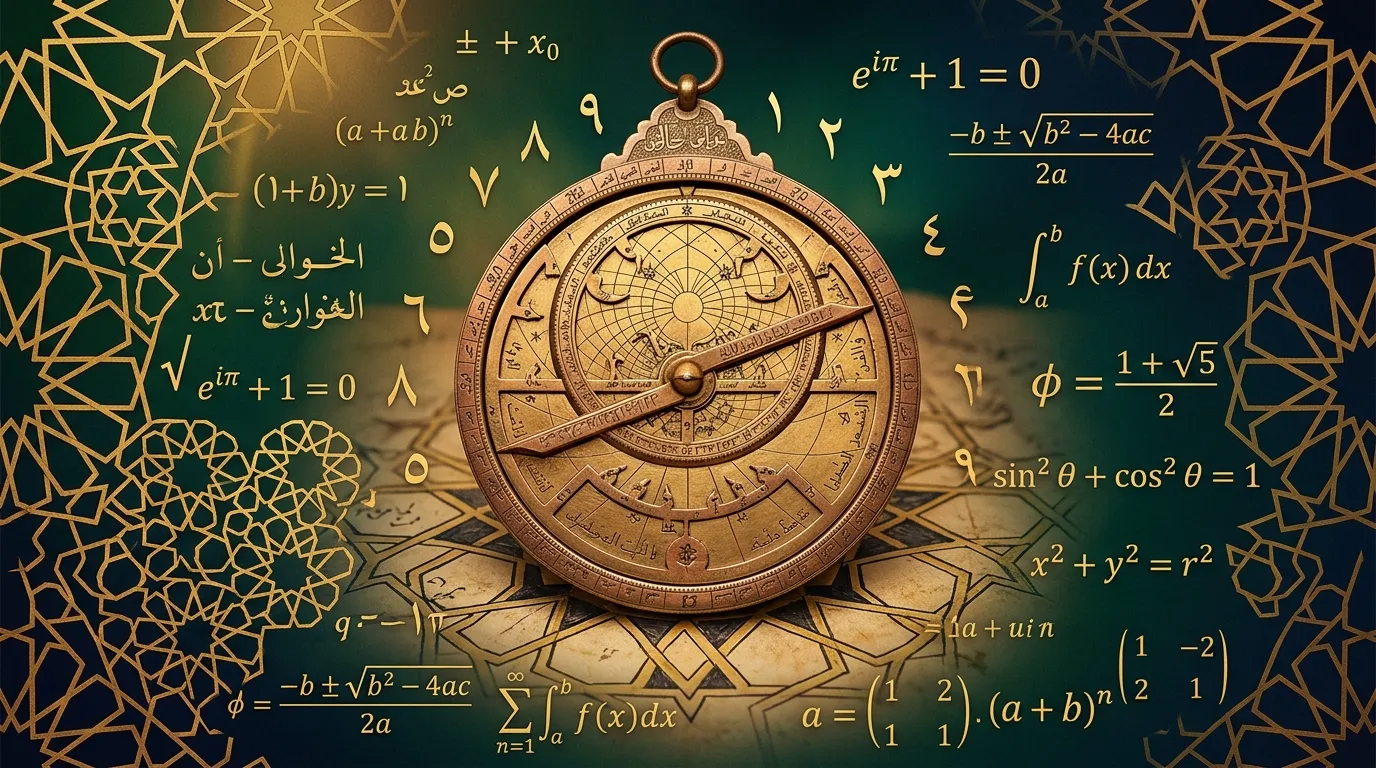
In the contemporary landscape of 2026, mathematics underpins every facet of civilization—from cryptographic security protocols and artificial neural networks to aerodynamic simulations and quantum orbital mechanics. Yet, the vast architecture of modern mathematics is not the sudden creation of the post-industrial West; it represents an uninterrupted, multi-millennial relay of intellectual discovery spanning Mesopotamia, the Nile Valley, the Indus Basin, Classical Greece, the intellectual capitals of the Islamic Golden Age, and Renaissance Europe.
Understanding the historical trajectory of mathematical thought is essential for scientists, software architects, historians, and students of epistemology. Mathematics is far more than an abstract tool for mechanical calculation; it is the universal formal language through which humanity perceives the profound structural symmetry, equilibrium, and physical constants embedded within the fabric of the universe.
This comprehensive inquiry investigates the full chronological arc of mathematics. We examine the early numerical systems of antiquity, the revolutionary transformations forged during the Islamic Golden Age by luminaries such as Muhammad ibn Musa al-Khwarizmi and Ibn al-Haytham, the profound metaphysical principles of cosmic order articulated in the Quran, and the direct genealogy connecting medieval algebraic treatises to 21st-century computational intelligence.
1. Executive Summary: Mathematics & Civilizational Evolution Matrix
The evolution of mathematical thought has historically progressed through five distinct paradigmatic epochs. Each era transformed quantitative calculation from localized practical reckoning into universal, abstract problem-solving engines.
| Parameter | Civilizational Dimension | Primary Methodological Focus |
|---|---|---|
| Archaic Foundations (3000–500 BCE) | Mesopotamia, Nile Valley, Indus Valley | Practical tallying, land surveying, sexagesimal arithmetic, architectural geometry |
| Axiomatic Synthesis (600–200 BCE) | Classical Greece, Magna Graecia | Deductive geometry, axiomatic rigor, Pythagorean harmonic ratios, Euclidean proofs |
| Algebraic & Positional Revolution (750–1258 CE) | Baghdad, Cairo, Córdoba, Samarkand | Systematic algebra (al-Jabr), decimal positional zero (Sifr), spherical trigonometry, optics |
| Analytic & Calculus Epoch (1600–1850 CE) | Western Europe | Coordinate geometry, infinitesimal calculus, differential equations, classical dynamics |
| Computational & Quantum Paradigm (1900–2026+) | Global Distributed Networks | Turing computability, algorithmic AI, discrete topology, cryptography, quantum tensor calculus |
2. Antiquity and the Genesis of Number: Mesopotamia, Egypt, and Greece
The earliest mathematical records emerge from administrative, agricultural, and astronomical necessities. In ancient Sumer and Babylon (circa 3000 BCE), scribes developed a sexagesimal (base-60) positional number system preserved on cuneiform clay tablets such as Plimpton 322. The Babylonians computed reciprocal tables, square roots, and Pythagorean triples more than a millennium prior to Pythagoras.
Simultaneously, ancient Egyptian civilization developed decimal-based hieroglyphic and hieratic mathematical papyri (most notably the Rhind Mathematical Papyrus and Moscow Mathematical Papyrus). These texts detailed unit fraction arithmetic, practical volume formulas for frustums of pyramids, and slope calculations (seked) crucial for monumental stone engineering.
                      ANCIENT NUMBER SYSTEMS COMPARISON

   +--------------------+---------------------+----------------------------------+
   | Civilization       | Numerical Base      | Key Structural Legacy            |
   +--------------------+---------------------+----------------------------------+
   | Babylonian         | Base-60 Positional  | 360-degree circles, 60-min hours |
   | Egyptian           | Base-10 Additive    | Unit fractions, volumetric ratio |
   | Classical Greek    | Letter Numerals     | Axiomatic deductive proof        |
   | Maya               | Base-20 Positional  | Independent discovery of zero    |
   | Hindu-Arabic       | Base-10 Positional  | Operational zero, global algebra |
   +--------------------+---------------------+----------------------------------+
The Greek Axiomatic Shift
Between 600 BCE and 200 BCE, Hellenic thinkers shifted mathematics from empirical computation to abstract deductive proof:
- Thales and Pythagoras: Introduced the concept that geometric relationships must be universally demonstrated rather than verified merely through empirical measurement.
- Euclid of Alexandria (c. 300 BCE): Composed the Elements (Stoicheia), establishing the axiomatic method—deriving hundreds of theorems from five foundational postulates. Euclid's work served as the undisputed gold standard of geometric pedagogy for over two millennia.
- Archimedes of Syracuse (c. 287–212 BCE): Anticipated modern integral calculus through the method of exhaustion, calculating precise bounds for π (pi) and determining parabolic segment areas.
However, Greek mathematics remained fundamentally constrained by geometric spatial thinking. Because the Greeks lacked an efficient operational notation for arithmetic and zero, equations could only be conceptualized as geometric lengths, areas, and solids.
3. The Islamic Golden Age: The Revolution of Algebra, Algorithms, and Decimal Zero
Following the establishment of the Abbasid Caliphate in Baghdad and the founding of the House of Wisdom (Bayt al-Hikmah) in the late 8th century CE, Islamic scholars initiated the most explosive synthesis and advancement of mathematical science in human history.
Scholars translated, critiqued, and dramatically expanded upon Greek, Sanskrit, Persian, and Babylonian treatises. Rather than passively preserving antiquity, Muslim mathematicians created entirely new disciplines that uncoupled mathematical truth from physical geometry.
Al-Khwarizmi: The Father of Algebra and Algorithms
In approximately 820 CE, Muhammad ibn Musa al-Khwarizmi (c. 780–850 CE) published his monumental treatise:
Al-Kitab al-mukhtasar fi hisab al-jabr wa-l-muqabala
(The Compendious Book on Calculation by Completion and Balancing)
From this seminal title, the world inherited the word Algebra (al-Jabr), meaning the restoration and balancing of cancelled terms across an equals sign. Al-Khwarizmi achieved a revolutionary conceptual leap: he treated the unknown quantity (shay', literally "thing," which became x in European translation) as an independent algebraic entity that could be manipulated through systematic arithmetic operations.
Al-Khwarizmi classified and solved all six canonical forms of linear and quadratic equations:
ax² = bx         |  ax² = c          |  bx = c
ax² + bx = c     |  ax² + c = bx     |  bx + c = ax²
Moreover, his Latinized name, Algoritmi, gave rise to the term Algorithm, designating any deterministic, step-by-step procedure for solving a computational problem—the bedrock principle of all modern computer science.
The Institutionalization of the Decimal Zero (Sifr)
While ancient Indian mathematicians (notably Brahmagupta in the 7th century) had introduced the conceptual zero (shunya), it was Muslim mathematicians who systematized the decimal positional system into an indispensable global standard.
Al-Khwarizmi's Latin-translated work Algoritmi de numero Indorum popularized positional calculation using the zero (ṣifr, meaning "empty" or "void", which evolved into both cipher and zero in European languages). Abu al-Hasan al-Uqlidisi (c. 952 CE) in Damascus subsequently invented decimal fractions, completely eliminating the unwieldy sexagesimal conversions required for daily commerce.
The Trigonometric and Optical Renaissance
Muslim scholars transformed trigonometry from an astronomical accessory into an independent mathematical discipline:
- Al-Battani (Albatenius, 858–929 CE): Replaced cumbersome Ptolemaic chords with the trigonometric functions: sine (sin), cosine (cos), tangent (tan), and cotangent (cot), computing tables of unprecedented precision.
- Abu al-Wafa al-Buzjani (940–998 CE): Formulated fundamental trigonometric identities, including the addition formula
sin(a ± b) = sin(a)cos(b) ± cos(a)sin(b). - Ibn al-Haytham (Alhazen, 965–1040 CE): Authored the Kitāb al-Manāẓir (Book of Optics), establishing the modern scientific method by combining rigorous geometry with controlled physical experimentation. His solution to Alhazen's Problem (finding the reflection point on a spherical mirror) involved solving a fourth-degree polynomial through geometric conic intersections.
- Omar Khayyam (1048–1131 CE): Celebrated poet and polymath who systematically classified and solved cubic equations (
ax³ + bx² + cx = d) by intersecting parabolas with circles, establishing the direct precursor to Descartes' analytic geometry. - Sharaf al-Din al-Tusi (1135–1213 CE): Developed early concepts of differential calculus by determining the maximum values of cubic polynomials through derivatives to identify whether roots existed.
4. Quranic Metaphysics of Measurement, Balance, and Cosmic Order
In Islamic epistemology, the investigation of mathematical patterns is directly linked to spiritual contemplation. The Quran repeatedly emphasizes that the universe was engineered with absolute mathematical precision, quantifiable balance, and immutable natural laws established by the Supreme Creator.
Cosmic Measure: The Concept of Qadar and Miqdar
The Quran underscores that every created entity possesses an intrinsic, mathematically determined measure:
إِنَّا كُلَّ شَىْءٍ خَلَقْنَـٰهُ بِقَدَرٍ
"Indeed, all things We created with predetermined measure (Qadar)."
— Surah Al-Qamar (54:49)
Tafsir Insight: Classical commentators including Imam Al-Razi noted that Qadar signifies exact proportion, quantity, and dimensional equilibrium. Nothing in physical reality is arbitrary; every fundamental particle, planetary trajectory, and biological mechanism is calibrated to precise mathematical constants.
The Balance (Al-Mizan) of the Heavens
وَٱلسَّمَآءَ رَفَعَهَا وَوَضَعَ ٱلْمِيزَانَ • أَلَّا تَطْغَوْا۟ فِى ٱلْمِيزَانِ
"And the heaven He raised and imposed the balance (Al-Mizan), that you not transgress within the balance."
— Surah Ar-Rahman (55:7-8)
Tafsir Insight: Al-Mizan represents cosmic equilibrium—gravitational balance, thermodynamic equilibrium, and geometric harmony. The Quran connects the physical equilibrium of the celestial spheres with the moral and ethical duty of human beings to maintain justice, honest weights, and rigorous equity in earthly affairs.
Mathematical Reckoning and Heavenly Mechanics
ٱلشَّمْسُ وَٱلْقَمَرُ بِحُسْبَانٍ
"The sun and the moon move by precise calculation (Husban)."
— Surah Ar-Rahman (55:5)
The word Husban derives from the Arabic root H-S-B (to compute, reckon, or calculate), emphasizing that celestial mechanics are mathematically deterministic and calculable. This explicit theological affirmation drove Islamic astronomers to build sophisticated observatories, refine astrolabes, and formulate spherical trigonometry to calculate precise prayer times, the lunar calendar, and the geographic orientation toward Mecca (Qibla).
5. The Transmission to Europe: From Fibonacci to the Calculus Revolution
During the 11th and 12th centuries, a vast translation movement took root in Toledo (Spain), Salerno, and Sicily. Scholars such as Gerard of Cremona and Adelard of Bath translated hundreds of Arabic mathematical, astronomical, and medical treatises into Latin.
                    CROSS-CIVILIZATIONAL KNOWLEDGE VECTOR

   [Baghdad & Cairo Masters] ──► [Toledo Translation Movement]
                                              │
                                              ▼
                             [Leonardo Fibonacci (1202 CE)]
                             (Liber Abaci — Spread Hindu-Arabic)
                                              │
                                              ▼
                             [Renaissance European Algebra]
                             (Cardano, Tartaglia, Viète)
                                              │
                                              ▼
                             [Analytical Calculus Revolution]
                             (Descartes, Newton, Leibniz)
Fibonacci and the Liber Abaci (1202 CE)
Leonardo of Pisa (Fibonacci), who studied under Muslim tutors in the trading port of Bugia (modern-day Algeria), published his revolutionary text Liber Abaci (Book of Calculation) in 1202 CE. Fibonacci explicitly credited the Arab method (Modus Indorum), introducing Hindu-Arabic numerals, the zero, and algorithmic bookkeeping to European merchants and academics, which dismantled the cumbersome Roman numeral system.
The Scientific Revolution and Calculus
By the 17th century, European scholars expanded upon this foundation:
- René Descartes (1596–1650): Synthesized algebra and Euclidean geometry into Cartesian coordinate geometry, enabling curves to be expressed as algebraic functions.
- Isaac Newton (1642–1727) & Gottfried Wilhelm Leibniz (1646–1716): Independently formulated Infinitesimal Calculus, providing the mathematical framework for dynamics, gravitation, and fluid mechanics. Leibniz introduced the notation still used today (the integral symbol ∫ and differential notation d/dx).
6. Algorithmic Lineage: From Al-Khwarizmi to Machine Learning and Quantum Computing
The philosophical definition of an algorithm—a deterministic set of step-by-step operational rules—has evolved from manual pencil-and-paper computation into hyper-scale distributed algorithms that govern 2026 digital society.
                       EVOLUTION OF THE ALGORITHMIC ENGINE

   [820 CE: Al-Khwarizmi] ────► Manual Arithmetic & Algebraic Reductions
             │
             ▼
   [1843 CE: Ada Lovelace] ───► First Machine Algorithm for Babbage Engine
             │
             ▼
   [1936 CE: Alan Turing] ────► Universal Turing Machine & Computability Limits
             │
             ▼
   [1950s–1980s: Von Neumann]► Electronic Stored-Program Digital Computers
             │
             ▼
   [2026: Transformers & AI] ─► Multi-Billion Parameter Deep Learning Tensors
             │
             ▼
   [Quantum Computing] ───────► Unitary Matrix Transformations & Qubits
In modern machine learning, artificial neural networks execute billions of linear algebraic matrix multiplications (Y = WX + B) followed by non-linear activations every millisecond. The mathematical foundation of backpropagation (gradient descent via the calculus chain rule) is the direct intellectual heir of the analytical balancing procedures pioneered over a millennium ago.
7. Comparative Analysis: Ancient Antiquity vs. Islamic Mathematical Innovations
A rigorous historical assessment reveals how the Islamic Golden Age redefined the very scope of mathematical inquiry:
| Dimension | Pre-Islamic Antiquity | Islamic Golden Age Innovation | Modern Impact (2026) |
|---|---|---|---|
| Algebraic Notation | Geometric proofs; equations tied to physical geometric figures | Dedicated symbolic abstraction; operational rules (Al-Jabr) | Universal algebraic notation; software compiler logic |
| Positional Zero | Place-holder dot (Babylon/Maya); absent in Roman system | Operational decimal zero (Sifr); full arithmetic rules | Binary arithmetic (0 and 1); digital memory registers |
| Trigonometry | Astronomical chord tables (Ptolemaic chords) | Sine, cosine, tangent, spherical trigonometry theorems | GPS navigation, 3D graphics rendering, signal processing |
| Scientific Method | Pure deductive reasoning or speculative natural philosophy | Empirical experimentation integrated with mathematical proof | Peer-reviewed laboratory science, quantitative validation |
| Calculus Precursors | Geometric method of exhaustion (Archimedes) | Polynomial maxima via algebraic derivatives (Al-Tusi) | Optimization algorithms, machine learning backpropagation |
8. Practical Epistemological Principles for Modern Learners and Researchers
To cultivate mathematical mastery and analytical rigor, students and professionals can implement five timeless principles derived from the historical masters:
- Prioritize First-Principles Conceptualization: Never treat mathematical formulas as arbitrary memorized steps. Understand the structural origin and derivation of every theorem, just as Al-Khwarizmi derived algebraic solutions from fundamental geometric balance.
- Embrace Unified Cross-Disciplinary Synthesis: Break down artificial barriers between disciplines. Connect pure mathematics with computer programming, physical systems, economics, and architectural aesthetics.
- Cultivate Algorithmic Thinking: Deconstruct complex, ambiguous problems into finite, verifiable, deterministic sub-routines.
- Value Empirical Verification: Pair analytical theory with computational simulation, experimental data, and rigorous sanity checks.
- Acknowledge the Teleological Beauty of Nature: Contemplate the profound mathematical symmetry present in natural fractals, Fibonacci spirals in botanical biology, and the fundamental physical constants (Planck's constant ħ, speed of light c, gravitational constant G) as manifestations of divine cosmic balance.
9. Global Case Studies: Institutional Preservation and Mathematical Flourishing
Historical analysis demonstrates that mathematical flourishing requires specific civilizational incubators:
Case Study I: The House of Wisdom (Bayt al-Hikmah) in 9th-Century Baghdad
The Abbasid state allocated massive financial endowments to translate, evaluate, and expand global scientific literature. Scholars of diverse ethnic and religious backgrounds (Muslims, Christians, Jews, Persians, and Arabs) collaborated under state patronage, proving that institutional tolerance and open inquiry accelerate scientific revolutions.
Case Study II: The Maragha Observatory (1259 CE)
Under the leadership of Nasir al-Din al-Tusi, the Maragha Observatory in northwestern Iran developed the Tusi Couple—a mathematical device where a small circle rotates inside a larger circle to generate linear motion from circular motion. Centuries later, Nicolaus Copernicus utilized the identical Tusi Couple in De revolutionibus orbium coelestium to formulate the heliocentric model of the solar system.
Case Study III: Modern Global Distributed Open-Source Mathematics
In 2026, decentralized open-source platforms (such as the Polymath Project and formal proof verification systems like Lean) continue this global collective tradition, allowing thousands of mathematicians worldwide to collaboratively prove long-standing conjectures in real time.
10. Addressing Historical Obfuscations: The Continuity of Mathematical Knowledge
A persistent historical misconception known as the "Dark Ages myth" asserts that scientific progress paused between the fall of the Western Roman Empire (c. 476 CE) and the European Renaissance (c. 1400 CE).
Modern historiography of science has thoroughly debunked this narrative. The global transmission of knowledge was continuous. European pioneers of the Renaissance did not rediscover Classical Greek geometry in isolation; they received an immensely enriched, revolutionized mathematical corpus that had been systematically expanded, corrected, and algebraized by over six centuries of Islamic scholarship.
Acknowledging this shared civilizational heritage fosters intellectual humility and illustrates that scientific advancement is the collective inheritance of all humanity.
11. Frequently Asked Questions (FAQ)
Q1: Who is officially considered the father of algebra?
Muhammad ibn Musa al-Khwarizmi is widely recognized as the father of algebra due to his 820 CE book Al-Kitāb al-mukhtaṣar fī ḥisāb al-jabr wa-l-muqābala. While Diophantus of Alexandria wrote on arithmetic equations, Al-Khwarizmi was the first to establish algebra as an independent, general analytical discipline with systematic rules for balancing and reducing equations.
Q2: What is the historical origin of the word "algorithm"?
The word algorithm is derived from the Latinization of Al-Khwarizmi’s name (Algoritmi). In the 12th century, his translated Latin treatise Algoritmi de numero Indorum introduced Europe to step-by-step arithmetic procedures using Hindu-Arabic numerals. Over time, the term evolved to mean any systematic, step-by-step problem-solving computational process.
Q3: How did Islamic mathematicians contribute to the concept of zero?
While the mathematical concept of zero (shunya) originated in ancient India, Muslim mathematicians institutionalized it into the decimal positional system under the Arabic name ṣifr (meaning empty or void). They developed operational arithmetic rules for zero (addition, subtraction, multiplication, and algebraic place-holding), which were subsequently transmitted to Europe via Arabic translations.
Q4: What role did Islamic religious practices play in mathematical developments?
Islamic rituals directly catalyzed advancements in applied mathematics. Determining the precise direction to Mecca (Qibla) from anywhere in the world drove the creation of spherical trigonometry. Computing exact prayer times based on shadow lengths advanced solar trigonometry, and dividing complex estate inheritances according to Quranic law spurred the practical applications of Al-Khwarizmi's algebra.
Q5: What is the significance of the "Tusi Couple" in the history of science?
Invented in 1247 CE by the Persian mathematician Nasir al-Din al-Tusi, the Tusi Couple is a geometric construction where a circle rotates inside another circle of twice its diameter, producing linear motion. This critical mathematical theorem solved anomalies in Ptolemaic planetary models and was later utilized by Nicolaus Copernicus in his heliocentric planetary model.
Q6: How does the Quran view the study of mathematics and natural sciences?
The Quran views the study of mathematics and empirical science as a profound form of contemplation (Tadabbur). By investigating the mathematical constants, equilibrium (Mizan), and calculated orbital periods (Husban) governing the cosmos, human beings deepen their appreciation of the Creator's supreme wisdom, order, and purpose.
12. Conclusion: Navigating the Mathematical Future with Intellectual Depth
The history of mathematics illustrates humanity's relentless quest to comprehend the underlying harmony of existence. From the clay cuneiform tablets of ancient Babylon to the brilliant algebraic and trigonometric syntheses of Baghdad and Cairo, mathematical discovery has always been an international, collaborative endeavor.
As we advance further into the 21st century—harnessing artificial intelligence, neural networks, and quantum computation—remembering this rich intellectual history reminds us that all computational technology is rooted in timeless principles of logic, precision, and universal balance.
Summary Checklist
- ✅ Multi-Civilizational Heritage: Mathematics is a collective human relay spanning Babylon, Egypt, Greece, the Islamic Golden Age, and modern global networks.
- ✅ Algebra & Algorithms: Al-Khwarizmi founded algebra (al-Jabr) and algorithmic thinking, providing the structural blueprint for modern computer science.
- ✅ Trigonometric Modernization: Muslim scholars developed sine, cosine, tangent, and spherical trigonometry as independent scientific disciplines.
- ✅ Decimal Positional Zero: The adoption of Sifr (zero) revolutionized arithmetic and enabled modern binary computing.
- ✅ Quranic Cosmic Balance: The Quran explicitly frames the cosmos as an engineered reality defined by exact measure (Qadar), calculation (Husban), and physical equilibrium (Mizan).
- ✅ Continuous Transmission: Renaissance science was built upon the advanced mathematical foundations transmitted and translated from the Islamic world.