

 QuranGPT
Halal Wealth & Ethical Investing in the AI Era: Beyond Riba to Shariah-Compliant FinTech
A comprehensive 2026 guide to building generational halal wealth, understanding AAOIFI stock screening, navigating AI robo-advisors, and investing ethically without Riba.
The Holy Quran Team
Author
In an era dominated by algorithmic trading, high-frequency execution, fractional shares, and volatile crypto-derivatives, navigating personal finance has become increasingly intricate for the modern Muslim. Millions of young professionals, entrepreneurs, and families across the globe are asking a crucial question: How can one participate in modern capital markets and build generational wealth without compromising spiritual integrity?
For centuries, conventional finance has operated on an extractive model centered on debt creation, usurious interest (Riba), and speculative gambles (Gharar and Maysir). This system systematically concentrates wealth among capital lenders while transferring systemic risk onto vulnerable borrowers and society at large.
Islam, by contrast, establishes an economic paradigm anchored in tangible productivity, risk-and-reward sharing, and moral accountability. With the emergence of sophisticated Shariah-compliant financial technology (FinTech) and automated screening algorithms in 2026, building authentic halal wealth is more accessible than ever before.
1. The Quranic Economic Philosophy: Productive Trade vs. Extractive Debt
The foundational charter of Islamic commercial law (Fiqh al-Mu'amalat) is articulated in Surah Al-Baqarah, where Allah draws a definitive line between productive commerce and the extraction of interest:
ٱلَّذِينَ يَأْكُلُونَ ٱلرِّبَوٰا۟ لَا يَقُومُونَ إِلَّا كَمَا يَقُومُ ٱلَّذِى يَتَخَبَّطُهُ ٱلشَّيْطَـٰنُ مِنَ ٱلْمَسِّ ۚ ذَٰلِكَ بِأَنَّهُمْ قَالُوٓا۟ إِنَّمَا ٱلْبَيْعُ مِثْلُ ٱلرِّبَوٰا۟ ۗ وَأَحَلَّ ٱللَّهُ ٱلْبَيْعَ وَحَرَّمَ ٱلرِّبَوٰا۟ ۚ فَمَن جَآءَهُۥ مَوْعِظَةٌۭ مِّن رَّبِّهِۦ فَٱنتَهَىٰ فَلَهُۥ مَا سَلَفَ وَأَمْرُهُۥٓ إِلَى ٱللَّهِ ۖ وَمَنْ عَادَ فَأُو۟لَـٰٓئِكَ أَصْحَـٰبُ ٱلنَّارِ ۖ هُمْ فِيهَا خَـٰلِدُونَ
Surah Al-Baqarah (2:275): "Those who consume interest cannot stand [on the Day of Resurrection] except as one stands whom the devil has driven to madness by his touch. That is because they say, 'Trade is just like interest.' But Allah has permitted trade and has forbidden interest. So whoever has received an admonition from his Lord and desists may have what is past, and his affair rests with Allah. But whoever returns to [dealing in interest or usury] - those are the companions of the Fire; they will abide eternally therein."
The divine prohibition of Riba is not an arbitrary restriction; it protects societal vitality. When money generates more money simply through the passage of time without undertaking genuine commercial risk or labor, capital concentrates in the hands of passive financiers.
The Quran explicitly warns against this structural distortion of the social fabric:
مَّآ أَفَآءَ ٱللَّهُ عَلَىٰ رَسُولِهِۦ مِنْ أَهْلِ ٱلْقُرَىٰ فَلِلَّهِ وَلِلرَّسُولِ وَلِذِى ٱلْقُرْبَىٰ وَٱلْمَسَـٰكِينِ وَٱبْنِ ٱلسَّبِيلِ كَىْ لَا يَكُونَ دُولَةًۢ بَيْنَ ٱلْأَغْنِيَآءِ مِنكُمْ ۚ وَمَآ ءَاتَىٰكُمُ ٱلرَّسُولُ فَخُذُوهُ وَمَا نَهَىٰكُمْ عَنْهُ فَٱنتَهُوا۟ ۚ وَٱتَّقُوا۟ ٱللَّهَ ۖ إِنَّ ٱللَّهَ شَدِيدُ ٱلْعِقَابِ
Surah Al-Hashr (59:7): "...so that it will not be a perpetual distribution among the rich from among you. And whatever the Messenger has given you - take; and what he has forbidden you - refrain from. And fear Allah; indeed, Allah is severe in penalty."
In Islam, capital must participate directly in the real economy. When an investor buys shares in an ethical enterprise, they become an owner (Sharik) sharing both profits and risks, directly incentivizing productive innovation, job creation, and sustainable enterprise.
2. Navigating Modern Markets: Understanding Gharar and Maysir
Beyond Riba, Islamic jurisprudence identifies two additional prohibitions that disqualify many conventional financial instruments:
A. Gharar (Excessive Ambiguity and Uncertainty)
Gharar refers to contractual terms where the core deliverables, price, ownership transfer, or outcome are vague or entirely contingent upon luck.
Narrated by Abu Hurairah (may Allah be pleased with him):
"The Messenger of Allah ﷺ prohibited sale by stone throwing (al-hasah) and transactions determined by chance or hazard (bay' al-gharar)."
(Sahih Muslim #1513)
In contemporary financial markets, high-risk derivative instruments — such as binary options, naked call/put options, and contract-for-difference (CFD) margin bets — frequently cross into Gharar because the trader never takes ownership of any real underlying asset; they are merely wagering on short-term price fluctuations.
B. Maysir & Qimar (Speculative Gambling)
When financial activities depend primarily on chance rather than economic effort, research, or value creation, they qualify as Maysir. Day trading with extreme leverage, "meme-coin" speculation, and lottery-style derivatives fall under this category.
يَـٰٓأَيُّهَا ٱلَّذِينَ ءَامَنُوا۟ لَا تَأْكُلُوٓا۟ أَمْوَٰلَكُم بَيْنَكُم بِٱلْبَـٰطِلِ إِلَّآ أَن تَكُونَ تِجَـٰرَةً عَن تَرَاضٍۢ مِّنكُمْ ۚ وَلَا تَقْتُلُوٓا۟ أَنفُسَكُمْ ۚ إِنَّ ٱللَّهَ كَانَ بِكُمْ رَحِيمًا
Surah An-Nisa (4:29): "O you who have believed, do not consume one another's wealth unjustly but only [in lawful] business by mutual consent. And do not kill yourselves [or one another]. Indeed, Allah is to you ever Merciful."
3. The AAOIFI Stock Screening Standard Explained
Because virtually all modern publicly traded corporations interact with conventional banking systems, leading Islamic jurists worldwide developed standardized screening methodologies to determine whether a public equity is permissible (Halal) to hold.
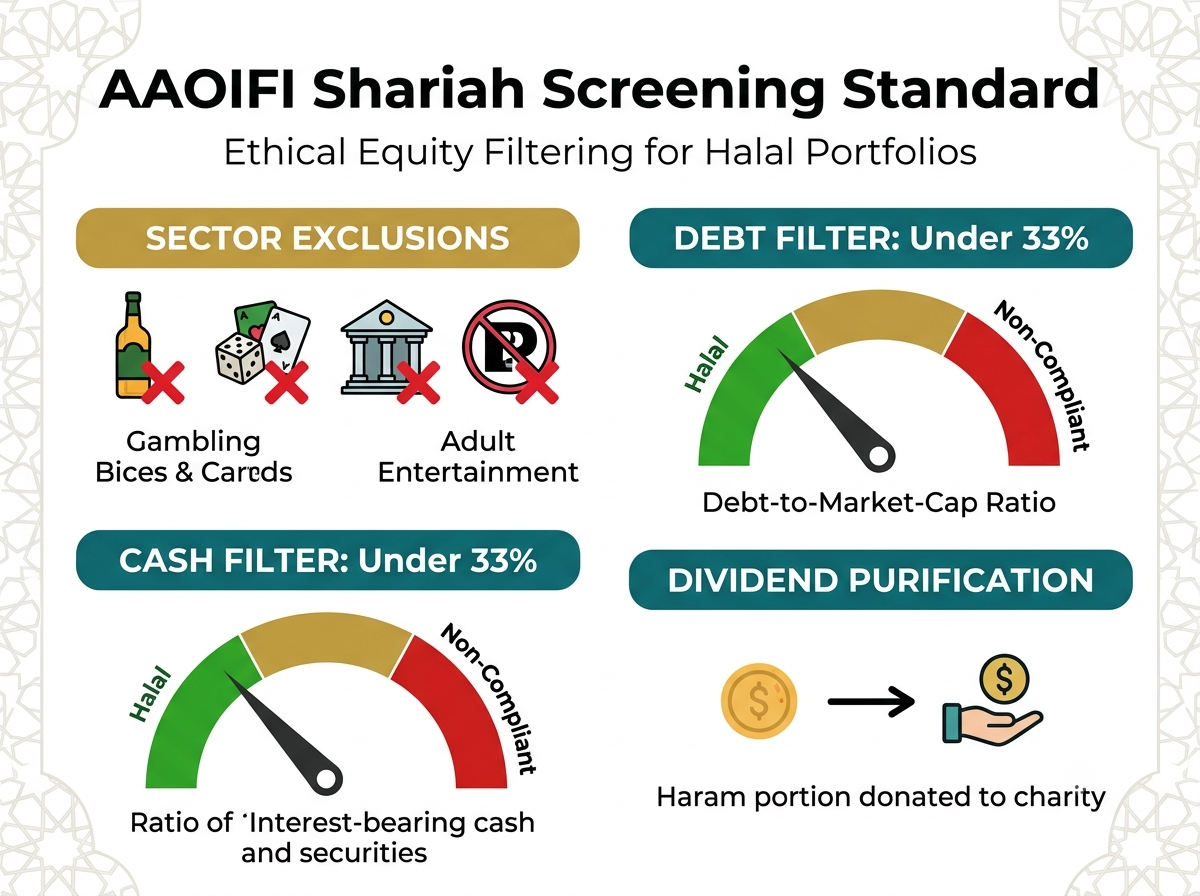
The most universally recognized framework is established by the Accounting and Auditing Organization for Islamic Financial Institutions (AAOIFI). To be deemed Shariah-compliant, a company must pass two successive screening stages:
Stage 1: Business Activity Screen (Qualitative)
The company's primary business must not derive significant revenue from impermissible (Haram) activities:
- 🚫 Conventional interest-based banking and insurance (Riba)
- 🚫 Alcohol manufacturing, distribution, and retailing (Khamr)
- 🚫 Pork products and non-halal meat processing
- 🚫 Gambling, casinos, and sports betting (Maysir)
- 🚫 Adult entertainment and pornography
- 🚫 Weapons and military munitions manufacturing
- 🚫 Tobacco and related nicotine products
Stage 2: Financial Ratio Screen (Quantitative)
Even if a company's business model is permissible (such as software, healthcare, or clean energy), its capital structure must not rely excessively on interest-bearing debt or cash deposits:
| AAOIFI Financial Metric | Maximum Allowable Threshold | Rationale & Objective |
|---|---|---|
| Debt to Market Cap | < 33% | Ensures the enterprise is primarily equity-financed, not artificially bloated by predatory debt leverage. |
| Cash & Interest Securities to Market Cap | < 33% | Ensures the business is actively deploying capital into productive operations rather than earning passive interest. |
| Accounts Receivable to Market Cap | < 33% to < 50% | Prevents trading in deferred debt instruments, ensuring transactions reflect real operating assets. |
| Impermissible Revenue (Impure Income) | < 5% of Total Revenue | Incidental impermissible revenue (e.g., interest on bank deposits) must be minor and requires mandatory purification. |
The Dividend Purification Protocol (Tathir)
If a Shariah-compliant company derives 2% of its total revenue from interest earned on its operational bank accounts, the investor cannot retain that 2%. Whenever dividends are paid, the investor must calculate that exact proportion and donate it to charitable causes without seeking personal tax advantage or spiritual reward (Sadaqah), thereby purifying (Tathir) their wealth.
4. Artificial Intelligence & Automated Wealth Management in 2026
The rapid development of generative AI and financial machine learning has transformed how Muslims invest. In 2026, algorithmic financial platforms provide powerful capabilities for ethical investors:
The Modern Halal FinTech Architecture
- Continuous AI Screening — Real-Time SEC 10-K & AAOIFI Compliance Audits
- Automated Fractional Diversification — Low-Cost Global Halal ETFs
- Automated Dividend Purification — One-Click Charity Calculation
- Algorithmic Rebalancing — Mitigating Emotional Impulse Trading

When Is AI Trading Permissible?
- ✅ Permissible: Using automated robo-advisors to execute long-term dollar-cost averaging (DCA), rebalance asset allocations across halal index funds, and screen quarterly balance sheets for debt violations.
- ❌ Impermissible: Utilizing AI algorithms for millisecond high-frequency arbitrage (HFT), automated margin liquidation wagers, or front-running retail orders, which violate the spirit of genuine commerce.
As the Prophet Muhammad ﷺ emphasized, ethical intent and honest transparency elevate economic life into an act of worship:
Narrated by Abu Sa'id al-Khudri (may Allah be pleased with him): The Prophet ﷺ said:
"The truthful, trustworthy merchant is with the prophets, the truthful ones, and the martyrs."
(Jami` at-Tirmidhi #1209, graded Hasan by Imam at-Tirmidhi and Sheikh al-Albani)
5. The Five-Pillar Strategy for Building Halal Generational Wealth
To move beyond speculative hype and build lasting financial resilience, Islamic financial advisors recommend a disciplined, long-term framework:
Pillar 1: Debt Elimination & Emergency Buffer
Before allocating capital to equities, eliminate all high-interest personal debts (such as credit cards or personal loans). Build a 3-to-6 month emergency reserve in a liquid, non-interest halal savings account or gold-backed custodian.
Pillar 2: Low-Cost Global Halal Indexing
Rather than attempting to outsmart markets through single-stock picking, allocate the core of your investment portfolio into globally diversified, low-expense Shariah-compliant ETFs (such as funds tracking the MSCI World Islamic Index or S&P 500 Shariah Index). This guarantees immediate diversification across hundreds of rigorously screened global enterprises.
Pillar 3: Real Asset Participation (Real Estate & Sukuk)
Incorporate asset-backed investments into your portfolio:
- Sukuk (Islamic Bonds): Asset-backed certificates where investors own an undivided share in tangible infrastructure, real estate, or commercial assets, receiving rental returns rather than usurious debt interest.
- Real Estate: Direct property ownership or Shariah-compliant real estate crowdfunding platforms focused on residential or commercial rental yields.
Pillar 4: Precision Zakat Calculation (2.5%)
Wealth is a trust (Amanah) from Allah. Paying Zakat on qualifying investment assets (using the net liquid asset or zakatable market value methods endorsed by contemporary fiqh councils) does not diminish wealth; it cleanses it and invokes divine expansion (Barakah):
خُذْ مِنْ أَمْوَٰلِهِمْ صَدَقَةًۭ تُطَهِّرُهُمْ وَتُزَكِّيهِم بِهَا وَصَلِّ عَلَيْهِمْ ۖ إِنَّ صَلَوٰتَكَ سَكَنٌۭ لَّهُمْ ۗ وَٱللَّهُ سَمِيعٌ عَلِيمٌ
Surah At-Tawbah (9:103): "Take, [O, Muhammad], from their wealth a charity by which you purify them and cause them increase, and invoke [Allah 's blessings] upon them. Indeed, your invocations are reassurance for them. And Allah is Hearing and Knowing."
Pillar 5: Endowing the Future (Waqf)
True generational wealth extends beyond biological heirs. Establish a perpetual charitable endowment (Waqf) or contribute a percentage of investment gains to community education, healthcare, and humanitarian initiatives, securing rewards that continue long after this worldly life.
Conclusion: Wealth as a Vehicle for Divine Pleasure
Islam does not praise poverty nor condemn legitimate prosperity. Some of the greatest companions of the Prophet ﷺ — including Uthman ibn Affan and Abdur-Rahman ibn Awf (may Allah be pleased with them) — were visionary entrepreneurs whose immense commercial acumen funded community defense, purchased water wells for the public good, and sustained the early Muslim state.
The difference between Islamic finance and secular wealth accumulation lies in the orientation of the heart. When money is kept in the hand to be deployed for lawful enterprise, family dignity, and community welfare, it becomes a powerful instrument of righteousness (Birr). By adhering to verified Shariah standards and embracing transparent technology, Muslims in 2026 can pioneer an ethical financial future that honors both reason and revelation.