

 QuranGPT
Fatima al-Fihri: Founder of the World's First University (Al-Qarawiyyin, 859 CE)
Discover how Muslim visionary Fatima al-Fihri established the University of Al-Qarawiyyin in Fez, founding the world's oldest degree-granting institution.
The Holy Quran Team
Author
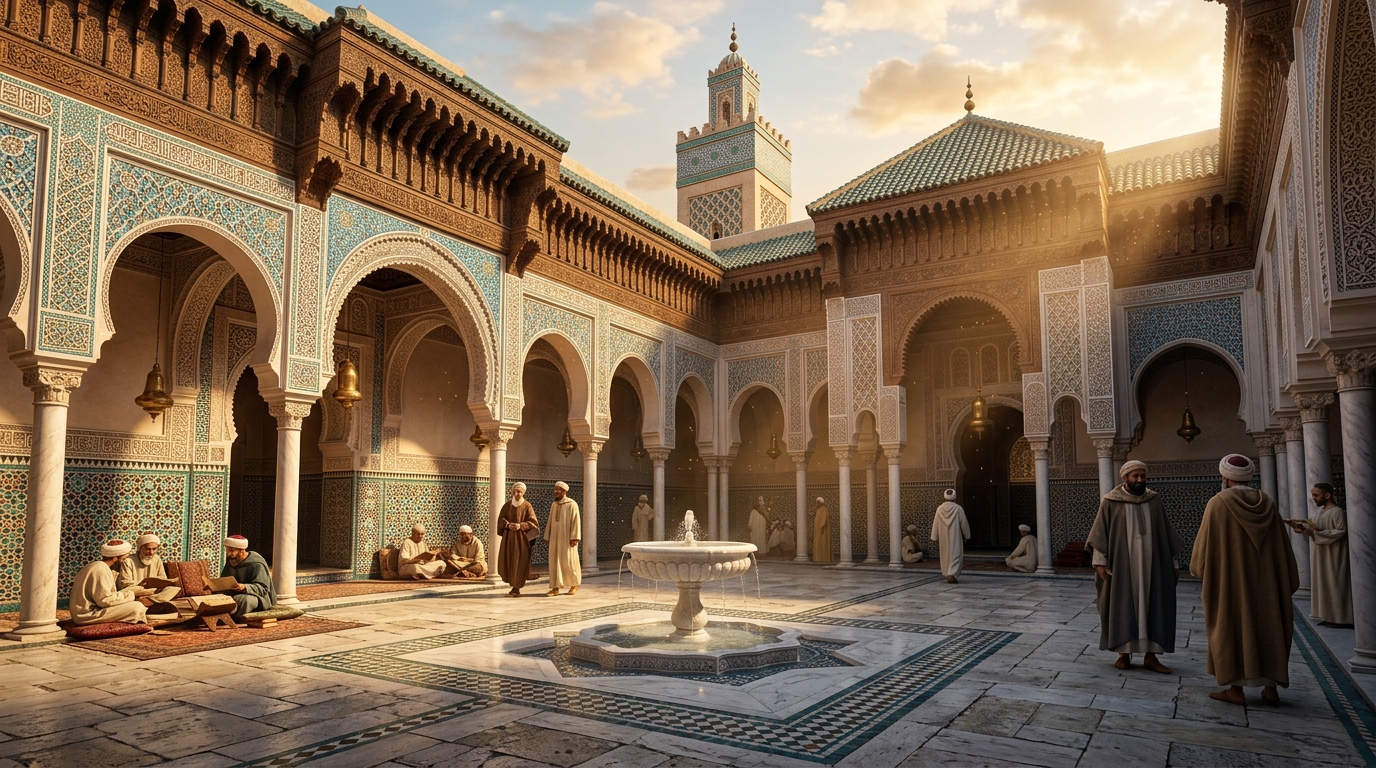
Centuries before the founding of the University of Bologna (1088 CE), Oxford (1096 CE), or the Sorbonne (1257 CE), an educated, deeply pious Muslim woman laid the architectural and intellectual foundations of modern higher education. In 859 CE (245 AH), in the historic spiritual capital of Fez, Morocco, Fatima bint Muhammad al-Fihriyya founded The University of Al-Qarawiyyin (جامعة القرويين).
Recognized officially by UNESCO and the Guinness Book of World Records as the oldest continually operating, degree-granting institution of higher learning on Earth, Al-Qarawiyyin was not merely a mosque; it was a pioneering intellectual crucible that bridged classical Islamic sciences, astronomy, mathematics, medicine, and philosophy.
أَمَّنْ هُوَ قَانِتٌ آنَاءَ اللَّيْلِ سَاجِدًا وَقَائِمًا يَحْذَرُ الْآخِرَةَ وَيَرْجُو رَحْمَةَ رَبِّهِ ۗ قُلْ هَلْ يَسْتَوِي الَّذِينَ يَعْلَمُونَ وَالَّذِينَ لَا يَعْلَمُونَ ۗ إِنَّمَا يَتَذَكَّرُ أُولُو الْأَلْبَابِ
"Say, 'Are those who know equal to those who do not know?' Only they will remember [who are] people of understanding."
— Surah Az-Zumar (39:9)
Fatima al-Fihri’s vision transformed global scholarship, dismantling modern orientalist misconceptions about the role of Muslim women in academia, philanthropy, and scientific leadership.
1. Migration, Legacy & The Vow of Perpetual Endowment (Waqf)
Fatima al-Fihri was born into a noble merchant family in Kairouan (modern-day Tunisia) during the early 9th century. Her family later migrated west across the Maghreb to Fez during the reign of the Idrisid Sultan Yahya I, joining a vibrant community of Kairouanese immigrants (Al-Qarawiyyin).
A. The Sacred Inheritance
Following the successive deaths of her father, Muhammad ibn Abdullah al-Fihri, and her husband, Fatima and her sister Maryam inherited immense commercial wealth. Rather than hoarding or consuming this fortune on fleeting worldly luxuries, the sisters resolved to dedicate their entire inheritance as a perpetual charitable endowment (Waqf) for the eternal elevation of the Muslim community (Ummah):
- Maryam al-Fihri founded the majestic Al-Andalus Mosque (Jami' al-Andalusiyyin) in the Andalusian quarter of Fez.
- Fatima al-Fihri (affectionately known as Umm al-Banin, "Mother of the Sons") purchased a vast estate of land in the Qarawiyyin quarter to construct a massive complex of worship and universal higher education.
مَّثَلُ الَّذِينَ يُنفِقُونَ أَمْوَالَهُمْ فِي سَبِيلِ اللَّهِ كَمَثَلِ حَبَّةٍ أَنبَتَتْ سَبْعَ سَنَابِلَ فِي كُلِّ سُنبُلَةٍ مِّائَةُ حَبَّةٍ ۗ وَاللَّهُ يُضَاعِفُ لِمَن يَشَاءُ ۗ وَاللَّهُ وَاسِعٌ عَلِيمٌ
"The example of those who spend their wealth in the way of Allah is like a seed of grain which grows seven spikes; in each spike is a hundred grains. And Allah multiplies [His reward] for whom He wills. And Allah is all-Encompassing and Knowing."
— Surah Al-Baqarah (2:261)
Narrated Abu Hurairah (may Allah be pleased with him):
The Messenger of Allah ﷺ said:
"When a human being dies, his deeds come to an end except for three: an ongoing charity (Sadaqah Jariyah), knowledge from which people benefit, or a righteous child who prays for him."
— Sahih Muslim #1631
Fatima combined the first two everlasting deeds — Sadaqah Jariyah and beneficial knowledge — into a single immortal monument.
B. The Spiritual Vow: Continuous Fasting Until Completion
Historical chroniclers, notably the 14th-century Moroccan historian Ibn Abi Zar' in Rawd al-Qirtas, document Fatima's extraordinary spiritual discipline:
- Fatima insisted that every building material used — the stone, yellow clay, gypsum, water, and sand — be quarried exclusively from the land she had legally purchased with clean, halal capital to ensure total spiritual purity.
- On the first day of construction, on the 1st of Ramadan 245 AH (859 CE), Fatima made a solemn vow to fast every single day until the entire complex was finished.
- For over two years of intensive excavation and construction, she maintained her daytime fast, and upon its completion, she entered the prayer hall and prostrated before Allah in tears of gratitude.
2. Institutional Innovations: The Birth of the Academic Degree (Ijazah)
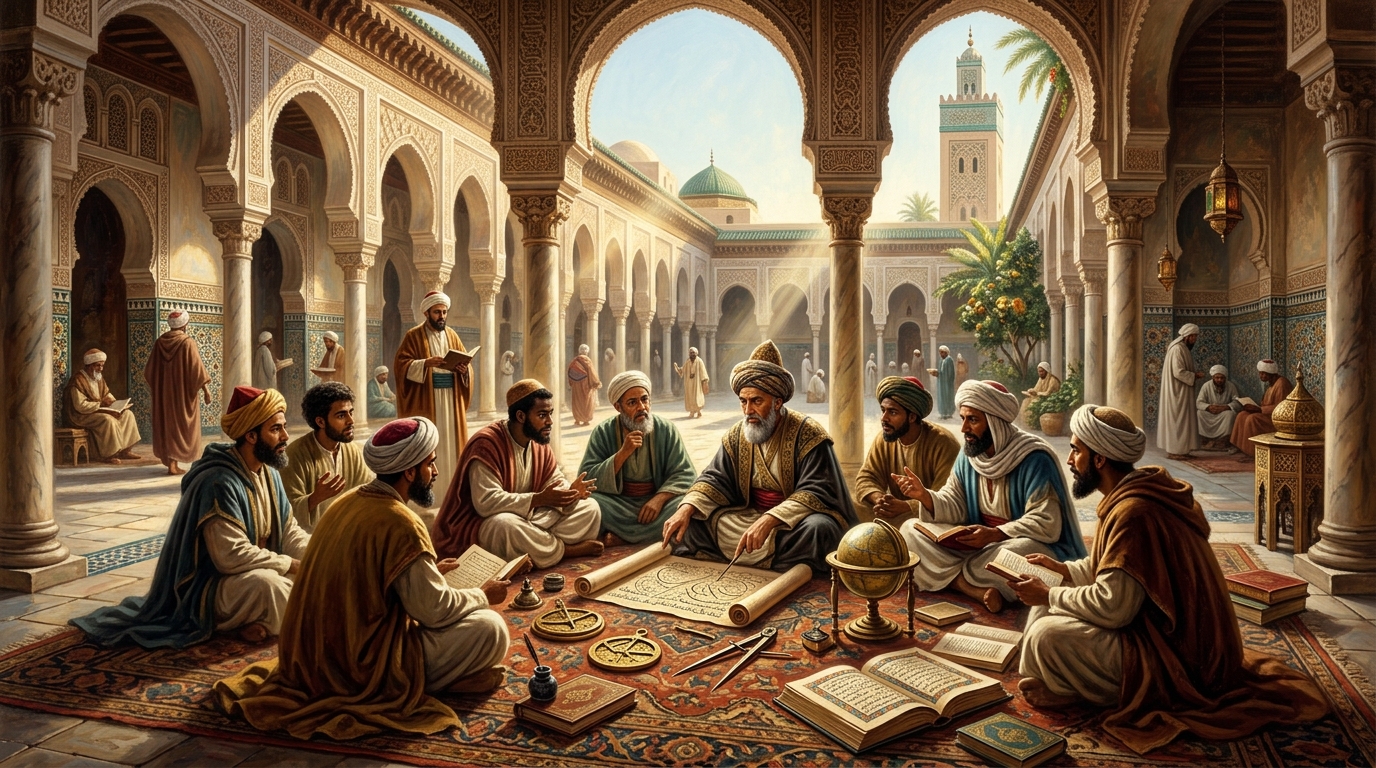
Al-Qarawiyyin rapidly evolved from a grand congregational mosque into the premier international intellectual center of the medieval world. It introduced institutional pedagogical frameworks that are the direct ancestors of modern university systems:
| Modern University Concept | Al-Qarawiyyin Origin (9th–12th Century CE) |
|---|---|
| Academic Degree / Diploma | Al-Ijazah (الإجازة): Formal parchment diploma certifying competence to teach after rigorous oral defense |
| Academic Chairs / Professorships | Al-Kursi (الكرسي): Endowment-funded professorial chairs allocated to master scholars (Shaykh al-Kursi) |
| Peer Review & Public Defense | Al-Munazarah: Rigorous open academic debate in front of university faculty and public peers |
| Tuition-Free Scholarships | Waqf Student Stipends: Free lodging, food rations, writing paper, and stipends for international students |
| Universal Curriculum | Integration of natural sciences (Ma'qulat) alongside divine revealed law (Manqulat) |
3. The Interdisciplinary Curriculum: Harmonizing Faith & Empirical Science
At Al-Qarawiyyin, there was no false dichotomy between scientific inquiry and Islamic theology. Seeking to comprehend the creation was viewed as an act of devotion honoring the Creator:
يَا أَيُّهَا الَّذِينَ آمَنُوا إِذَا قِيلَ لَكُمْ تَفَسَّحُوا فِي الْمَجَالِسِ فَافْسَحُوا يَفْسَحِ اللَّهُ لَكُمْ ۖ وَإِذَا قِيلَ انشُزُوا فَانشُزُوا يَرْفَعِ اللَّهُ الَّذِينَ آمَنُوا مِنكُمْ وَالَّذِينَ أُوتُوا الْعِلْمَ دَرَجَاتٍ ۚ وَاللَّهُ بِمَا تَعْمَلُونَ خَبِيرٌ
"Allah will raise those who have believed among you and those who were given knowledge, by degrees. And Allah is Acquainted with what you do."
— Surah Al-Mujadila (58:11)
The academic curriculum spanned a vast array of disciplines:
- Islamic Jurisprudence & Tafsir: Fiqh across the four Sunni madhabs, Hadith methodology, Usul al-Fiqh, and Quranic exegesis.
- Astronomy & Celestial Mechanics ('Ilm al-Falak): Calculating lunar calendars, prayer timings, solar declination, and astrolabe engineering.
- Mathematics & Algebra (Al-Jabr wa'l-Hisab): Spherical trigonometry, algorithmics, arithmetic, and inheritance law computations.
- Medicine & Pharmacology (At-Tibb wa'l-Saydalah): Clinical pathology, surgical theory, and herbal pharmacology.
- Linguistics & Rhetoric: Classical Arabic grammar (Nahw), lexicography, and rhetoric (Balaghah).
4. Notable Luminaries of Al-Qarawiyyin
Al-Qarawiyyin attracted and produced some of the greatest minds in world history, including Muslim, Jewish, and Christian scholars:
- Ibn Khaldun (1332–1406 CE): The father of sociology, demography, and historiography, author of the seminal Al-Muqaddimah, who taught and researched in the lecture halls of Al-Qarawiyyin.
- Ibn Rushd (Averroes, 1126–1198 CE): Master jurist, physician, and philosopher whose commentaries on Aristotle revolutionized European scholasticism.
- Al-Idrisi (1100–1165 CE): Landmark geographer and cartographer who created the Tabula Rogeriana world map, one of the most advanced medieval geographic surveys.
- Maimonides (Rabbi Moses ben Maimon, 1138–1204 CE): Renowned Jewish philosopher, astronomer, and physician who studied medicine and philosophy at Al-Qarawiyyin during his years in Fez.
- Gerbert of Aurillac (Pope Sylvester II, 946–1003 CE): Studied mathematics, astronomy, and the Arabic numeral system (including the concept of Zero / Sifr) at Al-Qarawiyyin, later introducing Arabic numerals and the abacus to Western Europe.
- Nur al-Din al-Bitruji (Alpetragius): Pioneering astronomer who proposed non-Ptolemaic planetary motion theories.
- Leo Africanus (Al-Hasan al-Wazzan, 1494–1554 CE): Renowned diplomat, geographer, and author of Description of Africa.
5. The Legendary Al-Qarawiyyin Manuscript Library
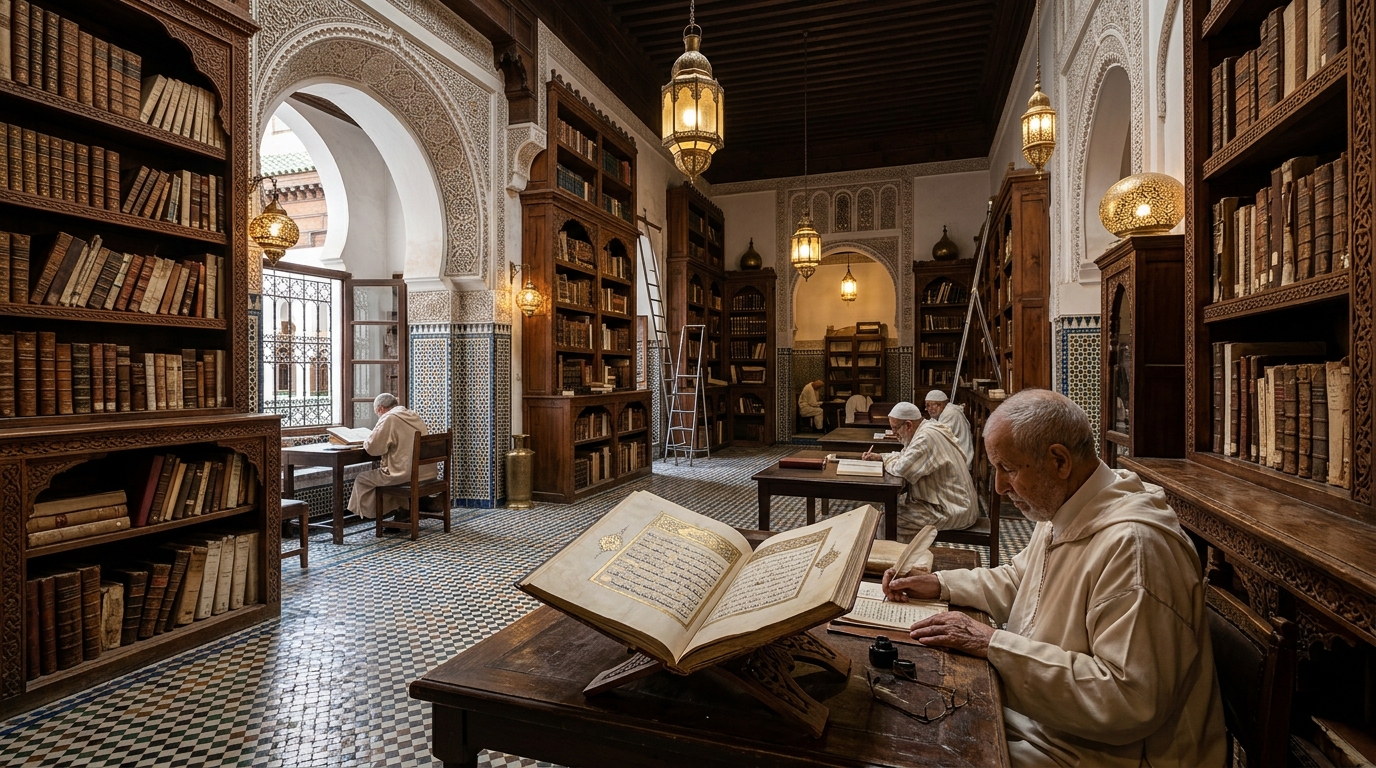
Within the university complex sits the Al-Qarawiyyin Library, recognized as one of the oldest operating libraries on Earth. It houses over 4,000 irreplaceable ancient manuscripts, including:
- An original 9th-century Quran inscribed in ornate Kufic script on treated parchment (gazelle skin).
- An original signed copy of Ibn Khaldun's historical masterpiece, Kitab al-'Ibar.
- A unique 12th-century manuscript on the medical Canon of Ibn Sina (Avicenna).
- Rare handwritten treatises on Islamic jurisprudence (Muwatta Imam Malik on ancient parchment).
In 2016, under the supervision of award-winning Moroccan-Canadian female architect Aziza Chaouni, the library underwent a meticulous modern restoration, installing advanced digital microclimate humidity controls, digitized archive scanners, and laboratory conservation systems to preserve these treasures for future generations.
6. The Enduring Legacy of Islamic Female Scholarship
The life of Fatima al-Fihri shatters contemporary historical revisionism:
- Autonomous Financial Agency: Long before Western legal systems granted married women the right to own property or manage independent wealth (e.g., the Married Women's Property Act of 1882 in the UK), Islamic law guaranteed women absolute financial autonomy to buy, sell, inherit, and establish multi-million-dirham endowments.
- Institutional Vision: Fatima al-Fihri did not build a private mansion; she built an intellectual citadel that educated thousands of scholars across twelve centuries.
- An Unbroken Tradition: Fatima belongs to a long, illustrious continuum of Muslim female pioneers — including Aisha bint Abi Bakr (the master jurist and Hadith scholar), Rufaydah al-Aslamiyyah (the pioneer of emergency clinical medicine and nursing), Sutayta al-Mahamali (the 10th-century mathematician), and Mariam al-Ijliya (Al-Asturlabiya) (the master astrolabe engineer of Aleppo).
Fatima al-Fihri’s legacy remains a beacon of sincere faith, boundless generosity, and intellectual brilliance — reminding the world that the first university ever built was designed, funded, and nurtured by the devotion of a Muslim woman.
Historical References
- Ibn Abi Zar', A. (1326 CE / 1972). Al-Anis al-Mutrib bi-Rawd al-Qirtas fi Akhbar Muluk al-Maghrib wa Tarikh Madinat Fas. Dar al-Mansur, Rabat.
- Ibn Khaldun, A. (1377 CE / 2005). The Muqaddimah: An Introduction to History. (F. Rosenthal, Trans.). Princeton University Press.
- UNESCO World Heritage Centre. Medina of Fez - University of Al-Qarawiyyin (Criteria II, V). UNESCO Reference #170.
- Guinness World Records. Oldest Higher-Learning Institution, Oldest University: University of Al-Qarawiyyin, founded 859 CE in Fez, Morocco.
- Makdisi, G. (1981). The Rise of Colleges: Institutions of Learning in Islam and the West. Edinburgh University Press.
- Al-Jazna'i, A. (14th Century / 1991). Zahrat al-As fi Bina Madinat Fas. Imprimerie Royale, Rabat.