

 QuranGPT
Cosmic Filaments & The Universal Web: Quranic Al-Hubuk
Discover the breathtaking harmony between the Quranic description of the heavens as Al-Hubuk (woven filaments) and supercomputer models of the cosmic web.
The Holy Quran Team
Author
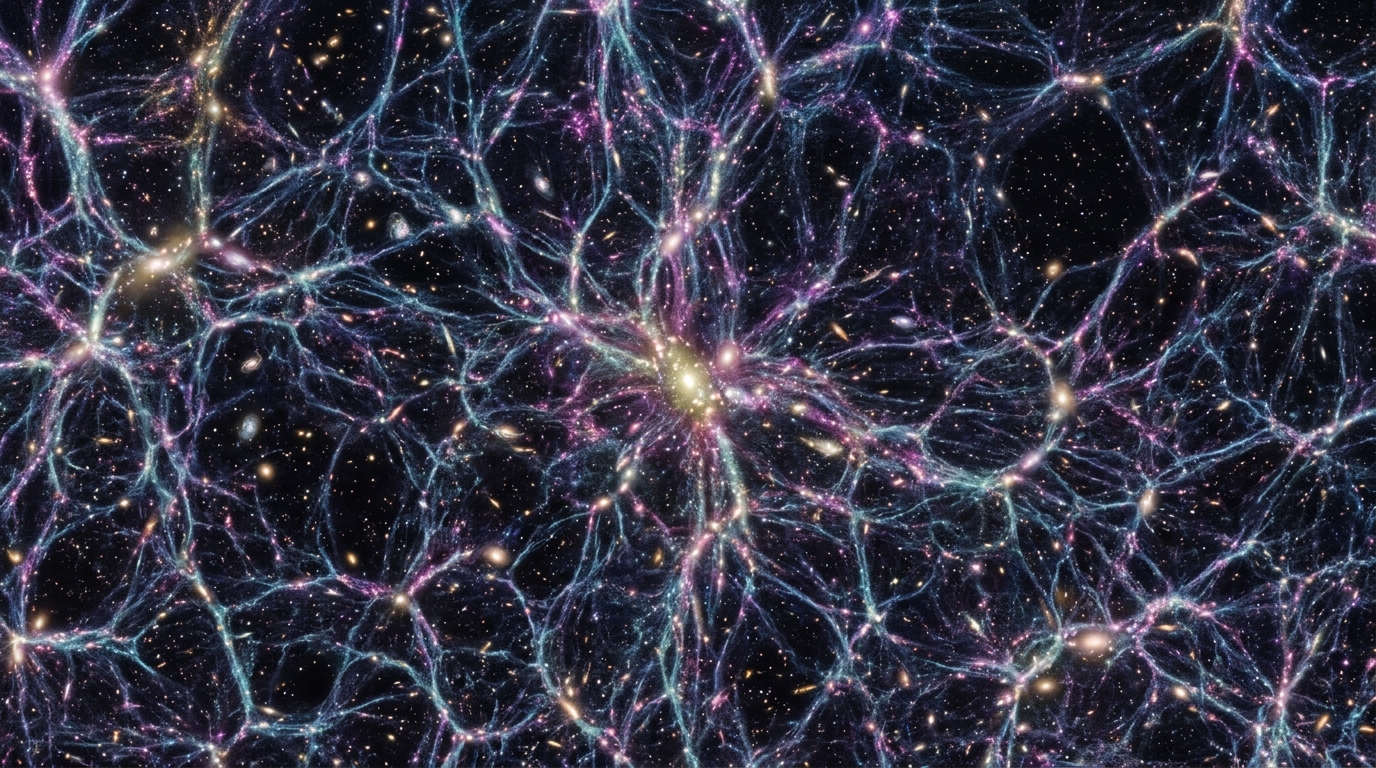
For thousands of years, human civilizations gazed up at the night sky and saw what appeared to be isolated points of light scattered haphazardly across an empty void. Classical Greek astronomers, from Aristotle to Ptolemy, conceptualized the heavens as rigid, concentric crystalline spheres. Early modern astronomy viewed stars and galaxies as islands of matter adrift in an unfathomable, unstructured sea of nothingness.
Yet over fourteen centuries ago, in the arid heart of seventh-century Arabia, the Quran presented an astonishingly distinct morphological description of the cosmos. In a short, electrifying oath, Allah swore by the very structural architecture of the heavens:
وَٱلسَّمَآءِ ذَاتِ ٱلْحُبُكِ
Surah Adh-Dhariyat (51:7): "By the heaven full of weaves, paths, and interwoven filaments (Al-Hubuk)."
To the ancient desert dweller, this verse was poetic, evocative, and mysterious. But to twenty-first-century astrophysicists utilizing the world's most powerful supercomputers, space telescopes, and spectroscopic arrays, the Arabic word Al-Hubuk (ٱلْحُبُك) reads as a startlingly literal, microscopic-to-macroscopic description of the universe's ultimate geometry: The Cosmic Web.
How did an unlettered Prophet in the seventh century come to describe the macro-structure of the universe not as empty space, but as an intricately woven, threaded, and braided cosmic fabric?
1. Classical Arabic Lexicology: Deconstructing "Al-Hubuk"
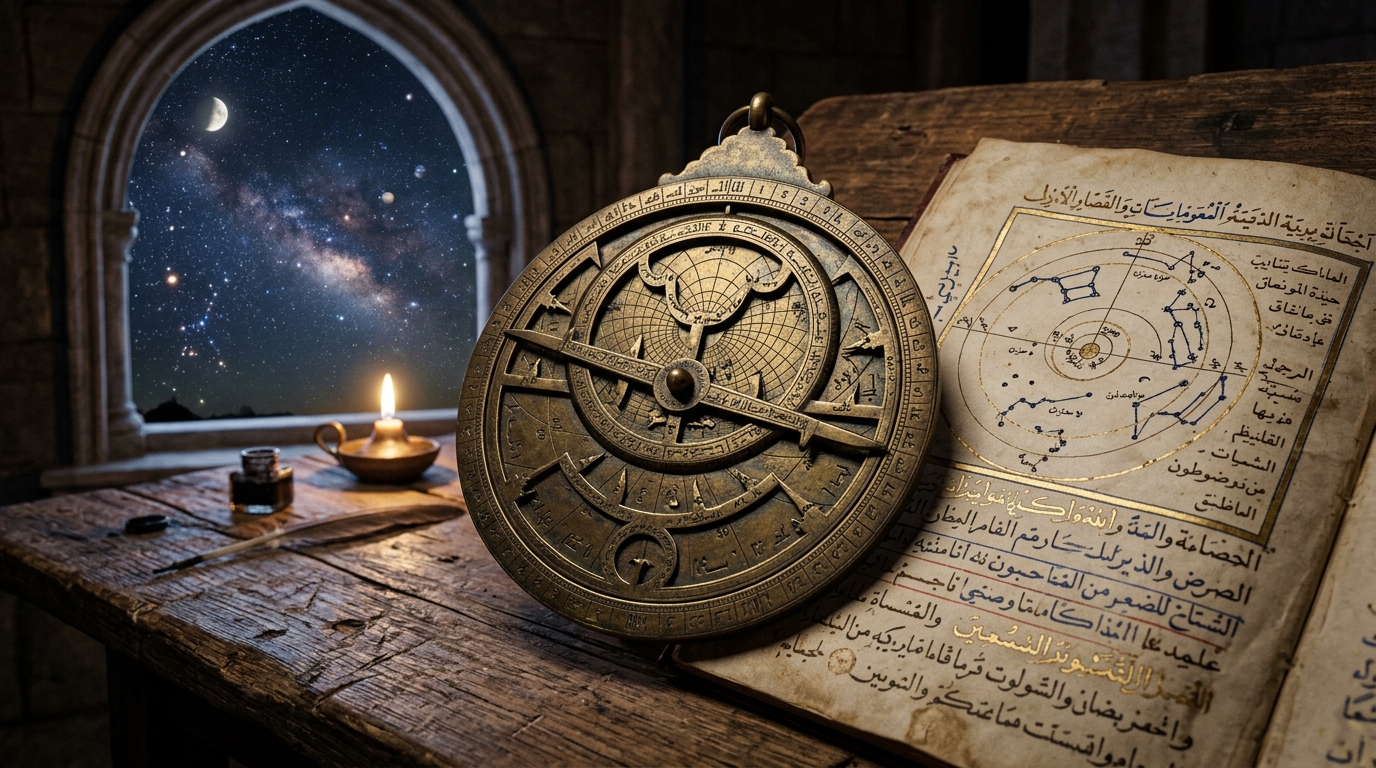
To appreciate the staggering precision of the Quranic text, one must examine how seventh-century Arabs and classical lexicographers understood the root ح-ب-ك (H-B-K).
In the authoritative classical Arabic dictionary Lisan al-Arab by Ibn Manzur (13th century) and the classical exegesis of Imam Ibn Jarir al-Tabari (839–923 CE):
- The Weaving of Cloth (Habk al-Thawb):
The primary linguistic meaning of habaka is to weave threads firmly, tightly, and uniformly into a cohesive cloth or tapestry. A thawb mahbuk is a garment woven with interlocking warp and weft fibers without gaps or slack. - Ripples and Waves on Water (Hubuk al-Ma'):
It describes the intricate, undulating wavelets and interwoven ripples formed on the surface of water when stirred by a gentle breeze. - Wind-Sculpted Sand Dunes (Hubuk al-Raml):
It refers to the parallel, braided ridges and crests carved across desert sand dunes by atmospheric currents. - Braided and Intertwined Strands (Hubuk al-Sha'r):
It denotes hair that is tightly braided, plaited, or curly, where individual strands twist around one another in organized pathways.
┌────────────────────────────────────────────────────────┐ │ THE ROOT: ح - ب - ك (H-B-K) │ └────────────────────────────────────────────────────────┘ │ ┌────────────────────────┬──────────────┴─────────────┬────────────────────────┐ ▼ ▼ ▼ ▼ 1. Woven Fabric 2. Water Ripples 3. Sand Ribs 4. Braided Tracks Firmly interlaced Fine, overlapping Waved dunes shaped Intricate, curved threads & fibers undulating waves by moving currents orbital pathways
When classical companions and successors were asked about Dhatil Hubuk, their answers reflected this rich structural imagery:
- Abdullah ibn Abbas (may Allah be pleased with him), the foremost Quranic exegete of the Sahabah, stated:
“It means: of beautiful, balanced, and interwoven craftsmanship (Dhat al-khalq al-hasan al-mustawi).” - Mujahid ibn Jabr (d. 722 CE), the renowned student of Ibn Abbas, explained:
“It means: intertwined with structured pathways and orbital tracks (Al-Turuq al-mahbuka).” - Imam Ibn Kathir (d. 1373 CE) concluded in his Tafsir al-Qur'an al-Azim:
“It means the heaven that possesses beauty, adornment, cohesion, and interwoven paths.”
For centuries, readers interpreted this as referring to the orbits of planets or the visible swirling mist of the Milky Way. But the true cosmological majesty of Al-Hubuk remained veiled until supercomputers simulated the universe at the scale of billions of light-years.
2. The Discovery of the Cosmic Web: From Randomness to Tapestry
In the mid-twentieth century, the prevailing scientific hypothesis assumed that on the largest scales, matter in the universe was distributed uniformly or clumped randomly like raisins in a loaf of bread.
That paradigm was shattered in 1996 when astrophysicists J. Richard Bond, Lev Kofman, and Nick Kaiser published their revolutionary paper in the journal Nature titled:
"How filaments of galaxies are formed" (Nature, Vol. 380, pp. 603–606, 1996).
In this landmark publication, the authors coined the definitive scientific term: The Cosmic Web. They demonstrated mathematically that gravitational collapse in an expanding universe dominated by cold dark matter does not produce spherical clusters in isolation. Instead, primordial quantum fluctuations in the early universe are stretched across billions of parsecs into an interconnected, three-dimensional network of anisotropic filaments.
The Modern Cosmic Architecture
Today, cosmological surveys confirm that the universe is structured into four distinct topological components:
| Cosmic Structure | Physical Nature | Cosmological Role | Percentage of Universe Volume |
|---|---|---|---|
| Filaments (The Threads) | Dense bridges of dark matter & hydrogen gas | Transport gas and young galaxies across deep space | ~10% |
| Nodes (The Knots) | Massive clusters of thousands of galaxies | Intersection hubs where filaments meet; birthplaces of superclusters | ~1% |
| Sheets (The Membranes) | Flattened planar walls of matter | 2D gravitational barriers enclosing cosmic voids | ~39% |
| Voids (The Interstices) | Vast under-dense regions of nearly empty space | Cavities separating the woven cosmic threads | ~50% |
When mapped at scales exceeding 500 million light-years, the universe is not a chaotic scatter of galaxies. It is an astronomical textile—a gargantuan, luminous fabric of glowing filaments along which galaxies are strung like glowing pearls on woven silk cords.
3. Supercomputer Confirmations: Millennium, IllustrisTNG & MillenniumTNG
How do astrophysicists visualize structures that span tens of billions of light-years? The answer lies in massive cosmological supercomputer simulations.
The Millennium Simulation (2005)
Led by astrophysicist Volker Springel and the Virgo Consortium at the Max Planck Institute for Astrophysics (Nature, 435, 629–636, 2005), the Millennium Simulation used supercomputers in Garching, Germany, to track the gravitational evolution of over 10 billion dark matter particles in a cubic region of space exceeding 2 billion light-years across.
When the simulation completed its run, the visualization stunned the scientific world: the output looked identical to a cross-section of biological neural networks or finely woven linen cloth. Countless glowing threads of dark matter crisscrossed the void, channeling cold hydrogen gas into gravitational nodes where galaxies ignited.
The IllustrisTNG & MillenniumTNG Projects (2018–2026)
Building on the Millennium legacy, the IllustrisTNG and MillenniumTNG (MTNG) simulations (Springel, Hernquist, Vogelsberger, Pakmor et al., Monthly Notices of the Royal Astronomical Society) incorporated full magnetohydrodynamics, radiative cooling, stellar evolution, and supermassive black hole feedback across hundreds of millions of light-years.
The findings verified that:
- Gas Flows Along Cosmic Fibers: Warm-hot intergalactic medium (WHIM) gas—accounting for nearly 50% of the normal baryonic matter in the current universe—does not float aimlessly. It flows in coherent currents along the dark matter filaments, exactly like fluid along woven rope fibers.
- Universal Filamentary Symmetry: The filaments possess characteristic diameters of roughly 2 to 5 megaparsecs (6.5 to 16 million light-years) and stretch over hundreds of millions of light-years without breaking.
4. Empirical Verification: JWST and the Keck Cosmic Web Imager
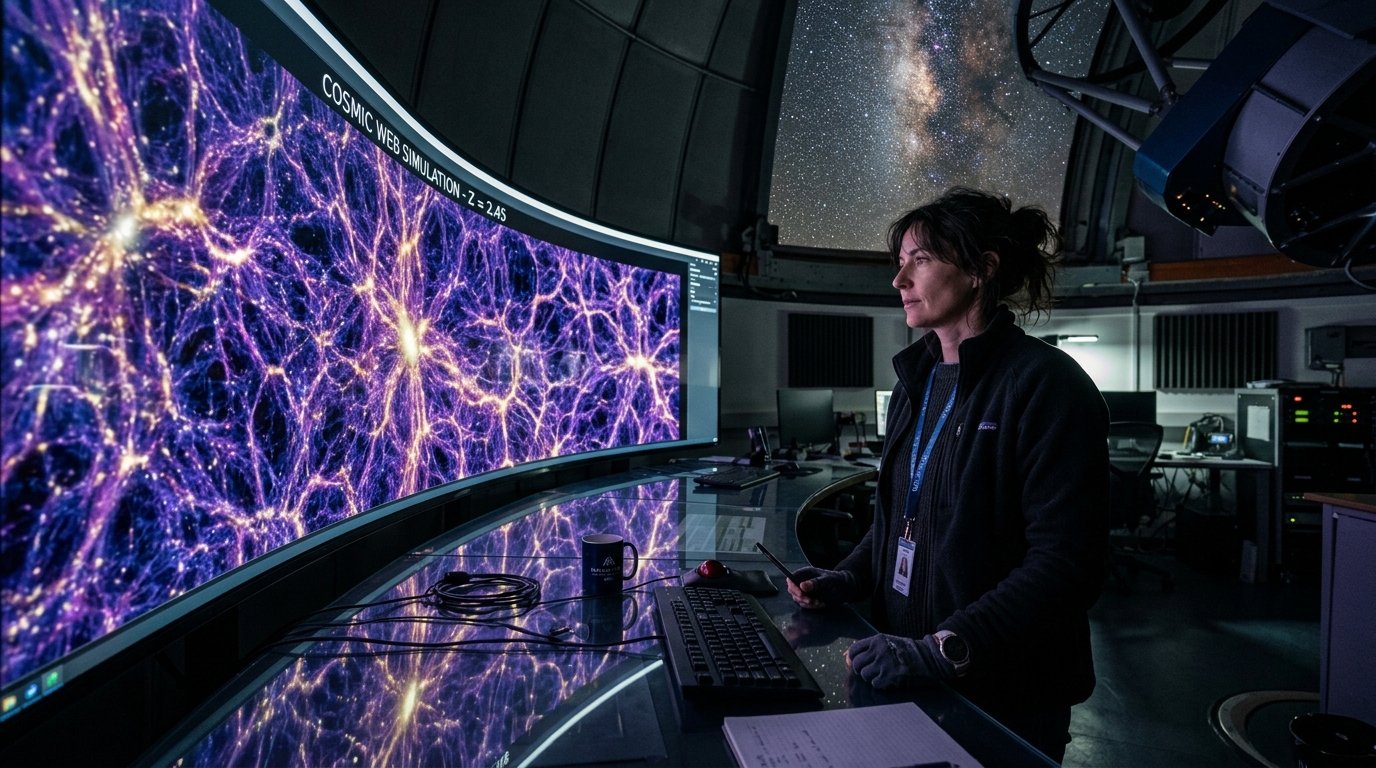
For decades, the Cosmic Web was primarily a theoretical construct supported by supercomputers and galaxy redshift surveys (such as the Sloan Digital Sky Survey, SDSS). The dark matter filaments themselves and the diffuse gas between galaxies were too dim to be observed directly.
That changed dramatically between 2023 and 2026:
Direct Imaging with the Keck Cosmic Web Imager (KCWI)
Astronomers at the W. M. Keck Observatory in Hawaii (D. Christopher Martin et al., Nature Astronomy) utilized the Keck Cosmic Web Imager—a hyper-sensitive integral field spectrograph—to directly capture the faint, glowing Lyman-alpha emission of hydrogen gas bridging ancient galaxies across 10 to 12 billion light-years. For the first time, humanity directly photographed the luminous threads of the intergalactic web stretching across the dark void.
The James Webb Space Telescope (JWST) Cosmic Web Survey
Using JWST’s Near-Infrared Camera (NIRCam), international teams observed a ten-galaxy filament that formed just 830 million years after the Big Bang, anchored by an ancient luminous quasar. The data revealed that this filament stretched across 3 million light-years, proving that the woven architecture of the cosmos was already established in the cosmic dawn.
5. The Quranic Architectural Paradigm: Structural Cohesion Without Rifts
The mention of Al-Hubuk in Surah Adh-Dhariyat is not an isolated curiosity; it is part of a cohesive Quranic cosmological framework that repeatedly describes the heavens as a structured, continuous, and meticulously engineered fabric:
ٱلَّذِى خَلَقَ سَبْعَ سَمَـٰوَٰتٍۢ طِبَاقًۭا ۖ مَّا تَرَىٰ فِى خَلْقِ ٱلرَّحْمَـٰنِ مِن تَفَـٰوُتٍۢ ۖ فَٱرْجِعِ ٱلْبَصَرَ هَلْ تَرَىٰ مِن فُطُورٍۢ
Surah Al-Mulk (67:3): "He who created seven heavens in layers. You do not see in the creation of the Most Merciful any inconsistency. So return your vision to the sky: do you see any breaks or rifts (Futur)?"
أَفَلَمْ يَنظُرُوٓا۟ إِلَى ٱلسَّمَآءِ فَوْقَهُمْ كَيْفَ بَنَيْنَـٰهَا وَزَيَّنَّـٰهَا وَمَا لَهَا مِن فُرُوجٍۢ
Surah Qaf (50:6): "Have they not looked at the heaven above them—how We structured it and adorned it, and how it has no flaws or fissures (Furooj)?"
Notice the extraordinary architectural vocabulary employed by the Creator:
- Bannaynaha (بَنَيْنَـٰهَا): We constructed it as a cohesive building or engineered superstructure.
- Ma Laha Min Furooj (وَمَا لَهَا مِن فُرُوجٍ): It possesses no tear, fissure, or discontinuity.
- Dhatil Hubuk (ذَاتِ ٱلْحُبُكِ): It is woven, braided, and interlaced together into harmonious tracks and filaments.
In modern topological physics, space-time is treated not as a void, but as a dynamic four-dimensional manifold—a structural fabric that curves under mass, ripples under gravitational waves, and is webbed with matter filaments that maintain gravitational equilibrium across cosmic epochs.
6. The Rational Implication: Who Wove the Cosmos?
Consider the historical and intellectual realities:
In 610 CE:
- Humanity possessed no telescopes, no spectroscopes, and no supercomputers.
- The greatest minds of Alexandria, Rome, Persia, and India believed the stars were affixed to crystal spheres or floating freely in atmospheric aether.
- No human eye had ever seen, nor could ever imagine, the grand-scale filamentary morphology of the universe.
Yet the Quran selected the single most accurate, nuanced, and evocative term imaginable: Al-Hubuk—the tightly woven, undulating, braided threads of a cosmic tapestry.
As Allah declares in Surah Fussilat:
سَنُرِيهِمْ ءَايَـٰتِنَا فِى ٱلْـَٔافَاقِ وَفِىٓ أَنفُسِهِمْ حَتَّىٰ يَتَبَيَّنَ لَهُمْ أَنَّهُ ٱلْحَقُّ ۗ أَوَلَمْ يَكْفِ بِرَبِّكَ أَنَّهُۥ عَلَىٰ كُلِّ شَىْءٍۢ شَهِيدٌ
Surah Fussilat (41:53): "We will show them Our signs in the horizons and within themselves until it becomes clear to them that it is the truth. Is it not sufficient that your Lord is a witness over all things?"
The Cosmic Web is not merely a triumph of twenty-first-century supercomputing; it is an ancient sign written across the grandest canvas in existence, confirming that the One who revealed the Quran in the desert is the very same Architect who wove the heavens from light and gravity.