

 QuranGPT
Comet Tsuchinshan-ATLAS: Perihelion, Tail Physics & Quranic Celestial Mechanics
Explore the astrophysics of Comet C/2023 A3 (Tsuchinshan-ATLAS), its perihelion dynamics, dual-tail mechanics, and Quranic reflections on cosmic orbits.
The Holy Quran Team
Author
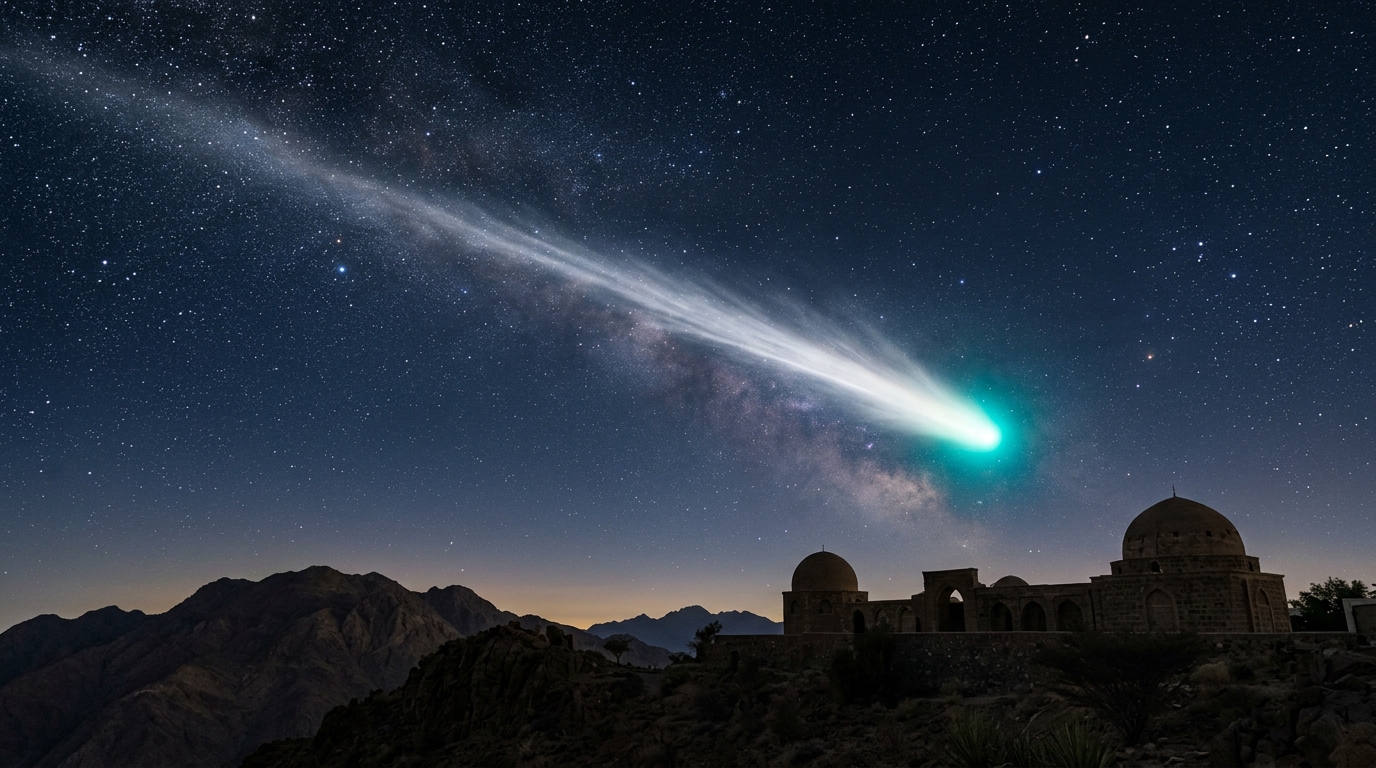
Across the velvet tapestry of the night sky, few celestial spectacles inspire as much profound awe and scientific inquiry as a great naked-eye comet. Blazing across the inner Solar System on an epochal trajectory originating from the frozen fringes of the Oort Cloud, Comet C/2023 A3 (Tsuchinshan-ATLAS) has captured the attention of global observatories and stargazers worldwide.
وَهُوَ الَّذِي خَلَقَ اللَّيْلَ وَالنَّهَارَ وَالشَّمْسَ وَالْقَمَرَ ۖ كُلٌّ فِي فَلَكٍ يَسْبَحُونَ
"And it is He who created the night and the day and the sun and the moon; all [heavenly bodies] in an orbit are swimming."
— Surah Al-Anbiya (21:33)
In the Quranic worldview, the cosmos is neither a chaotic void nor an astrological oracle of superstition; rather, it is a finely tuned sanctuary governed by precise mathematical laws (Taqdir), wherein celestial bodies "swim" (Yasbahun) along ordained gravitational paths. Modern astrophysics, planetary science, and the rich legacy of classical Islamic astronomy converge to reveal the intricate mechanics behind these icy wanderers.
1. Discovery and Orbital Trajectory of Comet C/2023 A3
Comet C/2023 A3 was independently identified in early 2023 by astronomers at the Purple Mountain Observatory (Tsuchinshan) in Nanjing, China, and the Asteroid Terrestrial-impact Last Alert System (ATLAS) telescope in Sutherland, South Africa.
الشَّمْسُ وَالْقَمَرُ بِحُسْبَانٍ • وَالنَّجْمُ وَالشَّجَرُ يَسْجُدَانِ • وَالسَّمَاءَ رَفَعَهَا وَوَضَعَ الْمِيزَانَ
"The sun and the moon [move] by precise calculation. And the stars and trees prostrate. And the heaven He raised and imposed the balance."
— Surah Ar-Rahman (55:5–7)
A. The Oort Cloud Reservoir
C/2023 A3 is a dynamically pristine, long-period comet originating from the Oort Cloud—a vast spherical envelope of icy planetesimals situated between 2,000 and 100,000 Astronomical Units (AU) from the Sun. Gravitational perturbations from passing stars or galactic tides dislodged the comet millions of years ago, sending it on a parabolic inward plunge toward the solar core.
B. Perihelion & Hyperbolic Velocity
On its closest approach to the Sun (Perihelion), Comet Tsuchinshan-ATLAS swung within approximately 0.39 AU (~58 million kilometers) of the solar surface—inside the orbital radius of Mercury.
- Extreme Solar Insolation: At perihelion, surface solar radiation intensity escalates exponentially, subjecting the comet's nucleus to temperatures exceeding 300°C (573 K).
- Orbital Velocity: Driven by solar gravitational acceleration, the comet's orbital velocity surged past 70 km/s (over 250,000 km/h) before swinging back outward on a slightly hyperbolic orbital track.
| Orbital Parameter | Scientific Value | Significance |
|---|---|---|
| Origin Reservoir | Outer Oort Cloud (>20,000 AU) | Preserved primordial matter from the solar nebula (~4.6 billion years old) |
| Perihelion Distance ($q$) | ~0.391 AU (~58.6 million km) | Deep solar penetration triggering intense volatile sublimation |
| Orbital Inclination ($i$) | ~139.1° (Retrograde) | Orbits opposite to the rotational direction of planetary orbital planes |
| Nucleus Diameter | Estimated 1.5 to 3.2 km | Compact conglomerate of water ice, dry ice, silicates, and complex organics |
| Orbital Eccentricity ($e$) | 1.00018 (Near-Parabolic / Hyperbolic) | May permanently escape the Solar System into interstellar space |
2. Cometary Anatomy: Nucleus, Coma, and Dual Tail Physics
Comets are frequently characterized in modern planetary science as "dirty snowballs" or "icy dirtballs"—amalgams of water ice, frozen methane, carbon monoxide, silicates, and organic tholins dating back to the genesis of our Solar System.
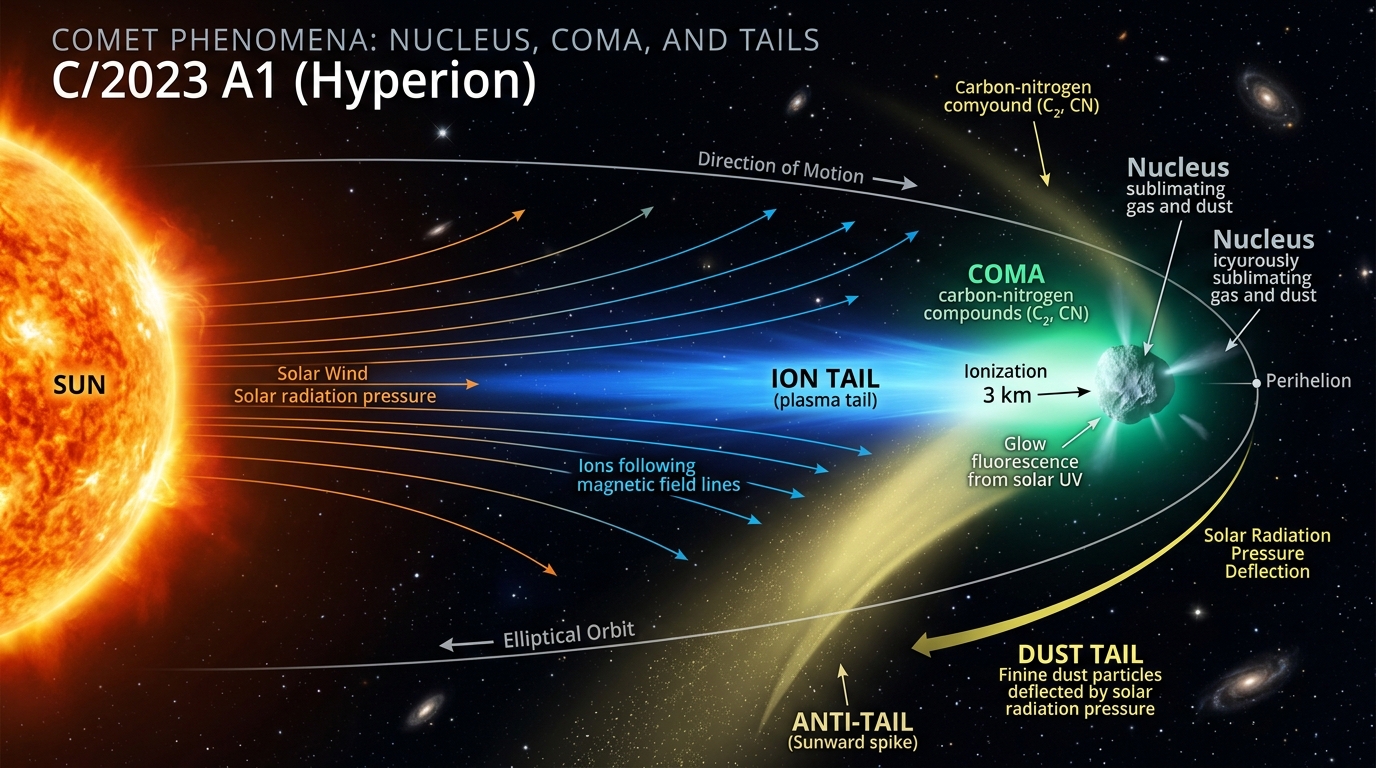
A. The Sublimation Engine and Glowing Coma
As a comet crosses the "frost line" (approximately 3 AU from the Sun), solar radiant heating causes frozen volatiles to sublimate directly from solid ice into gas without passing through a liquid state:
- Sublimating gases expand outward at supersonic speeds, carrying micrometer-sized dust particles with them to form a diffuse atmospheric halo called the Coma, which can expand to over 100,000 kilometers in diameter—larger than the planet Jupiter.
- The characteristic cyan-green luminescence surrounding the nucleus is produced by ultraviolet sunlight exciting diatomic carbon molecules ($C_2$) and cyanogen radicals ($CN$), which fluoresce in distinct green wavelengths (518 nm) before photo-dissociating.
B. Type I: The Electric Blue Ion (Plasma) Tail
Comets exhibit two distinct tails pointing in different directions due to separate physical forces:
- Ionization by Solar UV: Solar ultraviolet radiation strips electrons from sublimated carbon monoxide ($CO$) and water molecules, creating positively charged ions ($CO^+$, $H_2O^+$, $N_2^+$).
- Solar Wind Interaction: The Solar Wind—a continuous stream of magnetized plasma traveling outward from the Sun at 400 to 800 km/s—sweeps these light ions directly away from the Sun along interplanetary magnetic field lines.
- Linear Alignment: The ion tail always points directly away from the Sun, glowing with an eerie electric blue hue due to fluorescent $CO^+$ transitions.
C. Type II: The Sweeping Golden Dust Tail
Unlike microscopic ions, solid mineral dust grains (silicates, iron-magnesium pyroxene, and carbonaceous grains) possess significant physical mass:
- Solar Photon Radiation Pressure: Photons striking the dust particles impart momentum, pushing them away from the nucleus.
- Keplerian Orbital Lag: Because the heavier dust grains retain their individual orbital momentum around the Sun, they lag behind the comet's motion, forming a broad, gently curved, golden-white tail that can stretch across tens of millions of kilometers across the sky.
D. The Rare "Anti-Tail" Phenomenon
During its October apparition, observers photographed a prominent "anti-tail"—a sharp spike of light appearing to point directly toward the Sun:
- The anti-tail is an optical geometric projection: when Earth crosses through the orbital plane of the comet, we view the broad fan of larger, heavier dust particles that the comet shed months prior edge-on.
- The concentration of these reflective particles along our line of sight creates the striking illusion of a forward-projecting sunward beam.
3. Quranic Astronomy: The Precision of Celestial Orbits
The Holy Quran repeatedly directs human intellect to observe the heavens as signs (Ayat) of divine design, mathematical precision, and cosmic order.
لَا الشَّمْسُ يَنبَغِي لَهَا أَن تُدْرِكَ الْقَمَرَ وَلَا اللَّيْلُ سَابِقُ النَّهَارِ ۚ وَكُلٌّ فِي فَلَكٍ يَسْبَحُونَ
"It is not allowable for the sun to reach the moon, nor does the night overtake the day, but each, in an orbit, is swimming."
— Surah Yaseen (36:40)
فَلَا أُقْسِمُ بِالْخُنَّسِ • الْجَوَارِ الْكُنَّسِ
"So I swear by the retreating stars — those that run their courses and disappear."
— Surah At-Takwir (81:15–16)
Classical Exegesis of Al-Khunnas and Al-Kunnas
In Surah At-Takwir, Allah swears an oath by celestial objects that exhibit three specific mechanical traits:
- Al-Khunnas (الْخُنَّس): Objects that retreat, hide, or become invisible for long durations.
- Al-Jawari (الْجَوَارِ): Bodies that sweep forward along designated pathways with high velocity.
- Al-Kunnas (الْكُنَّس): Bodies that sweep their paths clean or conceal themselves within their dens.
Early Quranic commentators, including Abdullah ibn Abbas (RA), Ali ibn Abi Talib (RA), and classical linguist Al-Farra', noted that these verses describe celestial bodies with non-stationary, sweeping paths that periodically disappear from terrestrial view and re-emerge according to precise divine calculation. This description harmonizes with both planetary retrograde motion and long-period cometary trajectories that retreat into the cold depths of the outer solar system for millenia before sweeping past our inner skies.
4. The Islamic Astronomical Heritage: From Superstition to Empirical Observation
Before the advent of Islam, ancient civilizations viewed comets with dread, interpreting them as portents of impending war, plagues, or the demise of kings. The Prophet Muhammad ﷺ dismantled this astrological fatalism and established an empirical, theological framework for celestial observation.
A. The Prophetic Paradigm: Discarding Astrological Superstition
When the Prophet's infant son Ibrahim passed away in Medina, a solar eclipse coincided with his death, prompting some companions to suggest that the heavens were mourning. The Prophet ﷺ immediately addressed the congregation:
Narrated Abu Mas'ud and Aisha (may Allah be pleased with them):
The Messenger of Allah ﷺ said:
"The sun and the moon do not eclipse because of the death or life of anyone. Rather, they are two of the signs of Allah with which He reminds His servants. So when you see that, remember Allah, supplicate, and pray until it clears."
— Sahih al-Bukhari #1041, Sahih Muslim #901
By severing celestial phenomena from human omens, Islam laid the intellectual cornerstone for the scientific method: the universe is a rational, observable creation governed by consistent divine laws that invite empirical investigation (Tadabbur).
B. Golden Age Muslim Astronomers and Celestial Observations
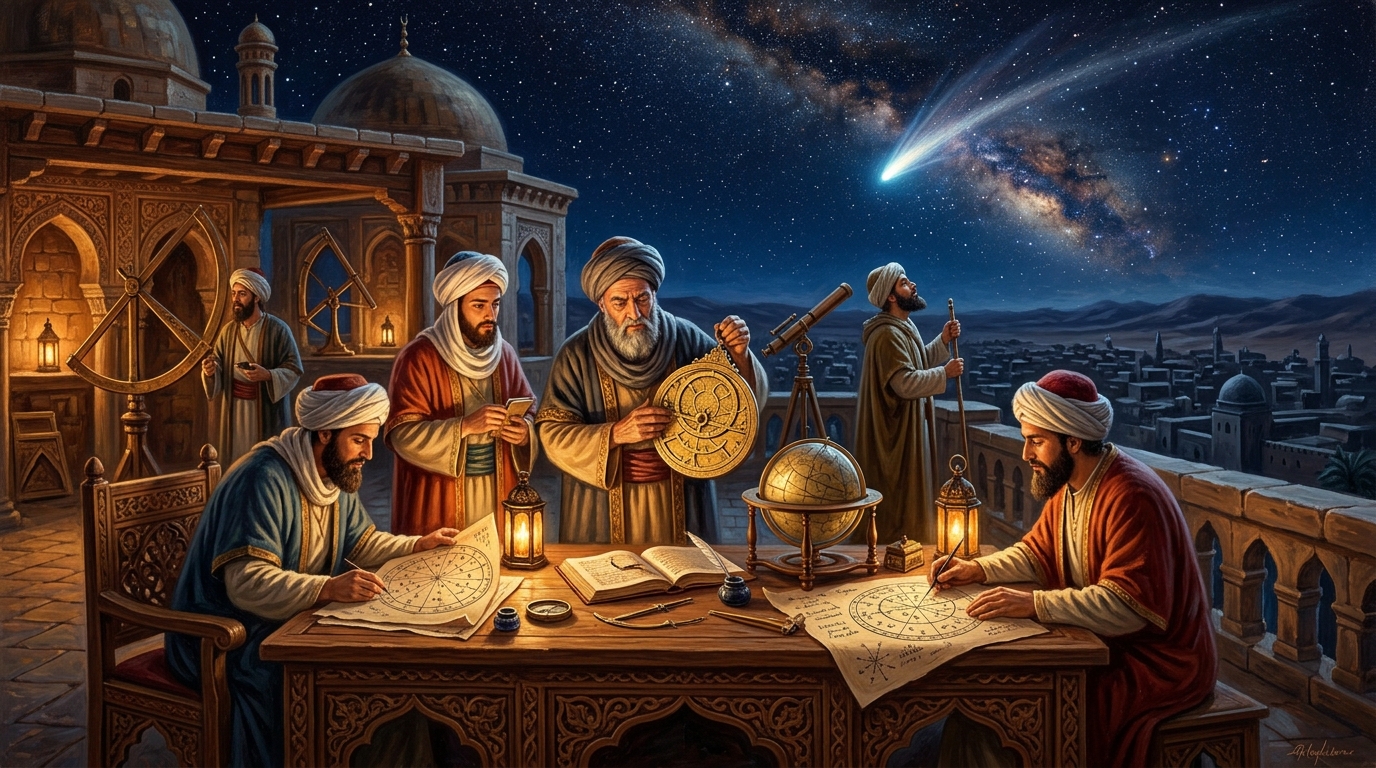
During the Islamic Golden Age, Muslim polymaths constructed the world's most advanced observatories, invented high-precision astronomical instruments, and recorded celestial transits with mathematical rigor:
| Islamic Scholar & Century | Landmark Contribution | Cometary & Orbital Impact |
|---|---|---|
| Al-Battani (Albatenius, 858–929 CE) | Kitab az-Zij (Astronomical Tables) | Calculated solar eccentricity and orbital precession with greater accuracy than Ptolemy; influenced Copernicus |
| Abd al-Rahman al-Sufi (Azophi, 903–986 CE) | Kitab Suwar al-Kawakib (Book of Fixed Stars) | First astronomer in human history to document the Andromeda Galaxy ("Little Cloud") and deep-sky nebulosities |
| Ibn al-Haytham (Alhazen, 965–1040 CE) | Al-Shukuk 'ala Batlamyus (Doubts Concerning Ptolemy) | Pioneered optics and empirical astrophysics; insisted celestial paths must follow physical bodies rather than abstract epicycles |
| Al-Biruni (973–1050 CE) | Al-Qanun al-Mas'udi (The Mas'udic Canon) | Calculated the Earth's radius and analyzed non-circular celestial motions; verified cometary trajectories are supra-lunar |
| Taqi al-Din (1526–1585 CE) | Zij of the Istanbul Observatory | Made detailed, systematic sextant measurements of the Great Comet of 1577, proving comets exist far beyond Earth's atmosphere |
5. Modern Skywatching: How to Observe Cometary Passages
For contemporary seekers and amateur astronomers observing comets like C/2023 A3:
- Locate Dark Sky Horizons: Light pollution from metropolitan areas washes out the delicate, low-surface-brightness dust and ion tails. Travel to rural or elevated locations with an unobstructed western horizon.
- Utilize Averted Vision: The human eye uses rod photoreceptors around the periphery of the retina to detect faint, low-light structures. Looking slightly to the side of the comet makes the extended tail appear brighter and more detailed.
- Binoculars Over High-Magnification Telescopes: Standard wide-field binoculars ($7\times 50$ or $10\times 50$) provide the ideal field of view to capture both the compact nucleus and the sprawling tail in a single frame.
- Astrophotography with Long Exposure: Setting a DSLR or smartphone on a tripod with a 3 to 10-second exposure at ISO 1600–3200 reveals the vivid green cyanogen coma and delicate filamentary streamers invisible to the naked eye.
- Contemplation and Humility (Tadabbur): As your gaze meets light that has traveled through deep space from the dawn of creation, reflect upon the Majesty of the Creator who maintains cosmic equilibrium across billions of light-years.
الَّذِي خَلَقَ سَبْعَ سَمَاوَاتٍ طِبَاقًا ۖ مَّا تَرَىٰ فِي خَلْقِ الرَّحْمَٰنِ مِن تَفَاوُتٍ ۖ فَارْجِعِ الْبَصَرَ هَلْ تَرَىٰ مِن فُطُورٍ
"[And] who created seven heavens in layers. You see no flaw in the creation of the Most Merciful. So turn your vision again; do you see any break?"
— Surah Al-Mulk (67:3)
Scientific & Historical References
- Jewitt, D. (2021). The active Oort cloud: Dynamics and physical properties of long-period comets. The Astronomical Journal, 161(4), 188.
- Whipple, F. L. (1950). A comet model. I. The acceleration of Comet Encke. The Astrophysical Journal, 111, 375–394.
- Fulle, M., et al. (2016). Evolution of the dust and gas environment of comet 67P/Churyumov-Gerasimenko. Monthly Notices of the Royal Astronomical Society, 462(Suppl_1), S2–S10.
- Saliba, G. (2007). Islamic Science and the Making of the European Renaissance. MIT Press, Cambridge, MA.
- Al-Sufi, A. (964 CE). Kitab Suwar al-Kawakib al-Thabitah (The Book of Fixed Stars). Topkapi Palace Library / World Digital Library.
- Ibn Kathir, I. (2000). Tafsir al-Qur'an al-Azim. Dar Ibn Hazm, Beirut (Exegesis on Surah Al-Anbiya 21:33 and Surah Ar-Rahman 55:5–7).