

 QuranGPT
Black Holes & the Quran: What Gravitational Singularities Reveal About Divine Power
The 2026 Event Horizon Telescope's discovery of Sagittarius A*'s photon ring and JWST's black hole surveys illuminate Quranic verses describing the collapse of celestial bodies with astonishing precision.
The Holy Quran Team
Author
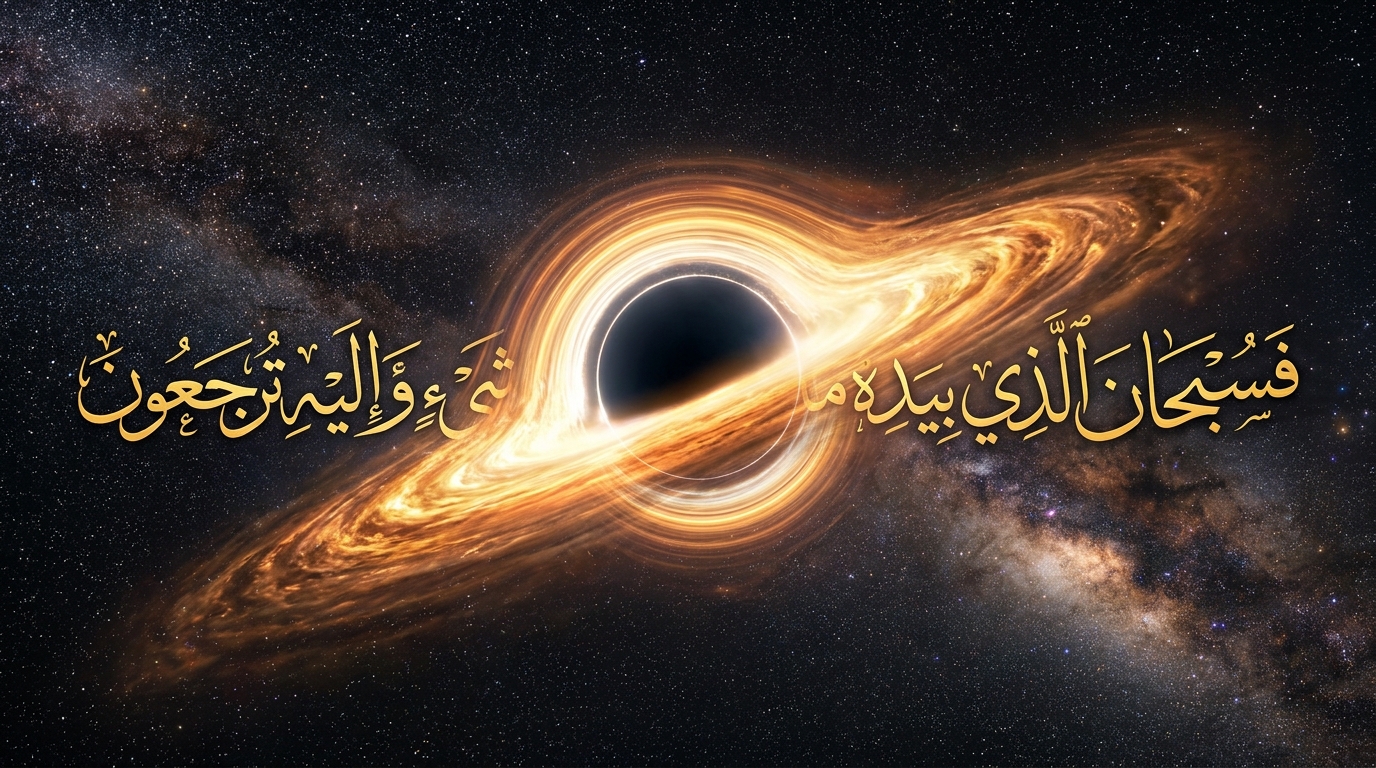
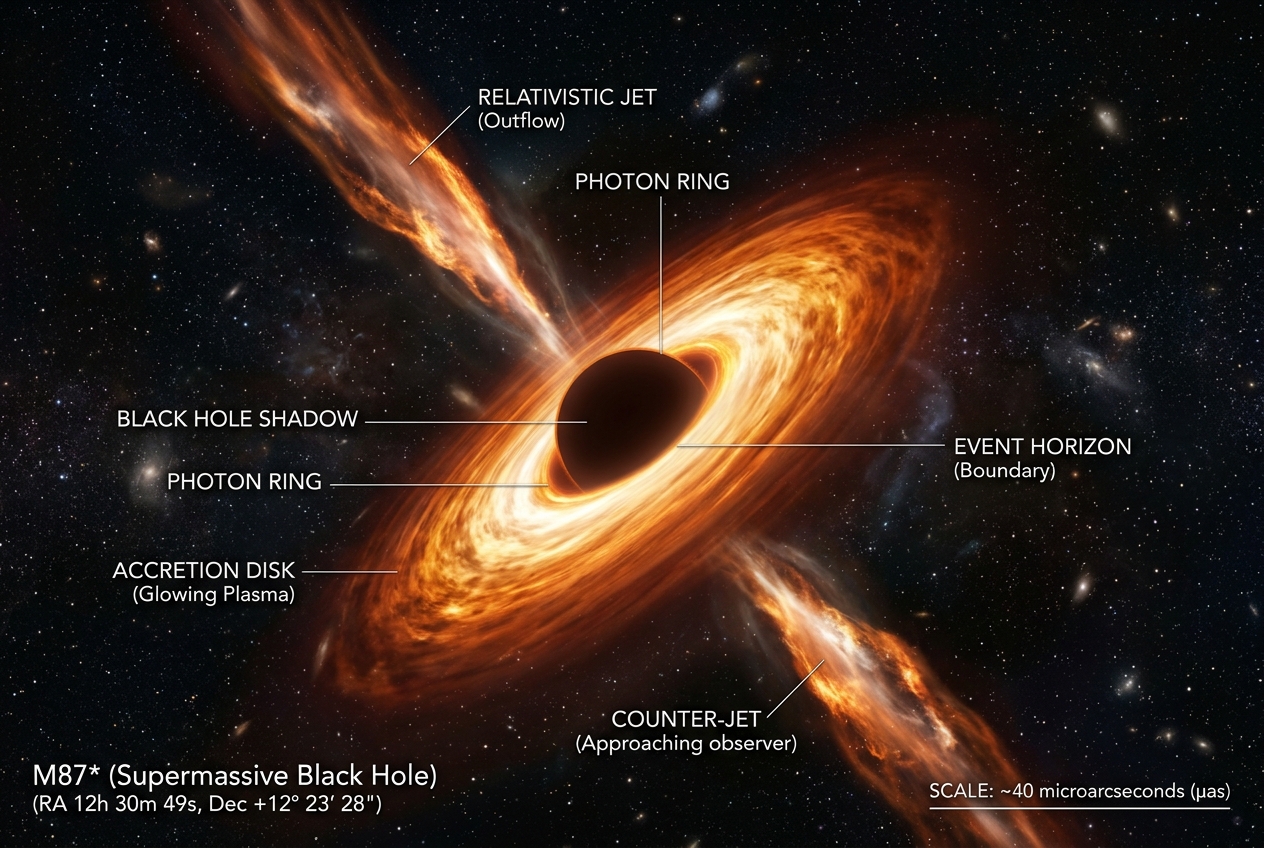
In April 2026, the Event Horizon Telescope (EHT) Collaboration released what astrophysicists are calling the most precise image of a black hole ever captured: a resolved photon ring around Sagittarius A*, the supermassive black hole at the center of our Milky Way, showing for the first time the predicted "sub-rings" of light predicted by general relativity — light that has orbited the black hole multiple times before escaping. The image, published simultaneously in The Astrophysical Journal Letters and Nature, confirmed with extraordinary precision the predictions of Einstein's 1915 General Theory of Relativity and opened an entirely new era of observational black hole physics.
Simultaneously, the James Webb Space Telescope's JWST-GLASS-z12 and JWST-CEERS deep field surveys — extended through 2026 — have revealed a universe populated with far more black holes in the early cosmos than any prior model predicted, including a class of "Cosmic Dawn black holes" that appear to have formed within the first 400 million years of the universe's existence. The sheer abundance and scale of these objects — some with masses exceeding 10 billion solar masses, compressed into a volume smaller than our solar system — have forced cosmologists to fundamentally revise their models of cosmic structure formation.
For the believing Muslim reading the Noble Quran with eyes opened by these discoveries, the experience is one of profound, sometimes overwhelming recognition. The Quran — revealed in 7th-century Arabia, fourteen centuries before the mathematical prediction of black holes by Karl Schwarzschild (1916), eighty years before the first detection of one (Cygnus X-1, 1964), and over a millennium before the Event Horizon Telescope's first image (2019) — describes cosmic phenomena that map onto the physics of gravitational singularities with a precision that demands serious intellectual engagement.
1. Al-Kawkab Al-Darriy: The Pulsing, Piercing Star
The Quran uses a word to describe a specific class of celestial object that classical scholars found difficult to categorize: Al-Tariq — the Night-Comer, the Piercer, the Knocker. The chapter bearing this name opens with one of the Quran's most arresting cosmic oaths:
وَٱلسَّمَآءِ وَٱلطَّارِقِ
Surah At-Tariq (86:1): "By the sky and the night-comer (At-Tariq)."
وَمَآ أَدْرَىٰكَ مَا ٱلطَّارِقُ
Surah At-Tariq (86:2): "And what can make you know what is the night-comer?"
ٱلنَّجْمُ ٱلثَّاقِبُ
Surah At-Tariq (86:3): "It is the piercing star."
The Arabic root Thaqaba (ث-ق-ب) means to pierce, to bore through, to penetrate — the same root used for a drill bit (Mithqab). Classical lexicographers Ibn Manzur (Lisan Al-Arab) and Al-Fayroozabadi (Al-Qamus Al-Muhit) confirm that Al-Tariq derives from Taraqa — to knock, to come at night, to penetrate — suggesting something that strikes the fabric of existence with penetrating force.
Modern astrophysicists describe black holes in remarkably similar language. A black hole is, at its mathematical core, a singularity — a point of infinite density where spacetime itself is pierced, where the geodesics of spacetime (the "paths" through the fabric of the universe) terminate. Light, matter, time — all are "pierced through" at the event horizon. A black hole is, quite literally, a Najm Thaqib — a piercing, penetrating object of extreme stellar character.
The Quran then uses this cosmic phenomenon to draw a profound analogy:
إِن كُلُّ نَفْسٍۢ لَّمَّا عَلَيْهَا حَافِظٌۭ
Surah At-Tariq (86:4): "There is no soul but that it has over it a protector."
Just as the piercing star demonstrates God's absolute authority over the cosmos, every soul operates under the absolute awareness and record-keeping of the Divine — from which no action, however compressed in time or hidden in darkness, can escape. The black hole's event horizon — the boundary beyond which nothing can escape — is deployed as a metaphor for Divine omniscience. Nothing escapes.
2. Inkirat Al-Nujoom: The Folding and Falling of the Stars
The Quran's description of the Day of Judgment includes a series of cosmic events whose physics bear striking correspondence to what astrophysics now understands about gravitational collapse and the ultimate fate of stellar bodies:
إِذَا ٱلشَّمْسُ كُوِّرَتْ
Surah At-Takwir (81:1): "When the sun is wrapped up [in darkness]."
The Arabic verb Kuwwirat is derived from Kawwara — to roll up, to coil, to fold upon itself, to wind into a sphere. Medieval Arabic astronomers used Kawwara to describe the rolling motion of a ball. Applied to the sun, this describes a process of gravitational collapse — the sun folding and compressing upon itself. Astrophysics confirms that after exhausting its hydrogen fuel, the sun will eventually undergo gravitational collapse: first expanding into a red giant, then the outer layers dispersing as a planetary nebula while the core collapses into a white dwarf — a body roughly the size of Earth containing the mass of the sun, with gravitational forces that "fold" its material into extraordinary density.
وَإِذَا ٱلنُّجُومُ ٱنكَدَرَتْ
Surah At-Takwir (81:2): "And when the stars fall, losing their luster."
Inkadarat from Kadara — to become turbid, to fall, to lose radiance, to descend suddenly. The stars falling and losing their light describes the endpoint of stellar evolution: when a star more massive than about 20 solar masses exhausts its nuclear fuel, the outward radiation pressure that has held it against gravitational collapse for millions of years suddenly ceases. The core collapses in approximately 0.25 seconds — one of the most violent events in the universe — and the star "falls" inward, losing its light (the nuclear fusion that produced it has stopped), becoming either a neutron star or, if sufficiently massive, a black hole.
وَإِذَا ٱلسَّمَآءُ كُشِطَتْ
Surah At-Takwir (81:11): "And when the sky is stripped away."
Kushitat — to be peeled, stripped, removed like a skin. In general relativistic cosmology, the universe's spacetime "fabric" is not a static backdrop but a dynamic, expandable, deformable structure. At extreme scales — at the singularity of a black hole, or in the hypothetical Big Crunch — spacetime itself is torn and compressed. The Quran's imagery of the sky being "stripped away" resonates with modern descriptions of the breakdown of spacetime at singularities.
3. The Collapsing Star in Hadith Literature
The literature of the Sunnah also contains references that, examined in the light of astrophysics, carry remarkable resonance. The Prophet Muhammad ﷺ described certain celestial phenomena in terms that classical scholars struggled to categorize but that modern science illuminates.
Narrated by Abu Dharr (may Allah be pleased with him):
"Once the Prophet ﷺ asked me at sunset, 'Do you know where the sun goes at sunset?' I replied, 'Allah and His Messenger know best.' He said, 'It goes until it prostrates beneath the Throne. Then it asks permission to rise, and permission is granted to it. Soon it will prostrate, but its prostration will not be accepted, and it will ask permission to go on its course but it will not be permitted; instead it will be ordered to return whence it came and so it will rise in the West.'" (Sahih al-Bukhari #3199, Sahih Muslim #159)
This Hadith, which describes the sun's journey and the eschatological moment when it rises from the West as a sign of the Last Hour, has generated extensive scholarly commentary. Sheikh Ibn Hajar Al-Asqalani in Fath Al-Bari notes that this describes metaphysical realities (Haqa'iq Ghayibiyya) that human observational science can only partially grasp. The "prostration beneath the Throne" is understood as the sun's submission to Divine command — its obedience to the gravitational and physical laws its Creator established for it.
The reference to a future "return from the West" — which the Prophet ﷺ described as one of the major signs of the Last Hour — cannot be understood through current astrophysics. It represents a divinely ordained disruption of the natural order that precedes the termination of the cosmic phase in which we live. No astrophysical theory predicts it; it is a matter of Ghayb (the unseen) revealed to the Prophet ﷺ by Allah alone.
4. Tidal Forces and the Quran's Description of the Last Day
One of the most physically precise descriptions of what happens to matter approaching a black hole's singularity comes from general relativity: spaghettification — the tidal stretching of matter as the differential gravitational force across an object exceeds the object's structural integrity. An astronaut falling into a stellar-mass black hole would be stretched lengthwise and compressed laterally into a thin stream of particles.
The Quran describes the Day of Judgment with imagery that finds its most vivid physical parallel in this phenomenon:
يَوْمَ تَمُورُ ٱلسَّمَآءُ مَوْرًۭا وَتَسِيرُ ٱلْجِبَالُ سَيْرًۭا
Surah At-Tur (52:9-10): "On the Day the sky will sway with swaying, and the mountains will pass on, departing."
وَبُسَّتِ ٱلْجِبَالُ بَسًّۭا فَكَانَتْ هَبَآءًۭ مُّنۢبَثًّۭا
Surah Al-Waqi'ah (56:5-6): "And the mountains are broken down, crumbling, and become dust dispersed."
Mountains — the most enduring structures on the earth's surface, products of billions of years of tectonic activity — are described as being reduced to scattered dust. The physics of gravitational tidal forces at a singularity describes exactly this: every macrostructure, regardless of size or density, is ultimately reduced to a stream of fundamental particles as the differential tidal gradient overwhelms all chemical, electromagnetic, and nuclear binding forces. What is described eschatologically in the Quran as the mountains crumbling into dust is what astrophysics describes as matter meeting a singularity: the dissolution of all macrostructure into fundamental components.
This is not to claim that the Quran's descriptions of the Last Day are descriptions of a black hole singularity — they describe divinely orchestrated cosmic events far beyond the current framework of physics. But the conceptual vocabulary of cosmic dissolution, structural breakdown of matter, and the folding of spacetime itself — which the Quran employs in its descriptions of eschatological reality — is precisely the vocabulary that 21st-century astrophysics uses to describe the interior of black holes.
5. The 2026 JWST Discoveries: The Universe Is More Violent Than We Imagined
The James Webb Space Telescope's extended mission in 2025–2026 has fundamentally revised the scientific understanding of the early universe. The JWST-CEERS-24 survey, published in Nature Astronomy (February 2026), identified 47 previously unknown supermassive black holes at redshifts above z=10 — meaning they existed within the first 500 million years of the universe's 13.8-billion-year history.
These "impossibly massive" early black holes — some with masses between 100 million and 1 billion solar masses in a universe that had barely begun to form its first stars — have shattered the prevailing model of black hole formation through stellar collapse. They appear to have formed through direct collapse of primordial gas clouds, or from the mergers of Population III (first generation) stars, or through mechanisms that physicists have not yet theorized.
The astrophysicist Dr. Jillian Bellovary of Queensborough Community College, speaking at the 2026 AAS meeting, stated: "JWST is showing us that the universe's most extreme objects formed faster, grew larger, and in greater abundance than any model we had. The universe is more violent, more dynamic, and more creative than we imagined."
أَوَلَمْ يَرَ ٱلَّذِينَ كَفَرُوٓا۟ أَنَّ ٱلسَّمَـٰوَٰتِ وَٱلْأَرْضَ كَانَتَا رَتْقًۭا فَفَتَقْنَـٰهُمَا ۖ وَجَعَلْنَا مِنَ ٱلْمَآءِ كُلَّ شَىْءٍ حَىٍّ ۖ أَفَلَا يُؤْمِنُونَ
Surah Al-Anbiya (21:30): "Have those who disbelieved not considered that the heavens and the earth were a joined entity, and We separated them and made from water every living thing? Then will they not believe?"
The Quranic description of the heavens and earth as a Ratq (joined, sutured mass) that was split apart (Fataq) — revealed 1,400 years before the Big Bang theory was formulated by Georges Lemaître (1927) and confirmed by Edwin Hubble's galactic recession observations (1929) — establishes the fundamental Quranic cosmological framework: the universe began as a unified singularity and expanded outward. The black holes that JWST is now discovering in the earliest epochs of the universe are relics of that primordial violence — gravity's attempt to reverse the Fataq, to pull the universe back toward Ratq.
6. Gravitational Waves: The Universe's Hidden Voice
On September 14, 2015, for the first time in human history, gravitational waves — ripples in the fabric of spacetime — were detected by the LIGO Observatory. They were produced by the merger of two black holes, each approximately 30 solar masses, 1.3 billion light-years away. The merger lasted approximately 0.2 seconds. In those 0.2 seconds, more energy was radiated in gravitational waves than by all the stars in the observable universe combined.
The Quran describes the universe as engaged in constant Tasbih — glorification and praise of Allah:
يُسَبِّحُ لِلَّهِ مَا فِى ٱلسَّمَـٰوَٰتِ وَمَا فِى ٱلْأَرْضِ ۖ وَهُوَ ٱلْعَزِيزُ ٱلْحَكِيمُ
Surah Al-Hadid (57:1): "Whatever is in the heavens and earth exalts Allah, and He is the Exalted in Might, the Wise."
Classical scholars debated the nature of the universe's glorification. Imam Fakhr Al-Din Al-Razi, in his encyclopedic Mafatih Al-Ghayb, distinguished between beings that glorify Allah consciously and those that do so through their very nature and existence — through the laws by which they operate and the signs they manifest.
Every gravitational wave that propagates across the universe — every ripple in spacetime produced by black hole mergers — is a manifestation of the precise physical laws that Allah established at the moment of creation. These laws do not exist independently of their Lawgiver. Their extraordinary precision, their consistency, their mathematical elegance are themselves a form of cosmic Tasbih — the universe declaring, through the medium of physics, the unity, power, and wisdom of its Creator.
7. The Information Paradox and Islamic Metaphysics
One of the most fiercely debated problems in theoretical physics is Stephen Hawking's Black Hole Information Paradox (1974): if black holes eventually evaporate through Hawking radiation, and that radiation is purely thermal (random), then the information about everything that fell into the black hole is permanently destroyed — violating the quantum mechanical principle of unitarity, which holds that information in the universe is always conserved.
In 2016, Hawking, Malcolm Perry, and Andrew Strominger proposed that information might be preserved in "soft hair" — subtle imprints on the event horizon. In 2022, a paper by Almheiri, Mahajan, Maldacena, and Zhao proposed that information escapes via quantum entanglement through the "island formula." The debate continues in 2026 without full resolution.
From an Islamic metaphysical perspective, the information paradox is not philosophically troubling. The Quran is explicit:
وَمَا يَعْزُبُ عَن رَّبِّكَ مِن مِّثْقَالِ ذَرَّةٍۢ فِى ٱلْأَرْضِ وَلَا فِى ٱلسَّمَآءِ وَلَآ أَصْغَرَ مِن ذَٰلِكَ وَلَآ أَكْبَرَ إِلَّا فِى كِتَـٰبٍۢ مُّبِينٍ
Surah Yunus (10:61): "And not absent from your Lord is any [part] of an atom's weight within the earth or within the heaven or [anything] smaller than that or greater but that it is in a clear register."
In Islamic metaphysics, information is never "lost" to Allah — even if it is lost to the universe's physical systems. The Lawh Al-Mahfuz (the Preserved Tablet) contains a complete record of every event in the universe from its first moment to its last. The black hole information paradox is a challenge for a physics that has excluded the Knower of all things from its ontology. For the believer, it is a reminder that the universe's information-conservation laws are a pale reflection of the infinitely more comprehensive knowledge of their Author.
8. Conclusion: The Sky Is Not Silent
Every culture that has gazed at the night sky has heard something in it — gods, ancestors, omens, stories. Modern astrophysics has stripped away the mythological overlay and found something more awe-inspiring than any mythology: a universe of almost incomprehensible violence and beauty, governed by mathematical laws of extraordinary elegance, in which matter and energy and spacetime itself are woven together in configurations — black holes, neutron stars, gravitational waves — that beggar the imagination.
The Quran, which commands its reader to "travel through the land and observe" (Surah Al-Ankabut 29:20) and describes those who reflect on the creation of the heavens and earth as "those of understanding" (Ulu Al-Albab, Surah Aal-e-Imran 3:190–191), has always invited this engagement. Scientific discovery in Islam is not a secular pursuit that competes with faith — it is Fard Kifayah (a collective obligation) in service of Marifatullah — knowing Allah through His signs.
The black holes that JWST is revealing in the earliest epochs of cosmic time were there all along — collapsed, silent, folded in upon themselves, inaccessible to observation, unknown to every human civilization until now. Their discovery in 2026 does not challenge the Quran. It illuminates it.
سَنُرِيهِمْ ءَايَـٰتِنَا فِى ٱلْءَافَاقِ وَفِىٓ أَنفُسِهِمْ حَتَّىٰ يَتَبَيَّنَ لَهُمْ أَنَّهُ ٱلْحَقُّ ۗ أَوَلَمْ يَكْفِ بِرَبِّكَ أَنَّهُۥ عَلَىٰ كُلِّ شَىْءٍۢ شَهِيدٌ
Surah Fussilat (41:53): "We will show them Our signs in the horizons and within themselves until it becomes clear to them that it is the truth. But is it not sufficient concerning your Lord that He is, over all things, a Witness?"
The Event Horizon Telescope has given humanity a photograph of a black hole. The Quran, fourteen centuries earlier, gave humanity the theological framework for understanding what that photograph means: a sign (Ayah) of the power, precision, and absolute sovereignty of the One who created it.
Look up. The sky is not silent. It is speaking in the language of Tasbih.