

 QuranGPT
Biomimicry & The Honeybee (Surah An-Nahl): How 120-Degree Hexagonal Geometry, Worker Genetics & Swarm Algorithms Changed Robotics
An exploration of the biological precision of Surah An-Nahl (16:68-69), female worker bee grammar, Hales' Honeycomb Conjecture mathematical proof, and 2026 swarm AI robotics.
The Holy Quran Team
Author
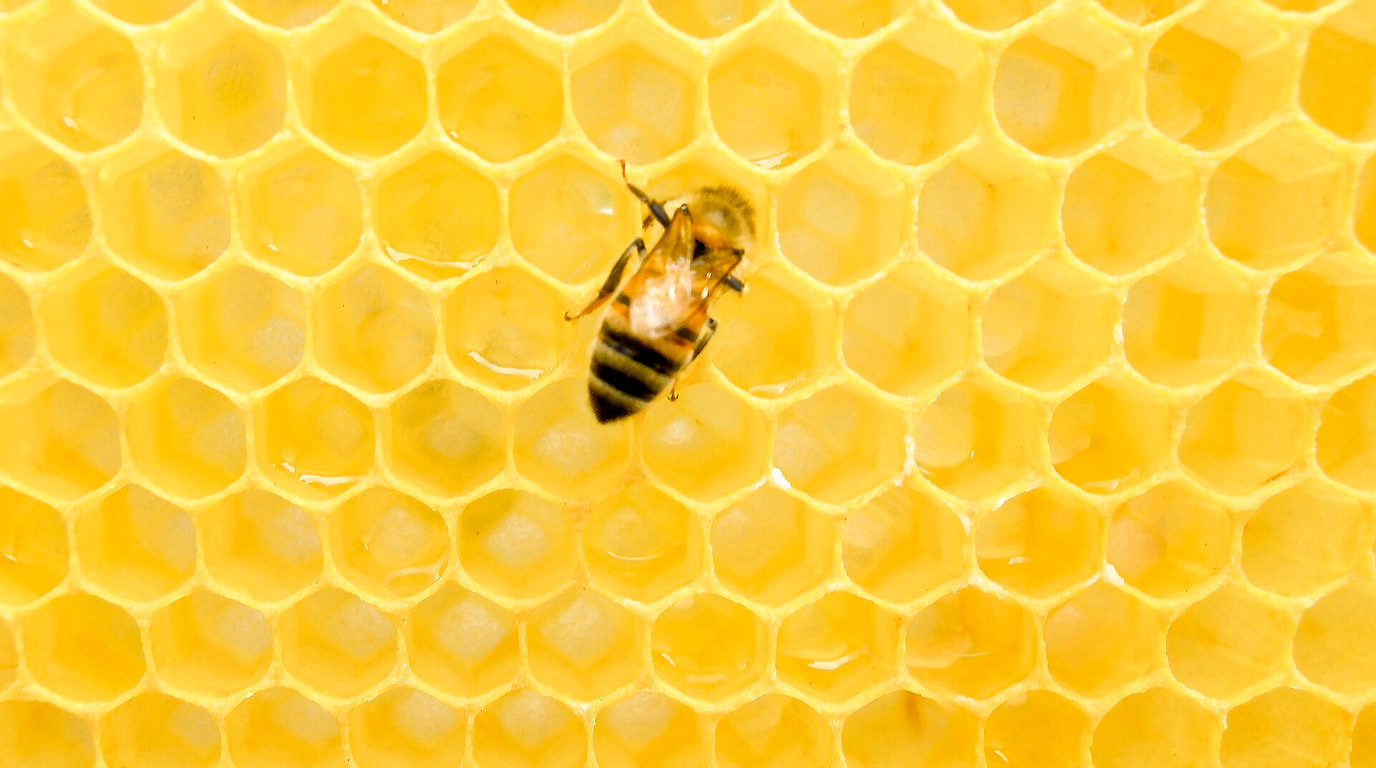
In 2026, one of the fastest-growing fields in aerospace engineering, autonomous robotics, and structural optimization is biomimicry — solving complex computational and mechanical engineering bottlenecks by reverse-engineering designs honed across biological systems. At the center of this technological renaissance is a tiny organism weighing barely 100 milligrams: the western honeybee (Apis mellifera).
Modern unmanned drone fleets rely on Artificial Bee Colony (ABC) metaheuristics to solve decentralized pathfinding problems; ultra-light spacecraft honeycomb cores copy hexagonal bee cells to maximize strength-to-mass ratios; and emergency wound-care clinics apply medical-grade enzymatic honey to combat antibiotic-resistant pathogens.
Yet over fourteen centuries before electron microscopes, vector mathematics, or autonomous swarm robotics existed, the Holy Quran dedicated an entire chapter — Surah An-Nahl (Chapter 16: The Bee) — to the behavior, gender-specific division of labor, architectural engineering, and medicinal chemistry of this extraordinary creature.
1. The Grammatical Precision: Why Feminine Verbs Address Worker Bees
In classical Arabic, verbs and imperatives must explicitly match the grammatical gender of the subject being addressed — masculine commands differ distinctly from feminine commands. For centuries, ancient folklore and early European observers assumed that the honeybee colony was led by a "king bee" and staffed by male soldier-workers; even William Shakespeare famously depicted a "king" ruling busy male workers in Henry V.
In stark contrast, the Quranic revelation issued three distinct feminine singular imperative commands directly to the honeybee (An-Nahl):
وَأَوْحَىٰ رَبُّكَ إِلَى ٱلنَّحْلِ أَنِ ٱتَّخِذِى مِنَ ٱلْجِبَالِ بُيُوتًۭا وَمِنَ ٱلشَّجَرِ وَمِمَّا يَعْرِشُونَ
Surah An-Nahl (16:68): "And your Lord inspired to the bee, 'Take for yourself [feminine: Ittakhidhi] among the mountains, houses, and among the trees and [in] that which they construct.'"
ثُمَّ كُلِى مِن كُلِّ ٱلثَّمَرَٰتِ فَٱسْلُكِى سُبُلَ رَبِّكِ ذُلُلًۭا ۚ يَخْرُجُ مِنۢ بُطُونِهَا شَرَابٌۭ مُّخْتَلِفٌ أَلْوَٰنُهُۥ فِيهِ شِفَآءٌۭ لِّلنَّاسِ ۗ إِنَّ فِى ذَٰلِكَ لَءَايَةًۭ لِّقَوْمٍۢ يَتَفَكَّرُونَ
Surah An-Nahl (16:69): "Then eat [feminine: Kuli] from all the fruits and follow [feminine: Fasluki] the ways of your Lord laid down [for you]. There emerges from their bellies [feminine plural: Butuniha] a drink, varying in colors, in which there is healing for people. Indeed in that is a sign for a people who give thought."
Modern entomology has proven conclusively what remained hidden until modern microscopy and hive-observation genetics:
- Only Female Worker Bees Build Hives (Ittakhidhi): Male drones have no wax-producing glands on their abdomens and lack the elongated specialized mandibles required to sculpt honeycomb cells.
- Only Female Worker Bees Forage Nectar (Kuli): Male drones possess shorter proboscises unable to extract deep floral nectar and lack pollen baskets (corbiculae) on their hind legs.
- Only Female Worker Bees Navigate & Synthesize Honey (Fasluki & Butuniha): Only female workers navigate back to the hive along sun-polarized pathways and possess the hypopharyngeal enzymes (invertase and glucose oxidase) to convert floral nectar into pure honey.
2. Hales' Honeycomb Conjecture: Optimal 120-Degree Engineering
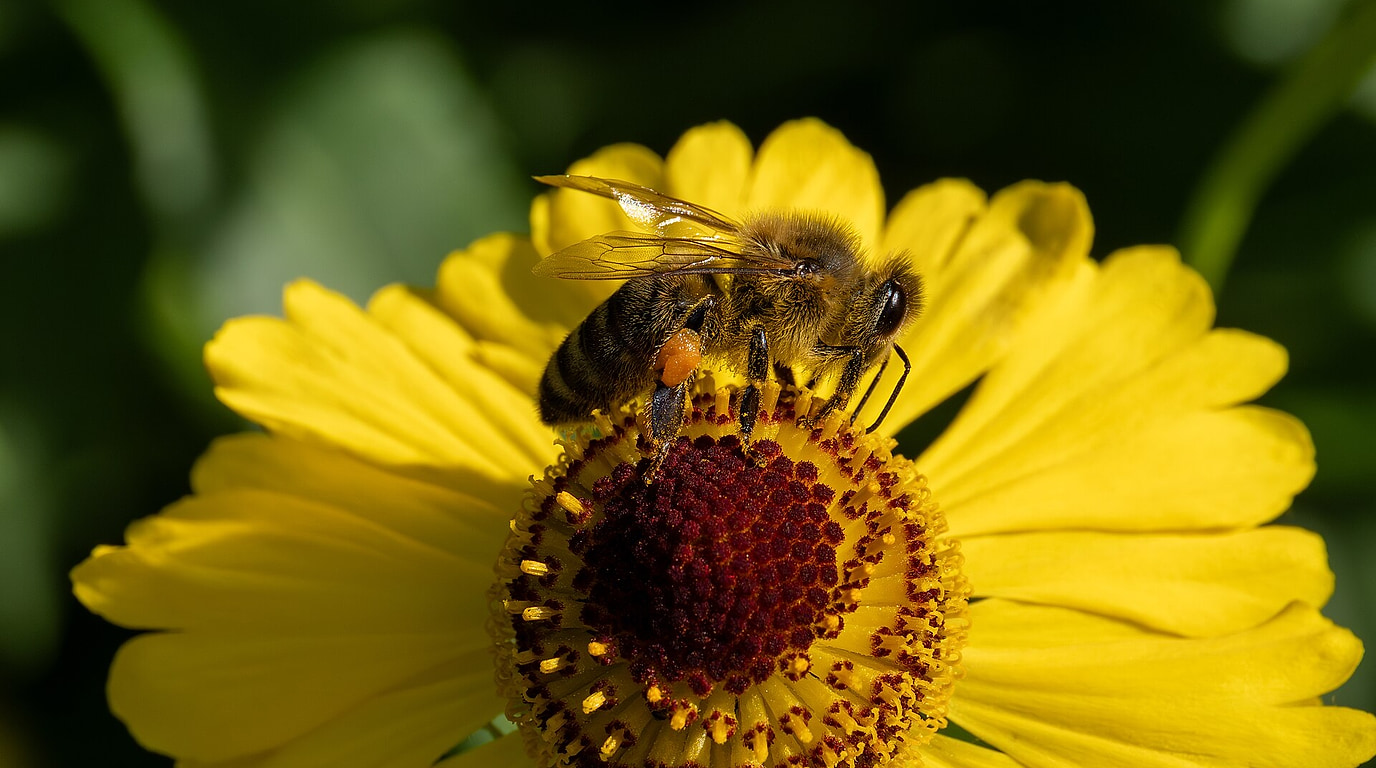
Why do honeybees invest their precious metabolic wax exclusively into interlocking regular hexagons with precise 120-degree interior angles, rather than squares, triangles, or circles?
For nearly two millennia, ancient Greek mathematicians including Pappus of Alexandria hypothesized that hexagonal tiling required the least total perimeter wall (and therefore the minimum amount of beeswax) to partition a two-dimensional plane into equal-volume storage cells. Yet the problem remained mathematically unproven for over 1,600 years due to subtle boundary-curvature complexities.
Finally, in 1999, mathematician Dr. Thomas C. Hales (of the University of Michigan) published a landmark geometric proof of the Honeycomb Conjecture. Hales rigorously demonstrated that any partition of the plane into regions of equal area has perimeter at least that of the regular hexagonal honeycomb tiling — confirming that the bee's instinctual architecture represents the absolute theoretical minimum material waste achievable in Euclidean geometry.
| Structural Geometry | Interior Angle | Edge-Sharing Efficiency | Aerospace / Structural Verdict |
|---|---|---|---|
| Circular Cylinders | Infinite | Leaves ~9.3% unutilized empty gaps | Wastes space and wax material |
| Equilateral Triangles | 60° | High perimeter wall per unit area (~18% more wax) | Mechanically inefficient wall-to-volume ratio |
| Squares | 90° | ~6.5% more wax perimeter than hexagons | Prone to shear deformation under lateral compression |
| Regular Hexagons | 120° | Absolute Minimum Perimeter (Hales 1999 Proof) | Highest strength-to-weight ratio; forms rocket & aircraft panels |
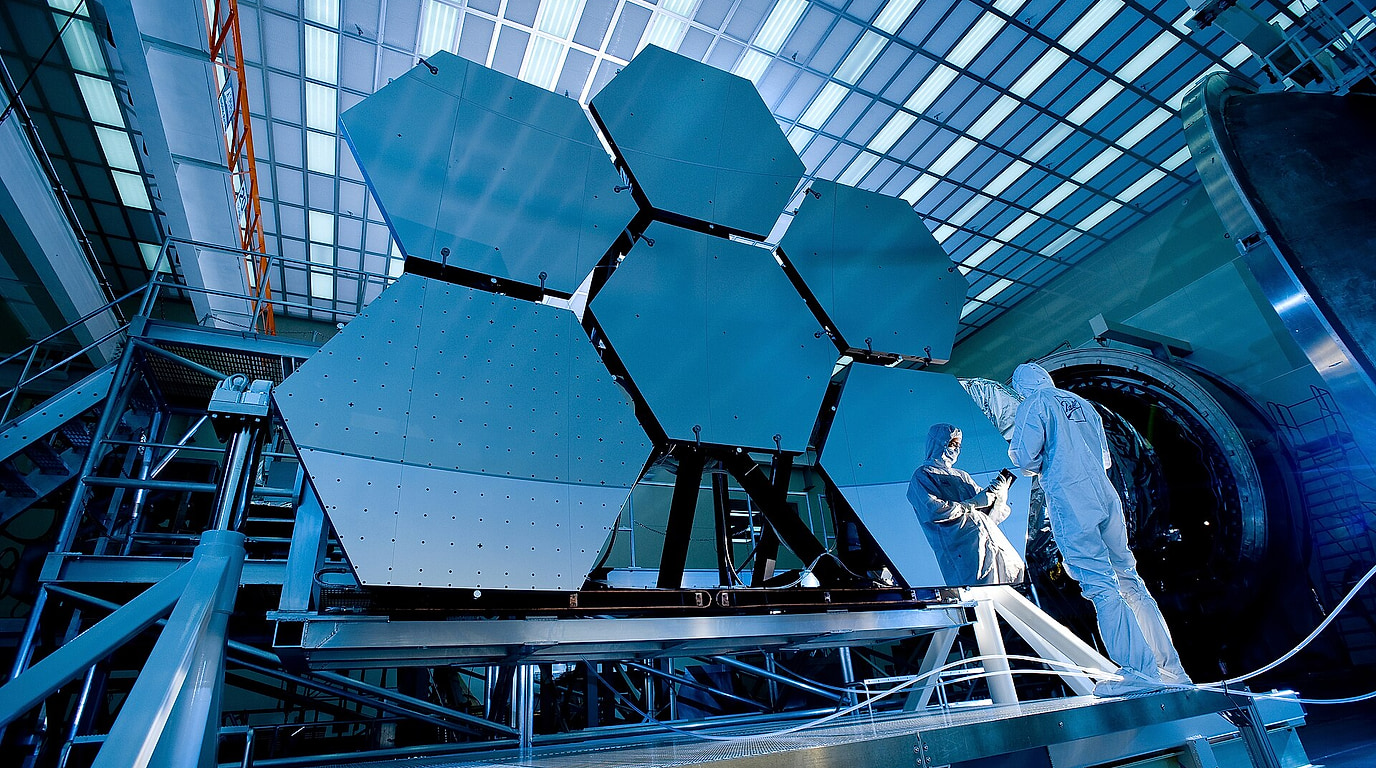
Today, the identical 120-degree hexagonal lattice inspired by Surah An-Nahl forms the structural core of James Webb Space Telescope primary mirror backplanes, Formula 1 crash structures, and ultra-light commercial aviation fuselages.
3. The Waggle Dance & Swarm Intelligence: Robotics in 2026
Notice the remarkable Quranic instruction in Surah 16:69: فَٱسْلُكِى سُبُلَ رَبِّكِ ذُلُلًۭا ("and follow the ways of your Lord laid down/made submissive for you").
How does an individual honeybee locate a microscopic patch of wildflowers five kilometers away, navigate back to a dark hive, and communicate the exact distance and GPS-like vector bearing to thousands of nestmates?
In the mid-20th century, Austrian ethologist Karl von Frisch won the 1973 Nobel Prize in Physiology or Medicine for decoding the honeybee's Waggle Dance — arguably the most sophisticated non-human symbolic language on Earth:
- Angular Direction Vector: Inside the vertical pitch-dark hive, the returning bee runs in a straight figure-eight waggle line angled relative to vertical gravity. That exact angle matches the azimuthal angle between the sun and the food source outside.
- Distance Calibration: The duration of the abdominal vibration (roughly 75 milliseconds per 100 meters) encodes exact radial flight distance, automatically compensating for headwinds!
- Solar Motion Compensation: Bees possess internal circadian oscillators enabling them to adjust their directional dance continuously even when clouds obscure the sun, relying on atmospheric UV-polarized light rings.
In 2026, computer scientists led by Dr. Dervis Karaboga and aerospace engineers utilize Artificial Bee Colony (ABC) algorithms directly modeled on honeybee scouts, onlooker bees, and employed foragers. These decentralized, fault-tolerant algorithms coordinate search-and-rescue micro-drones, balance global cloud server traffic, and optimize autonomous cargo routing without requiring any single central control hub.
4. Medical Biochemistry: "Fihi Shifa'un Lin-Nas"
Surah An-Nahl concludes verse 69 with a profound clinical declaration: "There emerges from their bellies a drink, varying in colors, in which there is healing for people."
Why does the plural phrase refer to "drinks of varying colors" (Sharabun mukhtalifun alwanuhu)? Depending on the botanical flora foraged (clover, Sidr, Manuka, Acacia, buckwheat), honey varies dramatically from pale translucent amber to deep mahogany, carrying distinct phytochemical profiles. Modern clinical microbiology confirms multiple synergistic healing mechanisms:
- Enzymatic Hydrogen Peroxide Release: Bees inject glucose oxidase into nectar, slowly releasing controlled, tissue-safe antibacterial doses of hydrogen peroxide when honey contacts wound moisture.
- Hyper-Osmolar Dehydration: With minimal water activity (below 0.6), pure honey strips intracellular moisture from resistant bacterial biofilms (including MRSA), halving proliferation without harming host tissue.
- Methylglyoxal (MGO) & Defensin-1: Specialized floral honeys contain non-peroxide bactericidal compounds and bee antimicrobial peptides that stimulate cytokine macrophage repair and collagen remodeling.
5. The Parable of the Believer
Beyond pure mathematics and bio-engineering, the Prophet Muhammad ﷺ turned the humble honeybee into an inspiring benchmark for ethical human character. As narrated by 'Abdullah ibn 'Amr (may Allah be pleased with him):
The Messenger of Allah ﷺ said:
"By the One in Whose Hand is the soul of Muhammad, the believer is like a bee which eats that which is pure and wholesome (Tayyib) and lays that which is pure and wholesome. When it lands on a branch or flower, it neither breaks nor ruins it."
(Musnad Ahmad #6872; graded Sahih li-ghayrihi by Shu'ayb al-Arna'ut and Sheikh al-Albani in Sahih al-Jami' #5847)
This extraordinary narration outlines three principles for thriving in the modern world:
- Selective Input: Filter what enters your body (pure Halalan Tayyiban sustenance) and mind (beneficial knowledge instead of toxic digital outrage).
- Value Creation: Transform whatever resources you encounter into healing, beneficial output for society.
- Gentle Footprint: Move lightly across ecosystems, families, and communities — building structures of breathtaking geometric precision without destroying the delicate environments around you.