

 QuranGPT
The House of Wisdom (Bayt al-Hikmah): How Baghdad Built the World's Greatest Research Institution
The extraordinary story of Bayt al-Hikmah — the 8th–13th century Baghdad institution that collected all human knowledge, translated Greek, Persian, Indian, and Chinese texts, and produced the scientific foundations of the Renaissance and modern civilization.
The Holy Quran Team
Author
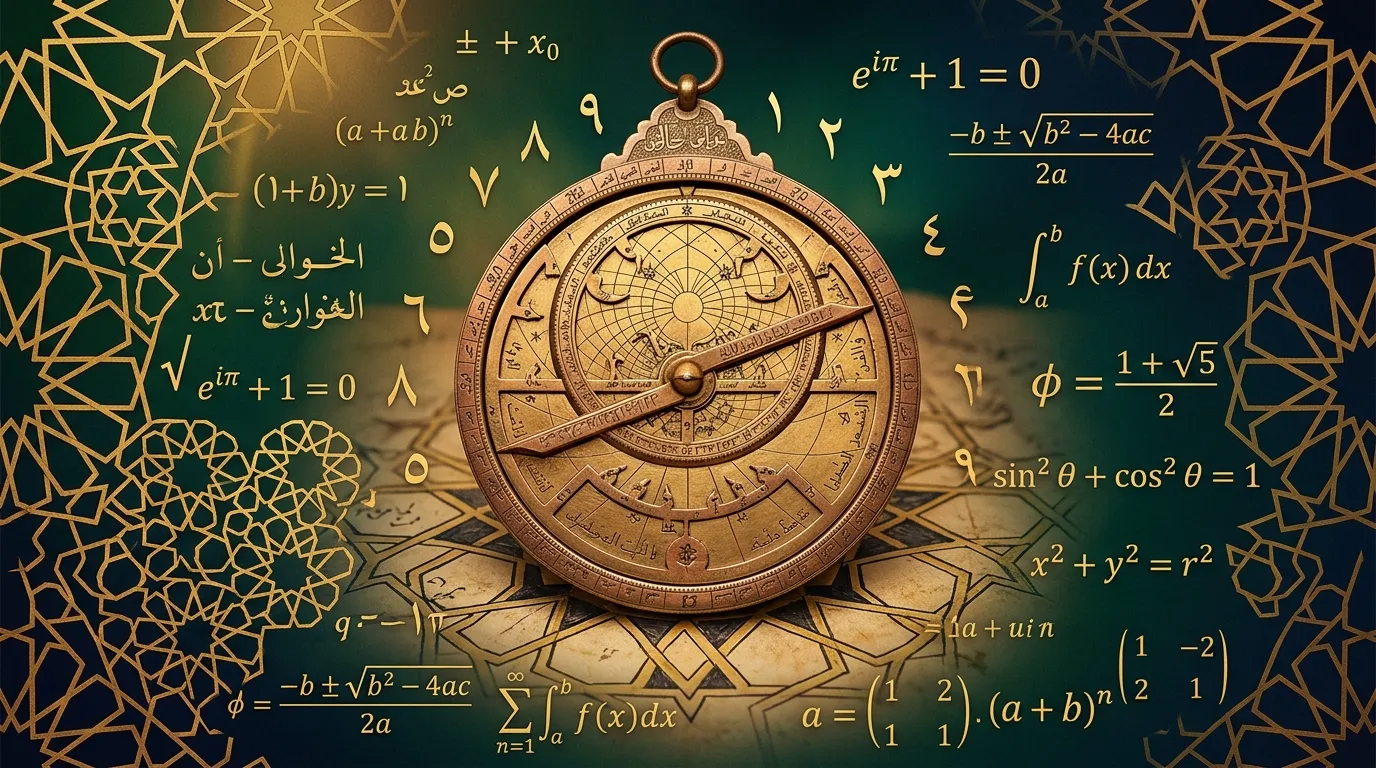
In the 8th century CE, the Caliph of the Islamic world issued one of the most consequential commands in the history of civilization:
"Bring me every book of knowledge from every corner of the world — and translate it into Arabic."
The institution this command created — Bayt al-Hikmah (The House of Wisdom) in Baghdad — became the greatest repository of human knowledge in history, the world's first funded research institution, and the laboratory in which Islamic scholars synthesized, tested, extended, and transmitted the accumulated wisdom of Greek, Persian, Indian, Syriac, and Chinese civilizations — eventually sparking the European Renaissance.
1. The Quranic Foundation: Knowledge as the Highest Islamic Value
The first word of Quranic revelation was:
اقْرَأْ بِاسْمِ رَبِّكَ الَّذِي خَلَقَ
"Read! In the name of your Lord who created."
(Surah Al-Alaq 96:1)
This was not a command to read the Quran alone. It was a universal command to acquire knowledge — of all creation, in all its forms. The Prophet Muhammad ﷺ reinforced this:
"Seeking knowledge is an obligation upon every Muslim."
(Ibn Majah 224)
"Wisdom is the lost property of the believer. Wherever he finds it, he has the most right to it."
(Jami' at-Tirmidhi 2687)
This last Hadith was the philosophical foundation of the Translation Movement: wisdom from Greek philosophy, Persian science, Indian mathematics, or Chinese technology was rightfully Islamic — because all truth belongs to the One who created it.
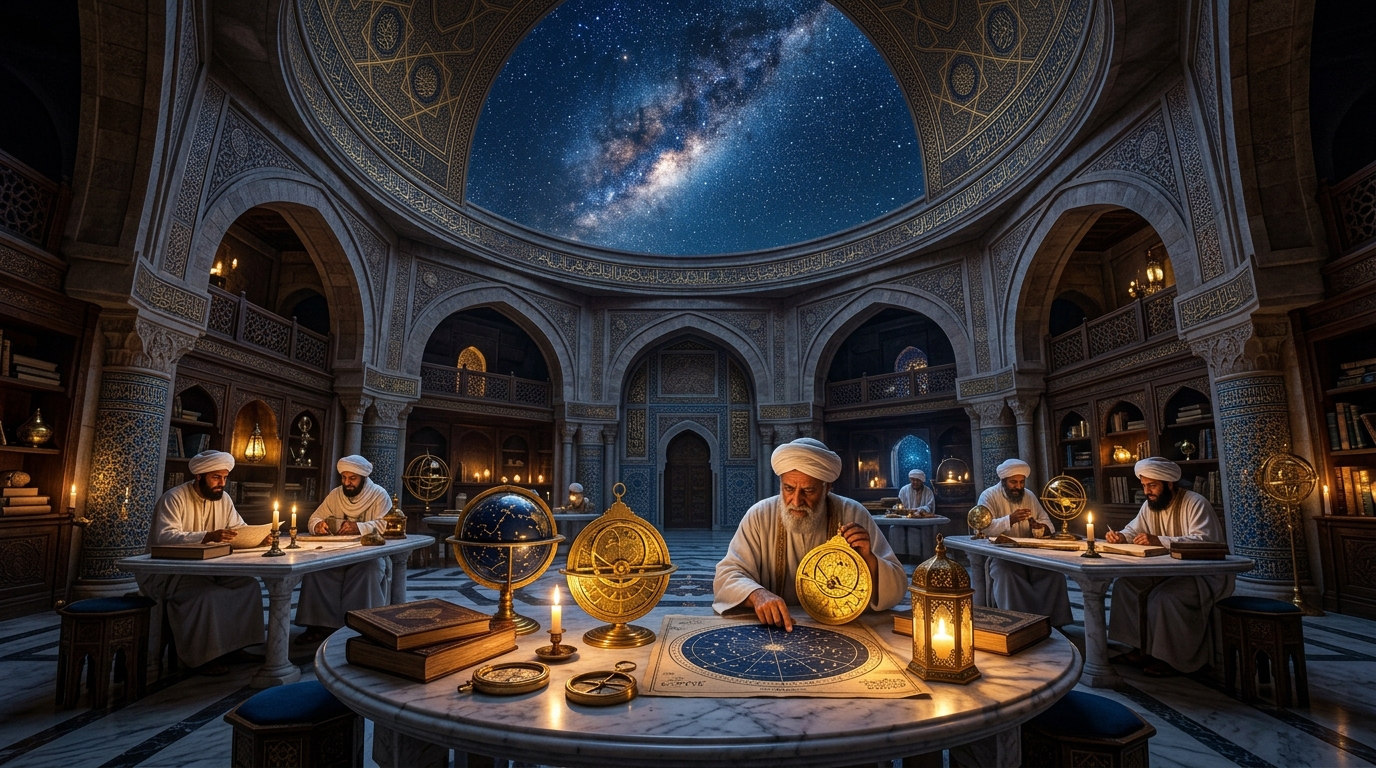
Scholars at the House of Wisdom and associated observatories engaged in translation, astronomical observation, and interdisciplinary scientific research.
2. The Origins: From Royal Library to Research Institution
Caliph Al-Mansur (754–775 CE) established the early precursor — a royal library and translation bureau. His grandson Harun al-Rashid (786–809 CE) significantly expanded it. But it was Caliph Al-Ma'mun (813–833 CE) who transformed it into the world's first true research university.
Al-Ma'mun:
- Made Baghdad the intellectual capital of the known world
- Funded scholars at state salaries equivalent to professional athletes today
- Sent diplomatic missions to Byzantium, India, and China specifically to collect manuscripts
- Reportedly paid translators their work's weight in gold for exceptional translations
- Established regular scholarly debates (Munazara) where scholars argued and tested ideas
Under Al-Ma'mun, Bayt al-Hikmah had:
- A library of 400,000–500,000 volumes — the largest in the world
- Scholars in mathematics, astronomy, medicine, philosophy, chemistry, geography
- A dedicated translation bureau processing Greek, Syriac, Persian, and Sanskrit texts
- A observatory for astronomical research
- An instrument workshop for scientific equipment
3. The Translation Movement: The Greatest Knowledge Transfer in History
The Graeco-Arabic Translation Movement (750–1000 CE) was the systematic translation of virtually every surviving Greek scientific and philosophical text into Arabic. This was not passive copying — it was critical scholarship:
| Scholar | From | To | Key Works Translated |
|---|---|---|---|
| Hunayn ibn Ishaq | Greek/Syriac | Arabic | Galen (129 works), Hippocrates, Plato, Aristotle |
| Thabit ibn Qurra | Greek/Syriac | Arabic | Archimedes, Ptolemy, Euclid |
| Al-Hajjaj ibn Yusuf | Greek | Arabic | Euclid's Elements, Ptolemy's Almagest |
| Qusta ibn Luqa | Greek/Syriac | Arabic | Dioscorides, Hero of Alexandria |
| Ibn Daud | Sanskrit | Arabic | Hindu mathematical and astronomical texts |
Hunayn ibn Ishaq alone translated 129 works of Galen into Arabic — texts that would otherwise have been lost forever, since most original Greek manuscripts were later destroyed or decayed. The world knows Galen's medicine today largely because of Hunayn's translations.
4. Beyond Translation: Original Research in Bayt al-Hikmah
Bayt al-Hikmah was not merely a translation bureau. The scholars working there conducted original research that went far beyond their Greek sources:
Al-Khwarizmi (at Bayt al-Hikmah): Invented algebra, wrote the treatise introducing Hindu-Arabic numerals to the Islamic world, and produced the first comprehensive geographical atlas (Kitab Surat al-Ard).
Al-Kindi (at Bayt al-Hikmah): "The Philosopher of the Arabs," wrote 260 works in philosophy, mathematics, medicine, music theory, and optics. Introduced Indian numerals and decimal arithmetic to the Islamic mathematical tradition.
Ahmad al-Farghani: Calculated the Earth's circumference, wrote Elements of Astronomy — translated into Latin by John of Seville in the 12th century and used by Dante in writing the Divine Comedy.
The Banu Musa Brothers: Three mathematician brothers who conducted geodetic surveys, developed mechanical devices, and wrote Kitab al-Hiyal (Book of Ingenious Devices) — 100 mechanical machines that inspired Al-Jazari.
5. The Mongol Destruction: The Day Knowledge Died
In February 1258 CE, the Mongol army of Hulagu Khan sacked Baghdad. For 40 days, they massacred the population — an estimated 200,000–1,000,000 people — and systematically destroyed the city.
Witnesses recorded that the waters of the Tigris River ran black with ink from the books thrown into it from Bayt al-Hikmah — so many manuscripts that the river changed color.
The destruction of Bayt al-Hikmah was one of the greatest catastrophes in intellectual history. Works that had survived for centuries, representing knowledge accumulated from across the ancient world, were lost forever.
The Caliph Al-Musta'sim — the last Abbasid Caliph — was executed by being rolled in a carpet and trampled by horses.
The Islamic Golden Age effectively ended on that day — though its intellectual legacy had already been transmitted to Europe.
6. The Legacy: How Bayt al-Hikmah Sparked the European Renaissance
Between the 10th and 13th centuries, the Arabic texts produced by Bayt al-Hikmah scholars were translated into Latin in Toledo (Spain), Sicily, and other translation centers. This triggered the European Renaissance:
- Gerard of Cremona (12th century) — translated 87 Arabic works into Latin, including al-Razi's Kitab al-Hawi, Ibn Sina's Canon, and Al-Battani's astronomical tables
- Adelard of Bath (12th century) — translated Al-Khwarizmi's algebra and Euclid (via Arabic translation)
- Constantine the African — brought Islamic medical texts to the Salerno medical school (Europe's first)
The subjects taught at early European universities — the quadrivium (arithmetic, geometry, astronomy, music) and trivium (grammar, rhetoric, logic) — were built substantially on Arabic translations of Islamic scholarly work.
Without Bayt al-Hikmah, the European Renaissance as we know it would not have happened. The knowledge pipeline ran:
   Ancient Greek knowledge
          ↓
   Preserved & extended in Bayt al-Hikmah (Baghdad)
          ↓
   Transmitted via Arabic-Latin translations (Toledo, Sicily)
          ↓
   Absorbed by European universities (Oxford, Paris, Bologna)
          ↓
   European Renaissance & Scientific Revolution
7. Bayt al-Hikmah's Model for Today
The principles of Bayt al-Hikmah remain a model for knowledge institutions:
- No intellectual borders — knowledge from any civilization is welcome
- State funding for pure research with no immediate commercial application
- Multidisciplinary collaboration — mathematicians, physicians, astronomers, philosophers working together
- Open access — scholars from across the world could come and study
- Translation and transmission — knowledge not shared is knowledge diminished
These are the principles of the modern research university — developed in Islamic Baghdad 1,200 years ago.
Conclusion: The Light That Shone from Baghdad
For five centuries, Baghdad's House of Wisdom was the brightest light of human civilization — the place where Greek wisdom was saved, Persian science was synthesized, Indian mathematics was integrated, and an extraordinary new synthesis of human knowledge was created.
It was built on the Quranic command to read, on the Prophetic tradition that wisdom belongs to the believer wherever it is found, and on the Islamic conviction that understanding creation is understanding the Creator.
The Mongols could burn the books. They could not extinguish the light those books had already transmitted — to Europe, to the Renaissance, to the Scientific Revolution, and ultimately to the modern world that emerged from all of these.
Every university library in the world is a descendent of Bayt al-Hikmah. Every researcher who sits in one carries forward the work that began in 8th century Baghdad under the command of a Caliph who believed that seeking knowledge is an act of worship.
"Indeed, those who are scholars (ulama) among His servants fear Allah."
(Surah Fatir 35:28)