

 QuranGPT
Al-Zahrawi: How the Father of Modern Surgery Transformed Medicine with the Kitab al-Tasrif
The remarkable story of Abu al-Qasim al-Zahrawi (Albucasis) — the 10th century Andalusian surgeon whose Kitab al-Tasrif invented surgical instruments still used today and established the principles of surgical medicine for 500 years.
The Holy Quran Team
Author
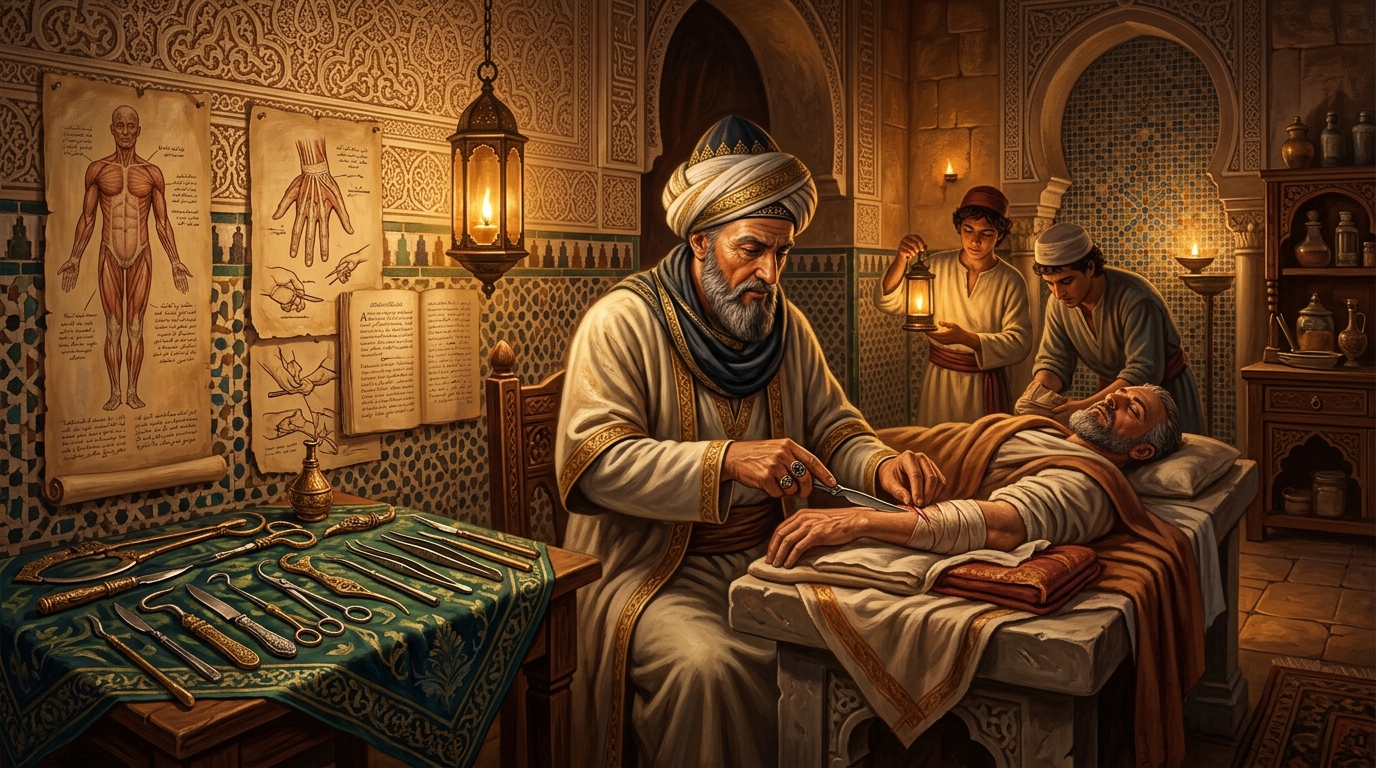
When a surgeon today uses catgut sutures to close a wound, employs a surgical forceps to grasp tissue, or uses a speculum for examination, they are using instruments whose design traces directly to a single 10th century Andalusian physician.
Abu al-Qasim Khalaf ibn al-Abbas al-Zahrawi (936–1013 CE) — known in Europe as Albucasis or Abulcasis — is universally recognized as the Father of Modern Surgery. His encyclopedic work Kitab al-Tasrif (The Method of Medicine) contained the first systematic surgical atlas in history — illustrated descriptions of over 200 surgical instruments, many of which he invented himself.
For 500 years, his surgical treatise was the standard textbook in every medical school in Europe.
1. Who Was Al-Zahrawi? The Surgeon of Al-Andalus
Al-Zahrawi was born in Medina Azahara (near modern Córdoba, Spain), where Islamic civilization had created one of the most advanced societies in the medieval world. As court physician to Caliph Abd al-Rahman III, he spent 50 years practicing, innovating, and documenting surgery with an unprecedented commitment to systematic documentation.
His Kitab al-Tasrif (A Compendium of Medical Knowledge) was a 30-volume encyclopedia of medicine. The final volume — "On Surgery" — was a revolution in medical literature.
"A man of great understanding and experience, and rightly considered the supreme master of surgical art."
— Guy de Chauliac (14th century), the leading European surgeon of the medieval period

Al-Zahrawi documented over 200 surgical instruments in Kitab al-Tasrif, establishing surgical protocols used across Europe for over 500 years.
2. The Kitab al-Tasrif: The World's First Illustrated Surgical Atlas
Volume 30 of Kitab al-Tasrif was the first illustrated guide to surgical instruments and procedures in history. Al-Zahrawi included detailed diagrams of each instrument alongside written descriptions of:
- The instrument's design and materials
- The surgical procedure it was used for
- Step-by-step operative technique
- Post-operative care instructions
Instruments Invented or First Documented by Al-Zahrawi:
| Instrument | Purpose | Still in Use? |
|---|---|---|
| Surgical hook | Tissue retraction | ✅ Yes |
| Surgical bone saw | Orthopedic amputation | ✅ Yes (evolved) |
| Ligature needle | Suturing blood vessels | ✅ Yes |
| Speculum (vaginal) | Gynecological examination | ✅ Yes |
| Forceps for delivery | Obstetric assistance | ✅ Yes |
| Lithotomy forceps | Bladder stone removal | ✅ Yes (evolved) |
| Tracheotomy tube | Emergency airway | ✅ Yes |
| Dental scaler | Tartar removal | ✅ Yes |
| Dental extractor | Tooth extraction | ✅ Yes |
| Ear syringe | Wax removal | ✅ Yes |
Over 200 instruments — many invented by al-Zahrawi himself — covering virtually every domain of surgery known today.
3. Catgut Sutures: Solving the Problem of Dissolving Stitches
One of al-Zahrawi's most important practical innovations was the use of catgut (natural gut fiber from sheep intestine) for internal sutures — stitches inside the body that needed to dissolve as tissue healed, without requiring removal.
Before al-Zahrawi, surgeons either left internal wounds unstitched (risking dehiscence) or used silk or linen that required dangerous re-opening of wounds for stitch removal.
Al-Zahrawi documented that catgut dissolves naturally within the body — the first documented use of biodegradable sutures, a concept reinvented by European surgeons only centuries later.
Catgut sutures remained standard in surgery until the development of synthetic biodegradable polymers (polyglycolic acid) in the 20th century — and the principle al-Zahrawi established remains unchanged.
4. Cauterization and Hemostasis: Stopping Bleeding Without Bloodletting
Al-Zahrawi developed systematic techniques for cauterization — using heat to seal bleeding blood vessels — and described the first rational approach to surgical hemostasis (stopping bleeding during operations).
He designed specialized cauterizing irons of different shapes for different blood vessel types and documented the precise technique for each application — including cooling times, patient positioning, and post-cauterization wound care.
His cauterization techniques were adopted wholesale by European surgeons and formed the basis of surgical hemostasis until the development of electrical cautery in the 20th century.
5. Innovations in Obstetrics and Gynecology
Al-Zahrawi dedicated an entire section of Kitab al-Tasrif to obstetric surgery — making him the first physician to systematically document surgical interventions in childbirth:
- Cephalic version — manually turning a fetus from breech to head-first position
- Embryotomy — surgical techniques for obstructed labor when vaginal delivery is impossible
- Repair of obstetric fistula — a devastating post-delivery complication
- Dental forceps for delivery — first described instrument for assisted delivery
His work on difficult deliveries saved countless maternal lives in an era when obstructed labor was frequently fatal.
6. Orthopedic Surgery and Bone Management
Al-Zahrawi wrote the most detailed early account of orthopedic surgical principles, including:
- Splinting techniques for bone fractures with pre-fabricated splint designs
- Surgical treatment of dislocation — manipulative reduction techniques
- Spinal vertebral fracture management — suspension and traction
- Surgical amputation — including arterial ligation before amputation to reduce hemorrhage
His amputation technique — with arterial ligation preceding limb removal — was the standard of care in European surgery until the 19th century, when antisepsis transformed surgical practice.
7. Medical Ethics in Al-Zahrawi's Practice
Al-Zahrawi's writings reflect a deeply Islamic ethical framework for surgery:
"I have treated poor patients as I treat the rich; I have treated the slave as I treat the free man; I have spent days and nights caring for those who could not pay me."
This ethical stance — the physician's obligation to treat regardless of social standing — derives from the Islamic principle that all human life has equal sanctity (hurma), regardless of wealth or status.
The Prophet Muhammad ﷺ said:
"There is no disease that Allah has created, except that He also has created its treatment."
(Sahih al-Bukhari 5678)
For al-Zahrawi, surgery was the practical fulfillment of this Hadith — actively seeking and applying the treatments Allah had made available through knowledge and skill.
8. Impact on European Surgery
When Kitab al-Tasrif was translated into Latin as Liber Servitoris and Chirurgia (1100-1200 CE), it transformed European surgery:
- Roger of Salerno (12th century) — based his Chirurgia entirely on al-Zahrawi's techniques
- Guy de Chauliac (14th century) — the most influential European surgeon of the medieval period, cited al-Zahrawi more than any other source
- Pietro d'Argellata (14th century) — called al-Zahrawi "the superior of all surgeons"
- European medical schools — used al-Zahrawi's surgical text as the core curriculum
His Chirurgia was reprinted 15 times between 1497 and 1544 CE alone — making it one of the most published medical texts of the early print era.
Conclusion: The Hands That Shaped Surgery
Al-Zahrawi's hands performed surgery. His mind created instruments. His pen documented procedures. His Kitab al-Tasrif trained surgeons across three continents for 500 years.
Every surgical instrument in a modern operating room, every technique a surgeon learns in residency, every principle of surgical hygiene and hemostasis — these have ancestors in al-Zahrawi's 10th century Córdoba workshop.
The Father of Surgery was a Muslim physician who practiced in Islamic Andalusia, guided by his faith that healing is a divine calling, and that the knowledge to heal is Allah's gift to be used in service of all humanity.
"The practice of surgery requires a thorough grounding in theory and practice, and endless patience with the sick."
— Al-Zahrawi, Kitab al-Tasrif