

 QuranGPT
Al-Zahrawi: The Father of Modern Surgery and the Medical Legacy of Kitab al-Tasrif
Explore the groundbreaking surgical innovations of Al-Zahrawi (Albucasis), inventor of over 200 surgical instruments, dissolvable catgut sutures, and modern operative techniques.
The Holy Quran Team
Author
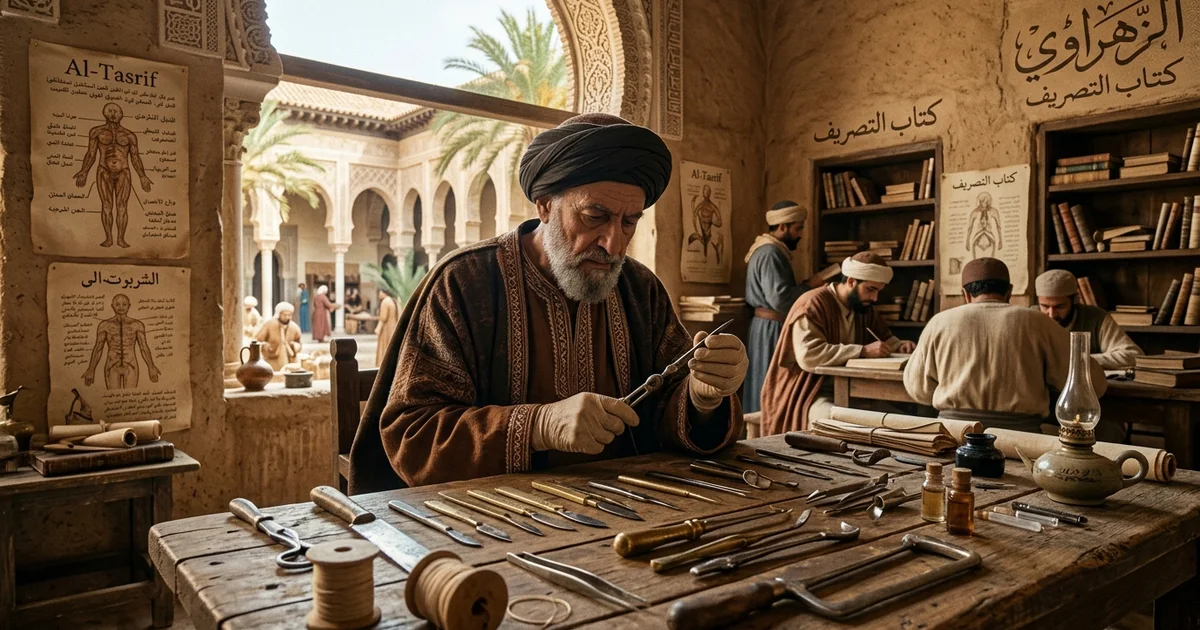
In the flourishing intellectual sanctuary of tenth-century Madinat al-Zahra near Cordoba, Andalusia, the physician and surgeon Abu al-Qasim Khalaf ibn al-Abbas Al-Zahrawi (known in Latin Europe as Albucasis, 936–1013 CE) revolutionized medical practice. At a time when medieval European medicine viewed surgery as a barbaric, demeaning craft relegated to uneducated barbers, Al-Zahrawi elevated surgery to an exacting, scientifically rigorous medical discipline grounded in detailed human anatomy, pathological pathology, and antiseptic hygiene.
His magnum opus, the monumental 30-volume medical encyclopedia Kitab al-Tasrif li-man 'Ajiza 'an al-Ta'lif (The Method of Medicine), served as the standard surgical reference across European and Middle Eastern medical universities for more than five hundred years.
1. Executive Summary: Al-Zahrawi's Pioneering Surgical Inventions
Al-Zahrawi conceptualized, engineered, and illustrated over 200 revolutionary surgical instruments, many of which remain fundamentally unchanged in modern operating theaters:
| Surgical Innovation | Al-Zahrawi's Historical Development (Kitab al-Tasrif) | Modern Surgical Application (2026) |
|---|---|---|
| Dissolvable Catgut Sutures | Utilized dried, twisted animal intestine for internal abdominal stitches that absorb naturally | Absorbable Vicryl and biological catgut sutures in laparoscopic & internal surgery |
| Surgical Forceps & Tweezers | Designed specialized scissor-action extractors for foreign bodies and childbirth | Obstetric forceps, hemostatic Kelly clamps, and grasping tweezers |
| Bone Saws & Trepanning Drills | Non-slipping cranial drills with protective collars to prevent brain dura injury | Modern craniotomy drills and orthopedic oscillating bone saws |
| Lithotrity (Bladder Stone Extraction) | Invented the Micrab al-Masaana to crush bladder stones internally via urethral entry | Modern transurethral endoscopic laser lithotripsy |
| Syringes and Speculums | Created calibrated piston-driven metal extractors and vaginal/rectal speculums | Standard diagnostic bivalve speculums and hypodermic piston syringes |
| Cauterization & Hemostasis | Systematic use of thermal cautery to instantly coagulate bleeding arteries | Modern electrosurgical bipolar diathermy and laser vessel sealing |
2. Catgut Sutures: The Biocompatible Revolution
Among Al-Zahrawi's most brilliant discoveries was the introduction of catgut for internal surgical suturing. Prior to his work, surgeons attempted to close deep internal lacerations with silk, linen, or metal wires, which provoked violent foreign-body immune reactions, chronic suppuration, and fatal septic shock because the materials could not dissolve safely inside the human body.
After observing that sheep intestines digested and dissolved naturally when accidentally ingested by musical instrument makers' animals, Al-Zahrawi processed and sterilized animal submucosa into flexible, sterile internal suture threads:
- Natural Enzymatic Degradation: Catgut is composed predominantly of natural collagen, which human tissue macrophages and proteolytic enzymes gradually break down and absorb without requiring secondary surgical removal.
- Abdominal Wall Closure: Al-Zahrawi established the technique of double-row internal suturing for abdominal and peritoneal trauma, drastically reducing postoperative herniation and mortality.
3. Surgical Ethics and Doctor-Patient Compassion
Al-Zahrawi was renowned for his profound ethical approach to medical care, treating indigent patients free of charge and warning his students against performing risky, unnecessary surgeries for financial gain:
Core Principles of Al-Zahrawi's Surgical Code:
1. Master Anatomy Before Touching the Scalpel: No practitioner should perform an incision without exhaustive knowledge of nerve tracts, veins, and muscle insertions.
2. Patient Safety Above Ambition: Avoid reckless heroic operations if the risk of harm outweighs potential clinical benefit.
3. Postoperative Care is Paramount: Diligent wound dressing, hygiene, and monitoring are as vital to survival as the surgery itself.
4. Compassion for All: Treatment must be administered without discrimination based on wealth, religion, or social status.
He performed the world's first recorded successful emergency tracheotomy on a household servant who had suffered a severe throat laceration, demonstrating that rapid surgical airway management could save lives during acute respiratory obstruction.
4. Enduring Legacy across Global Medical History
When Kitab al-Tasrif was translated into Latin by Gerard of Cremona in the twelfth century (under the title Liber Alsaharavi de Chirurgia), it became the primary surgical curriculum at the universities of Salerno, Montpellier, Padua, and Paris:
- Guy de Chauliac, the celebrated French "Father of European Surgery," quoted Al-Zahrawi over 200 times in his own major treatise Chirurgia Magna.
- Pietro Argallata described Al-Zahrawi as "without doubt the chief of all surgeons."
5. Frequently Asked Questions (FAQ)
Who was Al-Zahrawi and what is his most famous medical book?
Al-Zahrawi (936–1013 CE) was a legendary Andalusian surgeon and physician from Cordoba who authored Kitab al-Tasrif, a 30-volume medical encyclopedia that revolutionized surgery and instrument design.
What surgical tools did Al-Zahrawi invent that are still used today?
He invented over 200 instruments, including obstetric forceps, absorbable catgut sutures, surgical scalpels, bone chisels, curettes, retractors, and speculums.
How did Al-Zahrawi's Islamic values influence his medical career?
He viewed the healing arts as a spiritual vocation (Kifayah), prioritizing patient welfare, medical ethics, anatomical diligence, and charitable treatment for the poor.
6. Actionable Takeaways & Contemporary Lessons
- Precision Grounded in Knowledge: True surgical and clinical mastery requires relentless dedication to foundational anatomical science.
- Medical Innovation Through Observation: Groundbreaking breakthroughs often arise from observant minds recognizing practical solutions in natural materials (like catgut).
- Uncompromising Ethical Compassion: Modern healthcare systems must preserve Al-Zahrawi's founding ethos: placing human dignity and patient safety above commercial considerations.