

 QuranGPT
Al-Razi: Father of Clinical Medicine and the World's First Evidence-Based Physician
Discover how Muhammad ibn Zakariya al-Razi revolutionized medicine with clinical observation, controlled experiments, and the world's first hospital wards organized by diagnosis — centuries before modern science.
The Holy Quran Team
Author

Muhammad ibn Zakariya al-Razi (865–925 CE), known to medieval Europe as Rhazes, stands as one of the most brilliant physicians in human history. At a time when European medicine still relied on superstition and bloodletting rituals, al-Razi was conducting controlled clinical trials, systematically recording patient outcomes, and building the world's first disease-specific hospital wards in Baghdad.
His insistence on observation over tradition and evidence over authority — principles we now call the scientific method — made him a revolutionary 1,000 years before it became mainstream.
1. Who Was Al-Razi? The Physician of Baghdad
Born in Ray, Persia (near modern Tehran), al-Razi initially trained as a musician and alchemist before turning to medicine in his thirties. He became chief physician of the Ray Hospital and later the Baghdad Hospital, the most prestigious medical institution of the medieval world.
"The physician ought to know that his reputation rests upon results. If he cures the patient, then his art is confirmed. If he fails, then doubt is cast on it."
— Al-Razi
Key Biographical Milestones:
- 865 CE — Born in Ray, Persia
- 900 CE — Appointed chief physician of Baghdad Hospital
- 910 CE — Completed Kitab al-Hawi (The Comprehensive Book)
- 925 CE — Died in Ray, leaving an estimated 200+ works
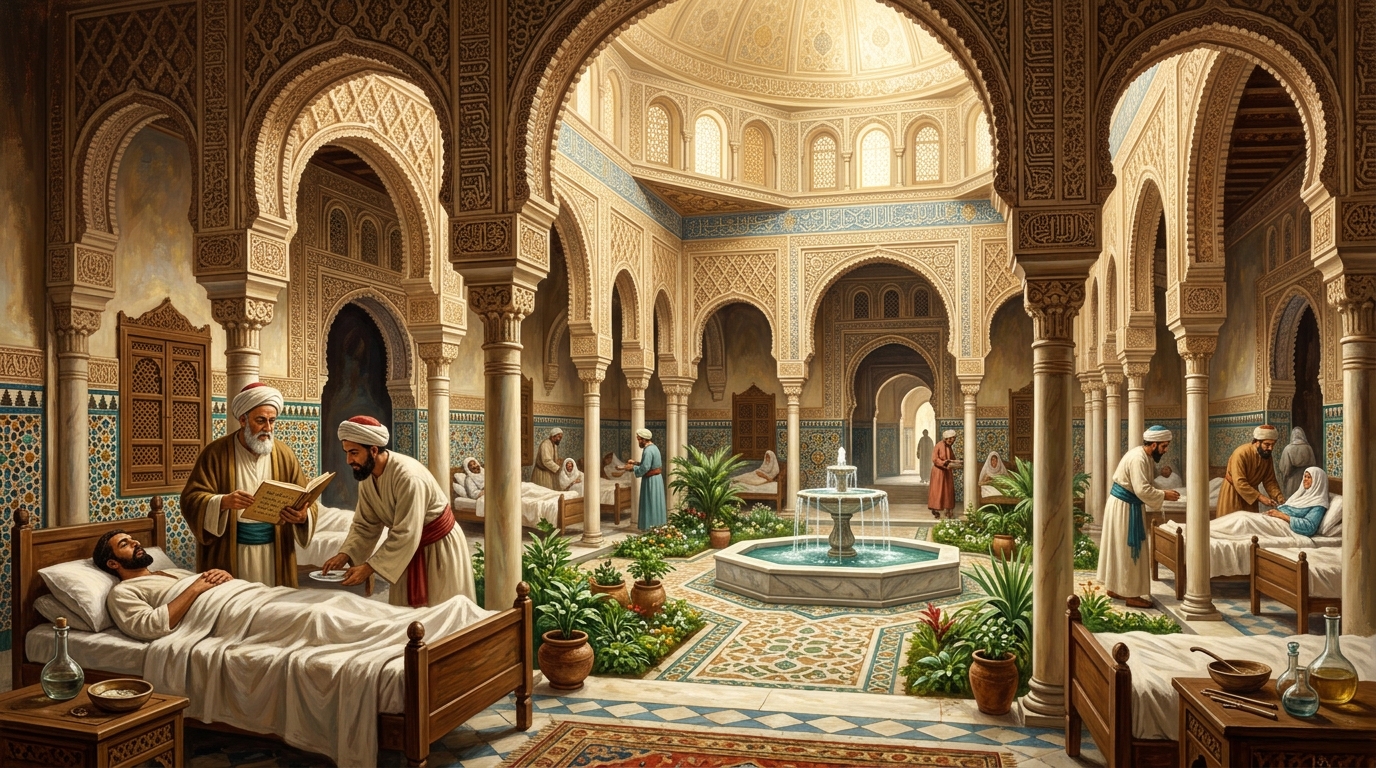
Al-Razi conducted the world first control-group clinical trials in Baghdad, pioneering observational pediatrics and clinical ward rounds.
2. Kitab al-Hawi: The World's Largest Medical Encyclopedia
Al-Razi's masterpiece, Kitab al-Hawi fi al-Tibb (The Comprehensive Book on Medicine), was a 23-volume encyclopedia of all known medical knowledge. It was so extensive that his students had to compile it from his notes after his death.
Contents of Kitab al-Hawi:
- Volume 1-5: Internal diseases — fevers, jaundice, kidney disease
- Volume 6-10: Surgical conditions and wound care
- Volume 11-15: Pharmacology and drug preparation
- Volume 16-20: Special conditions — eye diseases, dermatology, neurology
- Volume 21-23: Comprehensive index and case studies
Translated into Latin as Continens in 1279 CE, it became a standard textbook in European medical schools until the 17th century.
3. The First Controlled Clinical Experiment in History
Al-Razi's most famous experiment demonstrates his scientific genius. When asked to choose the best location to build a new hospital in Baghdad, he hung pieces of fresh meat at various sites around the city and waited for days. He then chose the location where the meat spoiled the least — correctly reasoning that slower spoilage indicated cleaner, less miasmatic air.
This was environmental epidemiology, performed in the 9th century.
        AL-RAZI'S HOSPITAL SITE SELECTION EXPERIMENT

   Site A (River District)  ──► Meat spoiled in 2 days
   Site B (Market Quarter)  ──► Meat spoiled in 3 days
   Site C (Elevated Ground) ──► Meat spoiled in 5 days ✓ SELECTED

   Conclusion: Slower decay = cleaner environment = healthier patients
4. Invention of Pediatrics and the First Dedicated Children's Medical Treatise
Al-Razi wrote Kitab al-Tibb al-Mansuri and later a dedicated treatise on childhood diseases — the world's earliest known systematic work on pediatric medicine.
He recognized that:
- Children have different metabolic rates than adults
- Drug dosages must be adjusted for body weight
- Children respond differently to fevers and infections
- Breastfeeding duration affects immune development
These insights mirror modern evidence-based pediatrics discovered 900 years later.
5. Distinguishing Smallpox from Measles — A Diagnostic Revolution
Al-Razi wrote Kitab fi al-Jadari wa al-Hasba (Treatise on Smallpox and Measles) — the world's first monograph to clinically distinguish between two viral diseases that had confused physicians for centuries.
"The eruption of smallpox is preceded by a continued fever, pain in the back, itching in the nose, and terrors in sleep... while in the measles, the symptoms are milder..."
— Al-Razi, Treatise on Smallpox and Measles
This work, translated into Latin, Greek, and English repeatedly over the centuries, remained the definitive clinical guide to both diseases until the 19th century.
6. Al-Razi's Critique of Galen: The First Peer Review in Medical History
In an act of intellectual courage extraordinary for his era, al-Razi wrote "Doubts About Galen" (Al-Shukuk ala Jalinus) — directly challenging the errors in Galen's 2nd century CE medical theories.
He wrote:
"I have found errors by Galen in practical medicine. His teachings are not infallible, and a physician who worships authority rather than evidence will cause harm to patients."
This was essentially the first peer review in medical literature — challenging established authority with empirical observation. Modern medicine runs on this exact principle.
7. His Islamic Framework: Medicine as an Act of Worship
Al-Razi viewed his medical work through an explicitly Islamic lens. The Prophet Muhammad ﷺ said:
"Allah has not sent down a disease except that He has sent down a cure for it."
(Sahih al-Bukhari 5678)
Al-Razi took this as divine mandate. Seeking cures was an act of worship. Understanding disease was understanding Allah's creation. His rigorous empiricism was not secular rationalism — it was deeply rooted in the Islamic intellectual tradition that knowledge (ilm) is a sacred duty.
8. Legacy: Al-Razi's Contributions That Shaped Modern Medicine
| Contribution | Year | Modern Equivalent |
|---|---|---|
| Organized hospital wards by disease type | ~900 CE | Specialized hospital departments |
| First controlled clinical experiment | ~905 CE | Randomized controlled trials |
| Pediatric medicine as distinct specialty | ~910 CE | Modern pediatrics |
| Distinguished smallpox from measles | ~910 CE | Differential diagnosis |
| Drug dosage based on body weight | ~915 CE | Pharmacokinetics |
| Challenged authority with empirical data | ~920 CE | Peer review system |
Conclusion: The Physician Who Built Modern Medicine
Al-Razi was not simply a great medieval doctor. He was the architect of clinical medicine itself — insisting that observation must trump authority, that evidence must override tradition, and that every patient deserves individualized care based on careful examination.
His legacy flows through every modern hospital ward, every clinical trial, every pediatric dosage chart, and every peer-reviewed medical journal. The world of modern medicine, in ways it has often forgotten to acknowledge, was built on the foundations that this great Muslim physician laid in 9th century Baghdad.
"Seek knowledge, even unto China."
— Prophet Muhammad ﷺ (Hadith)
Al-Razi exemplified this commandment in every observation he made, every patient he treated, and every page of his 200+ works that changed the world.