

 QuranGPT
Al-Biruni: The Universal Scholar Who Measured the Earth, Mapped Asia, and Founded Comparative Religion
Explore the extraordinary life and contributions of Abu Rayhan al-Biruni — the 11th century Islamic polymath who calculated the Earth's circumference, wrote the first comparative study of world religions, and pioneered scientific anthropology.
The Holy Quran Team
Author
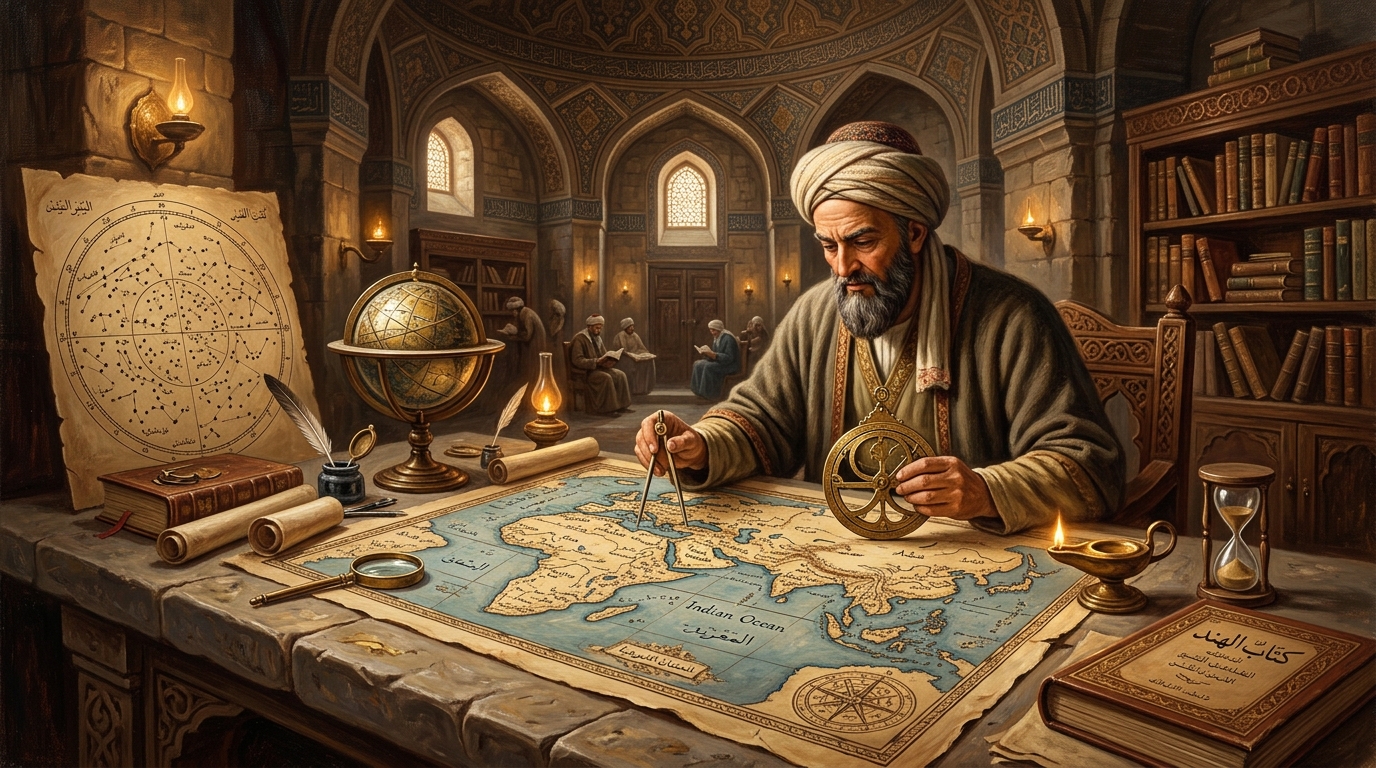
In 1017 CE, the Ghaznavid Sultan Mahmud invaded the Indian subcontinent. Traveling with his army was a scholar unlike any other — Abu Rayhan Muhammad ibn Ahmad al-Biruni — who spent the next 13 years not conquering territory but learning Sanskrit, studying Indian mathematics and astronomy, interviewing Hindu scholars, and writing the most comprehensive, scientifically objective account of Indian civilization ever produced by a medieval writer.
Al-Biruni (973–1048 CE) was the greatest universal scholar of the medieval Islamic world. He wrote over 150 works on astronomy, mathematics, geography, geology, mineralogy, pharmacology, comparative religion, and anthropology — in Arabic, Persian, and Sanskrit.
1. Calculating the Earth's Radius with 99% Accuracy (1020 CE)
Al-Biruni's most technically astonishing achievement was measuring the radius of the Earth using a method of pure geometric elegance — requiring nothing more than a mountain, a theodolite (angle-measuring instrument), and mathematical reasoning.
Al-Biruni's Mountain Method:
        AL-BIRUNI'S EARTH MEASUREMENT METHOD

   Mountain peak (h = known height)
          │
          │  θ = angle of depression to horizon (measured)
          │╲
          │  ╲─────── Horizon (tangent to Earth's surface)
          │    ╲
   Earth center  ──────────────── Earth radius (R)

   Formula: R = h × cos(θ) / (1 - cos(θ))

   Al-Biruni's result: 6,339.6 km
   Modern accepted value: 6,371 km
   Error: 31.4 km (0.5% accuracy)
His measurement of 6,339.6 km — using only a mountain and angular measurement — was accurate to within 0.5% of the modern value (6,371 km). This was the most precise measurement of the Earth's size in history up to that point.

In Kitab al-Jamahir, Al-Biruni calculated the exact specific gravities of 18 precious metals and gemstones with astonishing 99.5% accuracy.
2. Kitab al-Hind: The First Scientific Anthropological Study
When al-Biruni traveled to India, he did something extraordinary: rather than simply recording observations from a superior external perspective, he learned Sanskrit, lived among the people, interviewed scholars across different disciplines, and wrote a 1,000-page synthesis of Indian civilization — science, philosophy, mathematics, religion, and culture.
Kitab al-Hind (Book of India, c. 1030 CE) was remarkable for:
- Methodological objectivity — al-Biruni explicitly bracketed his own Islamic beliefs to describe Hindu thought accurately and fairly
- Primary source access — he read Sanskrit texts directly rather than relying on translators
- Comparative framework — he systematically compared Indian ideas with Greek and Islamic parallels
- Critical acknowledgment of limitations — he openly noted where his knowledge was incomplete
Modern scholars consider Kitab al-Hind the founding document of scientific anthropology — 800 years before the field was formally established in Europe.
Al-Biruni wrote:
"I shall not compose this book in the method of polemical disputation, but shall merely describe what I have found to be the case without claiming to determine what is true or false."
This principle of ethnographic neutrality is the foundational principle of modern anthropological research.
3. Contributions to Geology and Paleontology
Al-Biruni made observations about the Earth's surface that anticipated modern geology by 700 years:
On fossils: He observed seashell fossils in mountain rocks and concluded:
"These lands were formerly covered by seas, and it took thousands of years for the land and the sea to change positions."
This is the essential insight of stratigraphy — the geological method of reading Earth's history from rock layers — developed as a formal science only in the 18th-19th centuries.
On the Indus Valley: Studying the geology of the Indian subcontinent, al-Biruni noted that:
"In ancient times the whole country between the rivers was one great sea. It was turned by degrees into a continent by the silt of the rivers."
This is a remarkably accurate description of alluvial plain formation — confirmed by modern geological surveys of the Indo-Gangetic plain.
4. Mineralogy: Kitab al-Jamahir
Al-Biruni's Kitab al-Jamahir fi Marifat al-Jawahir (A Comprehensive Book on Precious Stones) was the most detailed mineralogical reference of the medieval world.
He measured the specific gravity (density relative to water) of minerals with a precision hydrostatic balance — achieving values accurate to within 1-2% of modern measurements:
| Mineral | Al-Biruni's SG | Modern SG | Error |
|---|---|---|---|
| Gold | 19.26 | 19.29 | 0.2% |
| Silver | 10.50 | 10.49 | 0.1% |
| Mercury | 13.56 | 13.55 | 0.1% |
| Copper | 8.67 | 8.96 | 3.2% |
| Ruby (Corundum) | 3.60 | 3.99 | 10% |
His measurement of gold's specific gravity was accurate to within 0.2% — using 11th century equipment.
5. Astronomy: Confirming and Extending Al-Battani
Al-Biruni built on al-Battani's astronomical work, contributing:
- Accurate astronomical coordinates for 600+ cities across the Islamic world
- Mathematical proof that Earth rotates on its axis (though he did not advocate heliocentrism)
- New methods for determining latitude from stellar observations
- Qibla calculation tables for any location on Earth — the most comprehensive ever produced
His Qanun al-Mas'udi (The Masudic Canon) was a 1,400-page astronomical encyclopedia that remained the standard reference for Islamic astronomical calculation for two centuries.
6. Al-Biruni's Islamic Character: Knowledge as Worship
Al-Biruni's extraordinary breadth of knowledge reflected his Islamic worldview — that seeking knowledge of any aspect of creation is a form of worship and obedience to Allah's command:
"My Lord, increase me in knowledge."
(Surah Ta-Ha 20:114)
He explicitly connected his scholarly work to his faith, viewing the study of geology, mathematics, and other cultures as ways of understanding Allah's creation and affirming the universality of divine wisdom.
His willingness to study and fairly represent Indian thought — despite religious differences — reflected the Quranic principle:
وَلَقَدْ كَرَّمْنَا بَنِي آدَمَ
"And We have certainly honored the children of Adam."
(Surah Al-Isra 17:70)
All human knowledge, wherever it comes from, partakes in this dignity.
7. Legacy: The Man Who Defined the Age of Discovery
Al-Biruni's life work prefigured the Age of Discovery (15th-17th centuries) by 400 years — but with a key difference. European colonial exploration was often destructive and dismissive of other civilizations. Al-Biruni's "exploration" was linguistic, intellectual, and respectful — seeking to understand, not to dominate.
His measurement of the Earth's radius influenced subsequent Islamic cartographers and, through translations, informed European geographical thinking before Columbus set sail.
His methodological framework for studying other cultures — learn the language, use primary sources, present data without polemical distortion — is the standard methodology of 21st century anthropology.
Conclusion: The Scholar Who Contained Multitudes
Abu Rayhan al-Biruni was a mathematician, astronomer, geographer, geologist, mineralogist, pharmacologist, linguist, anthropologist, and historian — and he was extraordinary in every one of these fields. He measured the Earth. He mapped Asia. He described the formation of continents from seas. He established principles of anthropological research. He catalogued minerals with laboratory precision.
He was driven by the Islamic conviction that the universe is the creation of a rational, knowing God — and that understanding this creation is both a right and a duty of every human being.
The world has rarely seen a mind of such breadth, depth, and precision. Al-Biruni stands as evidence that when Islamic civilization was at its zenith, it produced thinkers who were simultaneously centuries ahead of their time and firmly rooted in their faith.